In search of a coherent reality:
A brief introduction to the Sensible – Sensitive Universe Model
Introduction and Part I
NOTE TO THE READER
This essay proposes a philosophical framework that seeks to unite science and spirituality.
I have tried to make it accessible, but I recognize that some concepts are dense, with new, technical or unknown terms that can not reach the limit of knowledge. It is also a question, and I ask you, open up, to enter a sensitive reality. It has an intuitive, sensible, creative and resonant quality.
Imagine that your mind and your body are the center of the universe. Your universe. With mind, arms, eyes. Your senses. Imagine a simple and sensible universe, wow, how to learn to play a board game in 5 levels: Game of the goose with 5 boards, each with its own rules and language. Or five games, Chess, bridge, Gin Rummy, Monopoly, Memory. Ask anyone what their 5 favorite board or field games are, and they can explain the rules of each one. Each person can also talk about the content of their five favorite books.
Steve Jobs talked about the simplification and accessibility of technology for his customers. Touch screen, accessible. Yes, our thoughts can help us sensitize ourselves to the universe that surrounds us, but it can also do so in what is our conscious and sensory interior, a unified reality. Two fields of one reality.
Why do I talk about unified? To maintain the bond with the people I love, who I have lost or who are far away. My father’s voice, my mother’s touch, the complicity of my brother and my grandmother. These for me are points of emotional gravity and you could say existentially and ontologically heavy. Family, work, the world. It is this peculiar gravity, which seems to materialize love as an energetic constant in my existence.
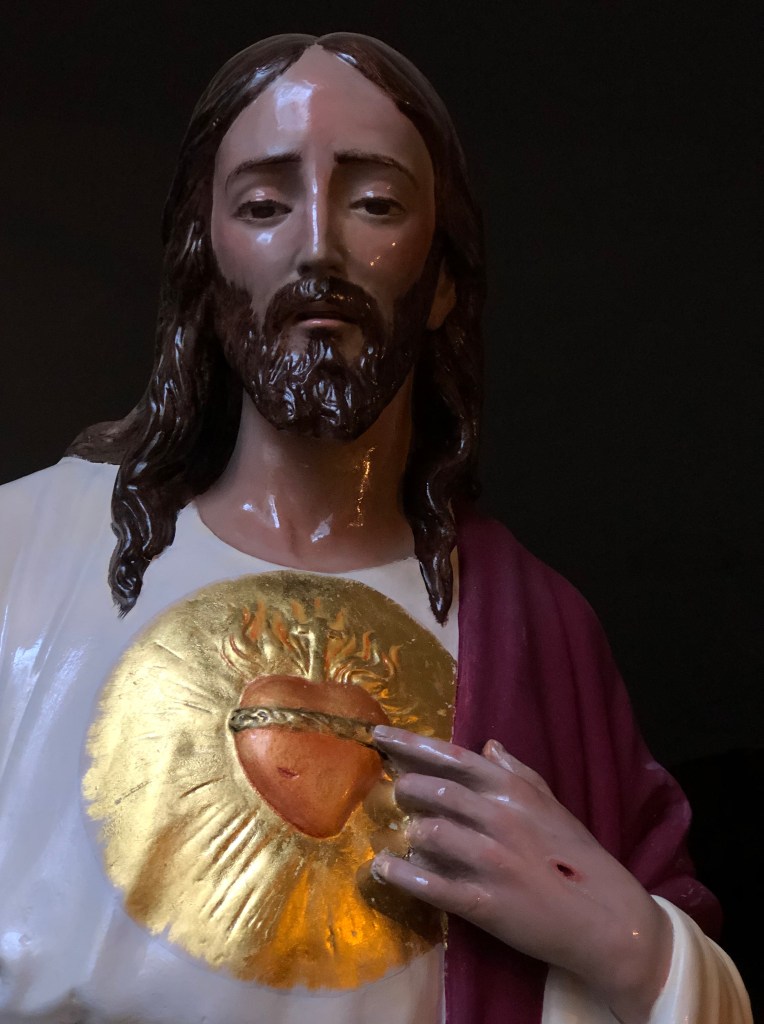
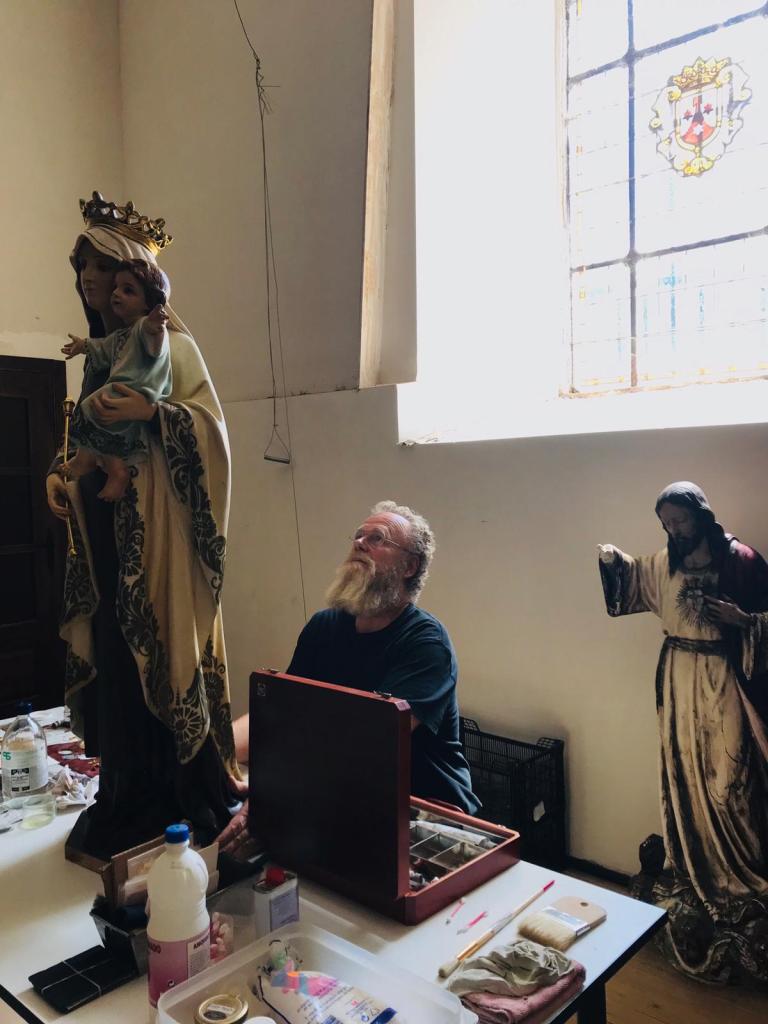
Yes. I use a language that sometimes sounds complex or fanciful, but the core is love. Yes, that red heart, symbolic synthesis of love. A specific moment: I spent a lot of time with this image in the choir of the monastery church. We were given a Christ of the Sacred Heart to the monastery. It was painted with black paint. The process of touching this image, in the iconographic tradition, requires steps that help the manifestation from the inside to the outside. It is touch: the pencil, the finger, the brush, the camera, these are tools. Christ is a loving expression, materialized not only by tools.
As lighthouses, people with a monastic vocation remind us that there is also inner light. There are very few in the world, and one of the deep aspects and expression of the hermit, monk or friar, they define the hermit (interior) and the hermetic (closed). Idea, hypothesis, theory, imagination and certainty, are wonderful creative spaces within my mind, these allow me to imagine and concretize internal and external worlds on a personal level. Set up in my reality. Create my painting and empowers me to choose a frame and context.
People familiar with my personal and professional work, see that I am interested in all the creative branches in the arts and sciences, maybe San Juan de la Cruz would interpret me as a “dispersed”, or a person who has to take care of his “appetites.” Santa Teresa has helped me in the sense that I can now draw a parallel with the stages and events in my life – and her work “Las Moradas”. It would be similar to how rivers curve with the pressure of the flow of water, and the resistance of one grain of sand, or so to speak, life. The impact of what we feel. As if it were an existential gravity that shapes matter, reality.
For me, I have recognized contemplative prayer from an early age, which I will talk about later. This essay is actually a testimony of how the events in my life have made me what I am, my self, my identity, my person, and my position in the universe and my relationship with it. It’s just a testimony. Not from a person who knows, but from a sensitive person. Sense is another story. “I am a sensitive man – sensible? That’s another story.
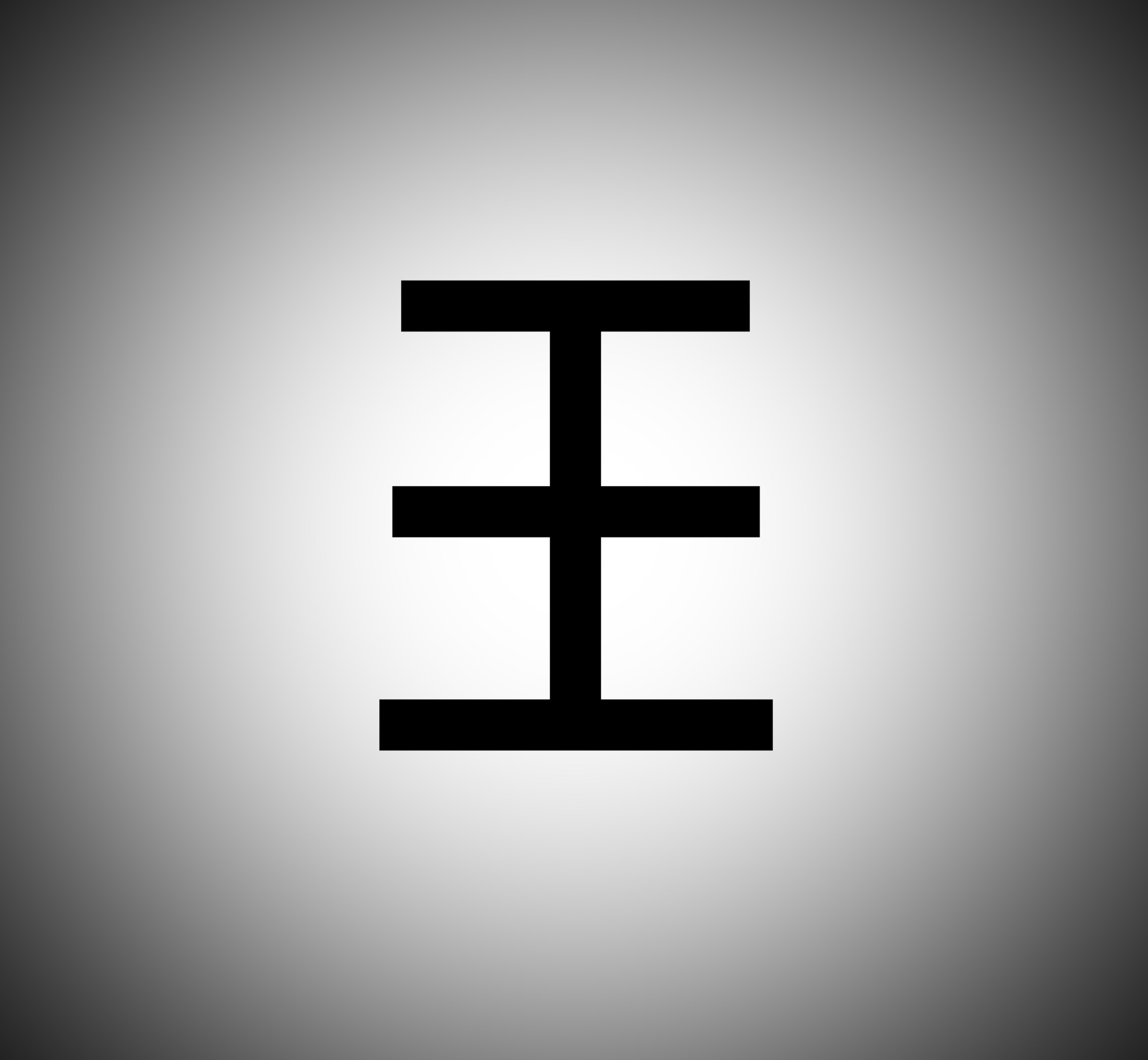
The events in my life, which will appear in a segmented way to illustrate an idea, an equation, a conjecture, a landscape, are made up of two spaces. My inner self, to the edge of the skin, and everything beyond. But “I”, my “id”, my psyche, my unified, united, singular absolute center, is symbolized in this work as “I”, capital of the Roman letter i and also the Roman 1. “I” in English. It is the union of my feelings and my being. My consciousness keeps me awake and connected to these two spaces constantly. These spaces are symbolized by science and spirituality.
My Personal Context
I am an artist, hermit and Carmelite missionary, busy and active inside and out: the principle of creation resides deeply both inside and outside of me.
My motivating quintessence is love. Love where you are, love what you do, love who you are with. Glow of Love. Some associate love with giving, but I have already received. Offering and giving is a facet of Love, just as Love is not a facet of the Absolute.
These last five months have been a difficult path for me. An existential turning point. Close to the horizon of the limit of my ignorance, they represent a period of intense intellectual research and spiritual transformation. After experiencing deep personal losses (three close beings by suicide), I found myself questioning the very foundations of my understanding of reality. How can there be so much suffering in a universe that I affirm is sustained by love?
This question led me to an exhaustive exploration that combined quantum physics, contemplative philosophy, symbolic mathematics and theology. The result is this framework that I propose—not as a definitive answer, but as an honest attempt to integrate scientific knowledge and spiritual experience without betraying either of them.
CONTENTS INDEX
- My Personal Path (Why am I writing this)
- Central Question and Objectives (What I seek to answer)
- Portico: Fundamental Principles (The basic ideas)
- Introduction: The Constant of Love (The Common Thread)
- Conservation and Enveloping Structure (How the union works)
- Why Philosophy, not only Physics (The right framework)
- Part I: The Phenomenological Base (Experience as a starting point)
- Chapter 1: Pain as an Ontological Revelation
- Glossary of Key Concepts (For quick reference)
1. CENTRAL QUESTION AND OBJECTIVES
The question that moves us
This work emerges from a simple but profound question:
What would happen if the apparent division between science and spirituality—a division we take as natural, even necessary—was neither?
What would happen if this fracture, so definitive in our contemporary consciousness, was merely a historical accident of the last century, a temporary forgetfulness of an older unit?
Specific Objectives
This work seeks to:
1. Propose a metaphysical framework where science and spirituality coexist without contradicting each other
2. Show that love (understood as an ontological structure, not as emotion) works as a constant that unites both domains
3. Demonstrate that the five human senses constitute a qualitative fifth dimension that complements the four physical dimensions of spacetime
4. Explore how this union respects and preserves the unique identity of each domain, without merging or reducing them to each other
Connection with Love
“Do you summarize spirituality in love?”
I do not summarize spirituality in love only, but I propose that without love as a structural foundation, no form of relationship—scientific, spiritual, human—would be possible:
• In the scientific field: The structural principle that allows the relationship and connection between elements (particles, fields, observers).
• In the spiritual: The strength that makes possible the genuine encounter, compassion, and the inner, meaningful union.
Love is a constant in this symbolic equation: (Λ=1): Not a variable that fluctuates, but a permanent structure that sustains every possible relationship.
2. PORTICO: FUNDAMENTAL PRINCIPLES
The Principle of Union
I propose a principle for the integration of knowledge: a union.
“Union of what things or do you mean unity of knowledge?”
I am referring to the union of two ways of knowing that today we consider separate:
Scientific knowledge: objective, measurable, repeatable, expressed in mathematics
Spiritual knowledge: subjective, experiential, transformative, expressed in experience
I do not propose to merge them into one, but to show how they can coexist while preserving their unique identities. Like two strands of DNA that wrap around each other without losing their individual structure.
A Field of Love
A field, a state of love that sustains reality, a curve towards the center.
“A curve towards the center? I don’t understand”
I think of an image of gravity curving spacetime. In physics, massive objects “curve” the space around them, causing other objects to move towards them. Similarly, I propose that love works as an “ontological gravity”—it attracts, connects, sustains—curving reality towards the center where consciousness resides. It is a metaphor to express how love structures reality, not only decorates it.
Identity of the “I”
The interior and the exterior with identity: with their own charm and charisma, defining the “I”.
“I don’t understand this last part”
The “I” (in Spanish “Yo”) or “I” (in English) represents self-reflective consciousness—the point from which I experience reality. I propose that this “I” has two inseparable aspects:
- The interior: my mental, emotional, spiritual life (only I have direct access)
- The exterior: my body, my actions, my presence in the world (others can observe)
These two aspects have their own identity—they are distinguishable—but are deeply connected. Charm and charisma refer to how this interior-exterior unity manifests uniquely in each person.
Instantaneous State of Consciousness
The unprocessed instantaneous state of consciousness.
“Concept to be developed for better understanding”
I refer to the present moment of experience before the mind interprets, categorizes, or judges it. For example:
- When you see the color red, there’s an initial instant where you simply “see red” before thinking “this is red, it’s a tomato, it reminds me of…”
- When you touch something hot, there’s an instant of “heat” before thinking “this burns, I should pull my hand away”
This “instantaneous state” is what philosophers call qualia—the pure quality of experience before cognitive processing. It’s important because it shows that consciousness has layers: one immediate (pure feeling) and another reflective (thinking about what is felt).
The Materiality of Love
The absolute and fundamental materiality of love, to be present and be constant.
“Do you believe love has materiality? I think not; a different matter is that it manifests in material things”
I don’t claim that love is physical matter (atoms, particles). Rather, I propose that love has effects as real and measurable as matter:
- When you embrace someone you love, you feel something—there is weight, warmth, presence
- This feeling is not “less real” than touching a table
- Love manifests materially through the body, actions, observable effects
Perhaps the more precise expression would be: “The substantial reality of love”—substantial in the sense that it has real, transformative effects, not in the sense of being a material substance. Love “has mass” in the phenomenological sense: it presses upon consciousness with real, not metaphorical, weight.
3. MY SPIRITUAL FRAMEWORK
Perennial Philosophy and My Approach
In Perennial Philosophy, structures are provided that interpret metaphysical worlds.
Explanation of the concept “Perennial Philosophy”
Perennial Philosophy is the idea that all great spiritual traditions—Christianity, Buddhism, Hinduism, Sufism, etc.—share common fundamental truths, though they express them in distinct cultural forms. These truths include:
- Reality has levels (material, mental, spiritual)
- There exists an ultimate unity behind all diversity
- The human being can know this unity through direct experience
- Love/compassion is central to spiritual development with consequences in physical reality
Perennialism has its roots in Renaissance interest in Neoplatonism and its idea of the One, from which all existence arises or in which it manifests. In this work, I focus not so much on the source from which it flows or arises, but more on its constancy and state: Consciousness.
“I don’t follow your reasoning”
I explain:
Traditional Perennial Philosophy asks: “Where does everything come from?” (the One, God, the Absolute as source)
My approach asks: “How does consciousness work?” and “What is constant in it?”
That is, less focus on metaphysical origin and more on the phenomenological structure of how we experience reality. I don’t deny the source, I simply focus on how consciousness operates here and now.
In a certain way, it is allowing structure and content to be given to consciousness, to achieve existential mass, in a world where emotional, sensory, and physical gravity are intertwined.
Explanation of “existential mass,” “emotional gravity,” and “Presential gravity = Resonant Gravitas”
- Existential mass: The “weight” or solidity that our experience has. Not all experiences are equally “heavy”—some seem superficial, others mark us profoundly. This difference in “ontological weight” is what I call existential mass.
- Emotional gravity: Just as planets exert gravitational attraction, significant emotions and experiences “attract” and “press” upon us. Intense pain, profound love, overwhelming beauty—all exert a force on our consciousness.
- Presential gravity = Resonant Gravitas: Field of existential weight and authenticity generated when two beings fully express their nature.
My Spiritual Field
My field encompasses Christian spirituality, but I approach universal spirituality as a gesture of free union.
- My root is Christian (specifically Carmelite—Saint Teresa de Jesús (Teresa of Ávila), Saint John of the Cross)
- But I dialogue with other traditions because I believe in the underlying unity described by Perennial Philosophy
- I don’t abandon Christianity to “mix everything,” but rather from my Christian identity I recognize fundamental truths in other traditions. The Holy as operator in humanity.
It would be like saying: “I am a hermit, but I travel the world recognizing common humanity in barley, rice and potatoes.”
Duality and Non-Duality
There will be areas of overlap in spiritual domains with many and varied different spiritual traditions. Non-dual and duality positions, language and communication color and frequency.
“This paragraph about duality is not clear to me. What are the two positions, language and communication?”
The two positions are:
- Duality: The vision that reality and consciousness are separate, typical of Western thought—subject vs. object, mind vs. matter
- Non-duality: The vision that reality and consciousness are fundamentally one, typical of Eastern thought—Advaita Vedanta, Buddhism, Taoism, it is also a main thread in christian hermit universality of love and non-materialism
My framework seeks to overcome this dichotomy by showing that both perspectives are valid from different angles. They are not contradictory but complementary.
“Language and communication” refers to how we express these ideas—the dualistic language of science vs. the non-dual language of mysticism.
The Hermit Conjecture
Science is part of my work, relating to light, space, form, color, and sound. This hermit’s conjecture seeks to overcome, because that is its nature.
“Overcome what?”
The Hermit’s Conjecture seeks to overcome the false dichotomy between science and spirituality. It is its “nature” because a hermit lives in the most intimate part of consciousness and from there discovers universal connections—not trapped in social categories that artificially separates or categorizes knowledge.
Does God love me? Why is there so much pain?
“Is God Love?”
The Hermit’s Conjecture affirms: Yes. Indeed, God is Love.
The hermit lives in all our centers.
“What do you mean by our centers? The hermit, almost by definition, lives in solitude; are the centers the Carmelite?”
“Our centers” refers to the center of each person—the most intimate point of consciousness where each one is alone with themselves and with God. I don’t refer to physical places (Carmelite convents) but to that interior space we all have.
The hermit’s paradox: he lives in physical solitude, but discovers that in the deepest part of his solitude he finds universal connection. That’s why I say “the hermit lives in all our centers”—in that intimate place we all share structurally, although we live it individually.
It is the focal point of GRAVIS. The sum of all gravity. Both subjective and objective. What is most dear to me. There, we are alone. The singularity of truth. It is not a revelation, but a resonant state, in and of reality. That even there, I realize that in my complete reality, I am not alone.
The hermit discovers a paradox and formulates a conjecture:
- In the deepest part of my consciousness, I am completely alone—no one else can be “inside” my subjective experience
- But precisely in that most radical solitude, I discover I am not alone—because I approach God, I also recognize that others have this same intimate center, because the structure of consciousness is universal although the experience is individual.
It’s like being in your own room (alone) but realizing that we all have similar rooms in the same house (not solitude).
4. The Realization of Love as Mass-Energy
This statement sounds like authentic madness. The realization that love has mass-energy!
What you feel is as real as a table.
Isn’t it wonderful to embrace someone you love?! There is touch, contact, affection materialized by the senses.
Not only touch makes it real. Feeling the person makes them completely real, not just their flesh and bones. I don’t only see that person with my eyes, there is a perceptive light that measures or reveals the quality and character qualities, what that person feels and what their presence projects. Their presential gravitas.
How does the gravity of their words and thought, the quality of their consciousness impact or press upon me? Their history? Does their gravity draw me near? Or does their gravity sustain me in truth?
That membrane so thin, an atom thick, our skin, contains all my consciousness and being, both materially and spiritually. I feel that my being inhabits my body: my being emanates from my body—my body emanates from my being, ergo, I nourish it. This nourishment is Love. The creative process is motivated by love in the form of light. Light operates in darkness, in nothingness.
Multiple Realities and the Thread of Love
The model for a sensible—sensitive universe is born from the idea that structure is not imposed from outside, but is born simultaneously from the singularity of consciousness in the human being.
“Each individual conceives and feels the universe in a unique way.”
No two are alike. This is complicated, because there are multiple realities in this scenario, but there is a common thread and that is love.
5. CONSERVATION AND ENVELOPING STRUCTURE
Laws of Conservation in Physics
There is a deeper principle at play: what I call an “enveloping” or “embracing structure” and “conservation of knowledge.”
In physics, conservation laws are fundamental: energy is conserved, momentum is conserved, charge is conserved.
“What does this concept of momentum consist of?”
Momentum (or linear momentum) is a physical property that combines an object’s mass and velocity:
Momentum = mass × velocity
The law of conservation of momentum says that in a closed system, total momentum doesn’t change. For example: when two billiard balls collide, the sum of their velocities×masses before the collision equals the sum after the collision.
I mention this because I propose a philosophical analogy: just as in physics certain quantities are conserved, in human knowledge, when science and spirituality unite correctly, no genuine knowledge is lost—both are conserved in their integrity.
These symmetries reveal profound truths about the structure of reality.
Not Hegelian Synthesis
This is not synthesis in the Hegelian sense, where thesis and antithesis produce something new that surpasses both. It is conservation through embrace (enveloping, or fitting like a glove)—like a Möbius strip, where what appears as two sides is revealed as a continuous surface, or like the double helix of DNA, where two strands wrap around, fold around each other to create the structure that carries life’s information.
But note: DNA doesn’t form spontaneously. It requires energy input, enzymatic action, the substantial dynamic force of life itself assembling the structure.
“And with all this baroque verbiage, what do you want to express? Isn’t there a simpler way to transmit your thought?”
The central idea:
When science and spirituality unite, they don’t fuse into one thing (that would be Hegelian synthesis). Rather, they maintain their separate identities but connect intimately, like:
- The two faces of a Möbius strip (they seem separate but are one continuous surface)
- The two strands of DNA (distinct but intertwined, each necessary)
The important point: This union is not automatic or easy—it requires work, energy, conscious intention. Just as DNA needs enzymes to form, the science-spirituality union needs the active effort of consciousness.
The Three Requirements for Union
Similarly, the union of science and spirituality requires:
1. Structure: where qualia (qualitative experience) exists within a 5D field, of five sensible dimensions.
2. Force: Lomega—the nomenclature for the energetic constant of qualia.
3. Agent: the conscious “I,” the witness (consciousness), who chooses to commit and share.
Note to the reader
These three elements are explained in detail later. For now, it’s enough to understand:
- Structure = the mechanism that makes connection possible
- Force = the energy that actualizes that possibility
- Agent = the consciousness that decides to apply force to maintain structure
6. WHY PHILOSOPHY, NOT ONLY PHYSICS
At the beginning of developing this project, I engaged in dialogue with a professor, mathematician, physicist, cosmologist, who offered crucial guidance: frame this work in philosophy, not physics.
He is right. The temptation to legitimize these perceptions by dressing them in the language of empirical science would be a category error, a misunderstanding of what type of truth is being claimed.
“Do you think a ‘normal’ reader would follow you? Really, who are you writing for? For yourself and it’s enough that you understand it, or thinking of other interlocutors with whom you’d like to share ideas and concerns?”
I write for:
- People who, like me, feel the science-spirituality union as natural
- Readers willing to engage with complex ideas, but who deserve clear explanations
- The academic community that can critically evaluate the proposed framework
I don’t write:
- Only for myself (then I wouldn’t need to publish)
- Exclusively for specialists (then I’d use only technical language)
- For mass dissemination (I present it in a conjecture framework that can be applied to conflict resolution)
My intention is to find the middle ground: rigor and fraternity, depth with clarity.
What This Work Is NOT:
This is not a theory of everything in the physicist’s sense. It doesn’t make predictions about particle behavior, doesn’t propose experiments with falsifiable results. It doesn’t compete with string theory, loop quantum gravity, or the Standard Model.
Explanation for the non-specialized reader
- String theory: A physical theory proposing that fundamental particles are vibrating “strings” (metaphorical)
- Loop quantum gravity: An attempt to unify quantum mechanics with relativity theory
- Standard Model: The current physical theory describing fundamental particles and their interactions
I mention these to clarify that I’m not proposing physics, I’m proposing a philosophical framework that complements and doesn’t replace science.
What This Work IS:
What this work offers is a metaphysical framework—an exploration of what could be structurally true about reality. If we take both scientific and spiritual experience seriously, it resolves the false choice between objective measurement and subjective meaning.
Modal Logic and Possible Worlds
The professor suggested modal mathematics as a formal mathematical structure for this idea, because it permits “possible worlds.”
Explanation of “Modal logic”
Modal logic is a type of philosophical reasoning that explores:
- What is necessary (must be so in all possible worlds)
- What is possible (could be so in some worlds)
- What is contingent (is so in our world, but could be different)
Simple example:
- “2+2=4” is necessary (true in all possible worlds)
- “It’s raining” is contingent (true at some moments, false at others)
- “Intelligent life exists on other planets” is possible (we don’t know, but it could be)
I use modal logic because it allows exploring whether my framework is possible and coherent without having to demonstrate it is actual and empirically true.
Modal reasoning explores conceptual space without claiming to describe actual space.
This is speculative philosophy in the most honorable sense: disciplined imagination applied to fundamental questions, using the tools of logic, phenomenology, and contemplative consciousness to see if a new configuration of ideas could illuminate what has remained obscure, while maintaining the mystery.
7. PART I: THE PHENOMENOLOGICAL BASE
Chapter 1: Pain as Ontological Revelation
“From suffering have emerged the strongest souls; the most massive characters are covered with scars.” — Kahlil Gibran
The Solidity of Suffering
There exists a type of pain that transcends the merely psychological. It possesses weight, density, a peculiar substantiality that philosophers have struggled to articulate.
Simone Weil understood this when she wrote: “Gravity and grace: these are the two essential forces operating on us. Gravity makes us fall, grace lifts us up.”
Pain, in its metaphysical dimension, is not simply a signal of bodily damage or emotional distress, it is GRAVIS, the gravity of reality itself pressing upon consciousness.
Explanation of GRAVIS
GRAVIS is a term I use to capture two meanings:
- Gravis (Latin): Heavy, serious, important
- Gravity (physical) and Quantum Gravity: The force that attracts bodies (matter)
I propose that experience has “ontological weight”—some experiences press more strongly upon consciousness than others. Intense pain, profound love, overwhelming beauty—all manifest this weight, this existential gravity.
When suffering reaches a certain intensity, it no longer feels like an experience about something else. It becomes its own phenomenon, irreducible and self-justifying.
Hermetic traditions speak of nigredo—blackness, the blackening, the descent into depths where all superficialities are burned away.
Saint John of the Cross called it the Dark Night, not as a poetic metaphor, but as a precise phenomenological description: “The dark night is an entrance of God into the soul, which purifies it of its ignorances and imperfections.”
This is where philosophy must begin, not with doubt, as Descartes proposed, but with the undeniable reality of felt experience.
Pain cannot be removed. It insists. It reveals.
Conversion as Epistemic Rupture
My life has been marked by inflection points, moments when the structure of reality seemed to shift beneath me. These were not gradual evolutions, but sudden conversions, though not always in the religious sense, more in the spiritual sense.
Sometimes what converted was my understanding of physics. Sometimes it was my experience of love, or interpretation of death. Sometimes it was the recognition that suffering itself was teaching me something that language, or reason itself could not fully capture. Intense pain can function as one of these transformative symbols. It is not only psychological suffering—it is an ontological revelation that forces an epistemic conversion. Pain taught me things about reality that no equation or book could teach you or make you feel.
Paul Ricoeur distinguished between mere change and genuine transformation: “The symbol gives rise to thought.” Symbols, whether mathematical, mystical, or experiential, don’t only represent reality; they reveal it.
The Hermit Tradition and the Carmelite Paradox
The hermit tradition offers a framework for understanding these ruptures and unions. In Carmelite spirituality, Teresa of Jesus describes the soul’s journey through seven mansions toward union with God.
But this is not escapism, nor hierarchical—it’s the opposite. As she writes: “Christ has no body now but yours. No hands, no feet on earth but yours.” The journey inward is simultaneously a journey outward. Maximum interiority produces maximum participation.
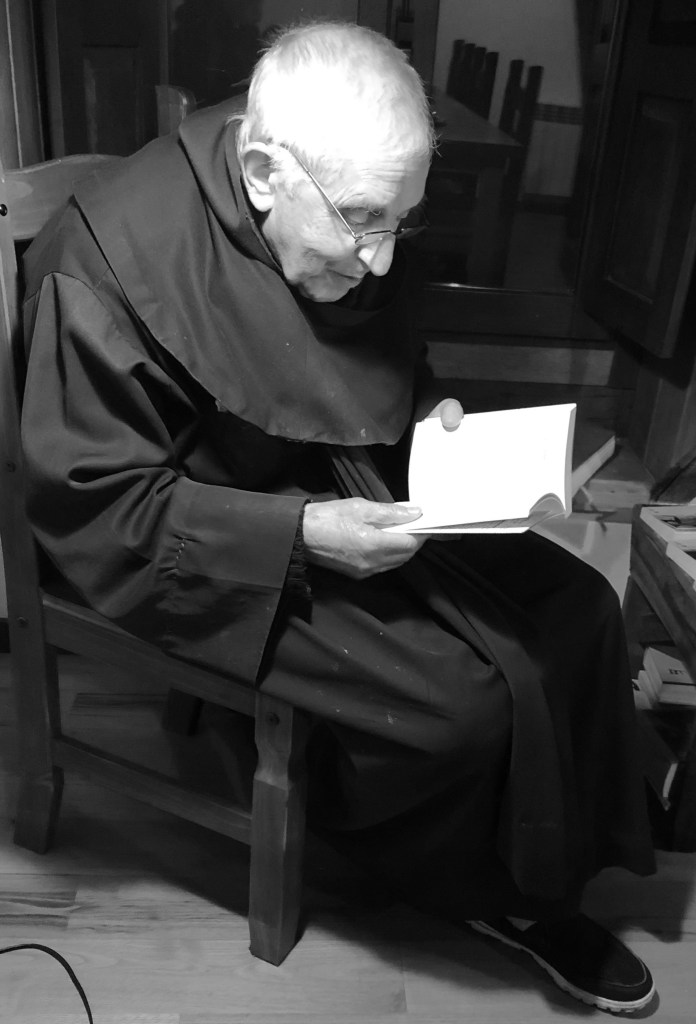
This is the paradox I have lived, the words of my beloved Father Miguel de los Sagrados Corazones, missionary in Africa, and holy man, the world opened to me when I heard his exclamation:
“A Carmelite is 100% contemplative and 100% missionary.”
Not 50-50, which suggests compromise or division, but both completely.
The more I descended into the gravity of my own consciousness, the more I found connections with everything else. Pain revealed the structure. A pattern of suffering revealed. What felt most private turned out to be most universal.
The Method: Phenomenology as Contemplation
Edmund Husserl’s phenomenological method, the epoché, the bracketing of assumptions to see what actually appears, is structurally identical to contemplative practice.
Both require rigorous attention. Both demand that we set aside our theories about experience to attend to experience itself. Both discover that consciousness has structure, that subjectivity is not chaos, but cosmos.
“To the things themselves!” Husserl declared. Saint Teresa of Jesus would have understood perfectly.
Her interior castle is phenomenological psychology avant la lettre, a systematic investigation of consciousness through disciplined introspection. When she describes the prayer of quiet, she is not being mystical in the vague sense; she is being precise about a specific state of consciousness with identifiable characteristics.
Pain, then, is my starting point, not because I glorify suffering, but because I take it seriously. It happened. It was real. It had structure. And most importantly, it revealed something: that consciousness is not epiphenomenal but fundamental, that love is not contingent but constant, that the division between matter and meaning is artificial.
8. GLOSSARY OF KEY CONCEPTS
“This clarification of key concepts is very pertinent, but the explanations are not accessible to everyone. (Send me your questions in the comments table.) Knowledge is assumed, is not within reach of any uninitiated person, but is bridged with reasoning.”
Fundamental Concepts
The “I” as Singularity
In simple language: The self-conscious point of consciousness from which each person experiences reality.
More technical: Based on topology (the branch of mathematics that studies forms and spaces) and mystical philosophy, I propose that the conscious “I” is not the result of brain processes, but something fundamental—an irreducible point of consciousness.
Analogy: Like an indivisible point of light from which all your personal experience and existence radiates.
Five-Dimensional Sensory Reality (5D)
In simple language: Beyond the three dimensions of space (length, width, height) and one of time, I propose a fifth dimension: the dimension of quality or “how it feels.”
More technical: The five human senses (hearing, smell, sight, taste, touch) are not just biological receptors, but fundamental modes through which Being reveals itself. This 5D structure is nodal (or modal in English) (of possibilities), not spatial.
Analogy: If the three spatial dimensions tell you where something is and time tells you when, the fifth dimension tells you how it feels to be there.
The Constant of Love (Λ = 1)
In simple language: Love understood not as an emotion that comes and goes, but as a permanent structure that makes all relationship possible.
More technical: Λ = 1 is symbolic mathematical notation expressing that love is constant (always equal to one, to unity). It is not a measurable quantity, but a philosophical principle: love is the structural condition for there to be perception, connection, communication and shared knowledge.
Analogy: As gravity is the constant that keeps planets in orbit, love is the “ontological constant” that keeps relationships possible.
Lomega (Λω)
In simple language: Love as the force that connects the beginning (Alpha) and the end (Omega) of any transformation process.
More technical: Based on Teilhard de Chardin’s “Omega Point” (the point toward which the universe evolves), Lomega represents that love is not only a future goal but a present force. The transformation from cocoon to butterfly occurs within this structure.
Analogy: The heat that transforms egg to chick—not only the final result (chick) but the force that makes transformation possible.
Qualia Mechanics
In simple language: Qualia is how an experience feels (the redness of red, the pain of pain). “Mechanics” are the rules of how these experiences relate to time, space, and consciousness.
More technical: Formal framework using the notation q=f(I,t,x⃗,s) where:
- q = qualitative experience
- I = field of consciousness
- t = time
- x⃗ = spatial position
- s = state
It is not empirical physics but philosophical formalism—using mathematical notation to express conceptual relationships with precision.
Analogy: As physics has equations describing how objects move, qualia mechanics proposes equations describing how experiences are structured.
GRAVIS
In simple language: The “weight” or “pressure” that reality exerts on consciousness. Both pain and joy have GRAVIS—they press, matter, have consequences. It’s consequential.
More technical: Both physical gravity (the force that attracts bodies) and “gravity” in the sense of seriousness, importance. The experience of suffering as ontologically significant, as mass-energy in the realm of consciousness. Pain and joy are not merely psychological, but reveal something about the structure of existence itself.
Analogy: Just as we feel the weight of an object in our hands, we feel the “weight” of important experiences in our consciousness.
Resonant Gravitas
In simple language: The “field” of authenticity and presence generated when two people express their true nature in mutual encounter.
Analogy: Like two tuning forks vibrating together—they tune in, when they’re at the same frequency.
Structure of This Work
What follows is organized into four major parts:
Part I: Phenomenology of the Love Constant establishes lived experience as philosophical foundation. Pain, love, sensory experience, and contemplative awareness are treated as data—not “mere” subjectivity but evidence about consciousness’s structure.
Part II: Modal Ontology of the Sensible Universe explores what must be true about reality for this framework to be coherent. It engages the demarcation problem, develops the 5D model within modal logic, and elaborates the Hermit Conjecture and Lomega.
Part III: Epistemology of Unity examines how we know through both scientific and contemplative methods. The zipper metaphor is developed theoretically, and contemplation is defended as legitimate epistemology.
Part IV: Ethics and the Lived Constant draws out practical implications. What does it mean to live in resonance with a love constant? How does this framework address freedom, beauty, and human flourishing?
9. FINAL REFLECTION
I want to be philosophically rigorous (which requires conceptual precision) but I also want to be accessible.
“Who are you writing for?”
I write for people like me: who love both science and spirituality, feel their union as a natural state, who feel this division as artificial and painful, who are willing to work with complex ideas, but who deserve clear explanations.
I don’t write only for myself (though clarifying my ideas is part of the process). Nor do I write simplified dissemination for the masses. I seek that space of: depth with clarity, an atmosphere that inspires and moves.
“Do you think Teresa of Jesus, so loving of simplicity, clarity of ideas and ways of expressing them, would understand you? Or would she give you a penance to write in another more transparent way accessible to everyone?”
Probably the penance! Teresa wrote with crystalline clarity about the most complex experiences. True depth doesn’t require obscurity. Teresa’s simplicity was not simplism—it was clarity gained through profound understanding, and being conscious of the entire range of grays.
“Have you tried doing something similar to bring out that intense force—volcanic magma—that I think I glimpse in your interior?”
The beauty of a rebel is not in having all the answers, but in daring to ask the difficult questions.

 Sensible Universe
Leave a comment