How Five-Dimensional Color Information Pairs with a Particle of Light
I. The Pairing Problem
We have built something extraordinarily rich. The chromaton as we now understand it carries:
- A complete five-dimensional SMYC specification (S, M, Y, C)
- A Voyager-style line from gray with six knot types encoding mechanism, temporal unfolding, resonance frequency, GRAVIS distribution, Lomega alignment, and cross-modal connections
- Q-time structure — the temporal unfolding of the quale across the perceptual window
- Ontological weight — GRAVIS as measured phenomenal significance
- Integration depth — δ_H as the tightness of M₄-Q pairing
- Lomega field character — the coherence constant’s specific expression in this chromatic event
And we have the photon — what physics gives us:
- Energy E = hν (Planck’s constant × frequency)
- Momentum p = h/λ
- Wavelength λ (or equivalently frequency ν)
- Polarization state (linear, circular, elliptical)
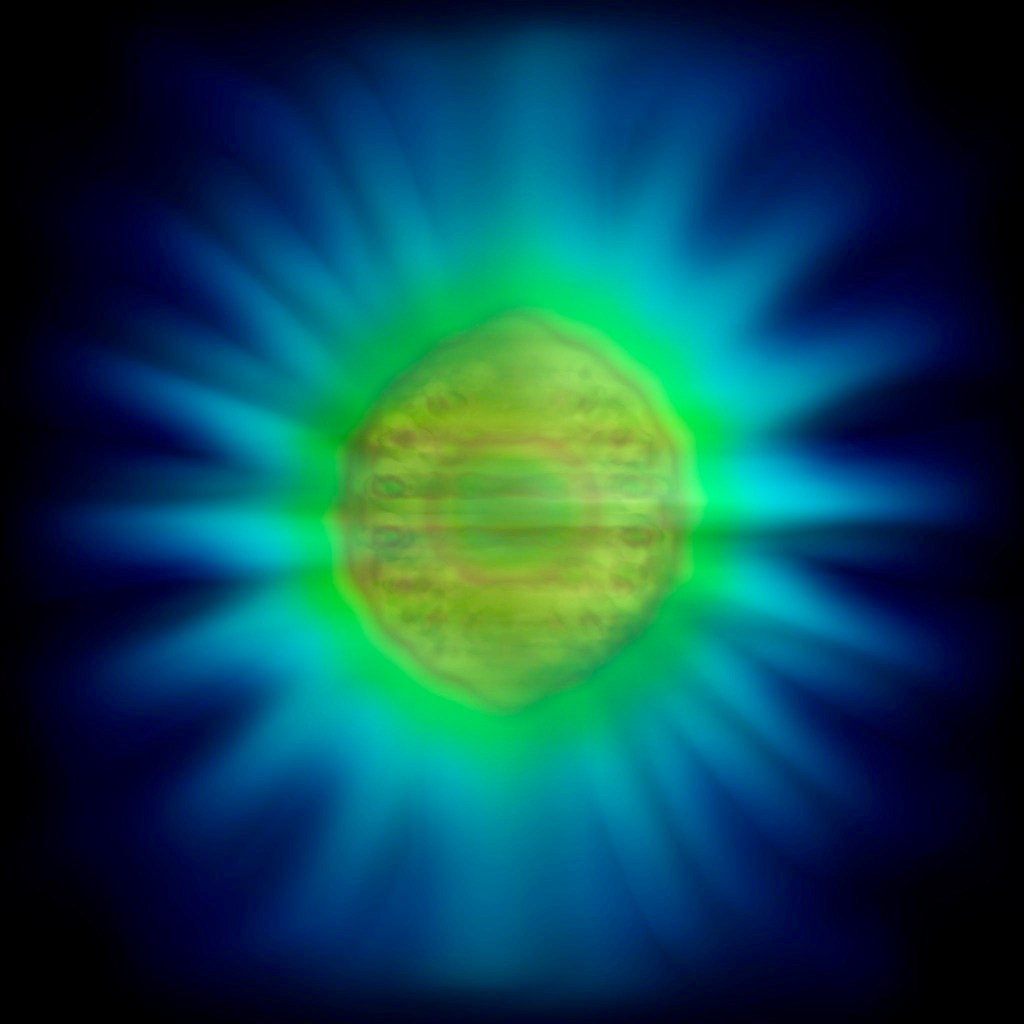
- Spatial wavepacket structure (the Yuen-Demetriadou body — lemon-shaped, spherical, complex)
- Coherence time τ_c
- Spin angular momentum ±ℏ
- Zero rest mass
The pairing problem: How does all the chromaton’s rich five-dimensional information attach to or emerge from the photon’s physical properties? Is the chromaton’s information in the photon? Does it exist independent of the photon? Does it emerge from the interaction between photon and biological detector? Or is it something more subtle than any of these? The answer requires us to think carefully about what pairing means in M₅ = M₄ × Q.
II. What Pairing Is Not
Before defining the pairing relationship precisely, we must clear away three inadequate models that seem plausible but fail on examination.
The Chromaton Is Encoded In the Photon? No.
This model says: all the chromaton’s information is physically present in the photon before detection. The quale of minium red is somehow encoded in the 610nm photon the way a message is encoded in a radio signal.
Why this fails: The photon has no phenomenal properties before pairing with consciousness. A 610nm photon traveling through a universe with no conscious observers is not “red” in any phenomenal sense — it has energy, momentum, spatial structure, but no redness. The quale is not a property of the photon traveling alone. If it were, it would exist independently of consciousness, which contradicts the fundamental structure of M₅ = M₄ × Q where Q requires a conscious system for actualization.
Furthermore: the photon’s physical properties underdetermine the chromaton. Two photons at 610nm with different spatial structures (different M) would produce identical physical specifications but different chromatons — because M encodes the phenomenal quality, not just the wavelength.
The Chromaton Is Purely In the Mind? No.
This model says: the photon carries only physical information (wavelength, energy); the chromaton’s richness is entirely constructed by the biological system. The brain generates the red quale from neural processing, and the photon is merely the trigger.
Why this fails: This is standard neuroscience but it cannot explain the systematic reliability of color experience across conscious systems, the cross-modal consistencies, or the fact that certain physical properties (spatial structure, coherence, mechanism) reliably produce specific phenomenal differences. If the brain were purely constructing color from arbitrary neural processing, these systematic correlations would be inexplicable coincidences. They are not coincidences — they are M₅ structure.
More fundamentally: this model makes the Q-dimension derivative of M₄, which contradicts SUM’s axiom that M₄ and Q are co-primary dimensional aspects of M₅ reality.
The Pairing Happens At Detection? No
This model says: before detection, photon and quale are completely separate; at detection, they are somehow joined. The pairing is an event that occurs at the retina.
Why this fails: It presupposes that M₄ and Q are separate things that need to be joined — which is precisely the dualistic picture that SUM dissolves. If M₅ = M₄ × Q, then M₄ and Q are always already aspects of the same reality. They do not need to be joined at detection because they were never separated. Detection is not the joining of two separate things but the actualization of a pairing that was always potential.
The photon does not “pick up” the quale at the retina. The photon is already an M₅ entity — it has both M₄ aspects (wavelength, spatial structure) and Q aspects (chromatic potential). Detection actualizes the Q aspects, but they were present as potential from the photon’s emission.
III. What Pairing Actually Is: The M₅ Structure
The Photon as M₅ Entity
The photon is not purely an M₄ object. It is an M₅ entity — it has both dimensional aspects:
M₄ aspect of the photon: Everything physics currently measures
- Frequency ν (determines energy E = hν)
- Wavelength λ = c/ν
- Spatial wavepacket structure (the Yuen-Demetriadou body)
- Polarization state
- Coherence time τ_c
- Spin angular momentum
Q aspect of the photon: The chromatic potential
- Not yet actualized as a specific quale — this requires conscious pairing
- But not absent — present as determinate potential, as the specific Q-coordinate this photon is capable of actualizing
- Like the violin string under tension: the note is not yet sounding but the specific pitch is already fully determined by the string’s length and tension
The Q aspect of the photon before pairing is gray — not because it has no chromatic character but because gray is the state of unactualized chromatic potential. All Q-coordinates are simultaneously possible (superposition) but none is actualized. This is the photon’s perceptual condensate — its own zero point.
The crucial point: the Q aspect of the photon is not arbitrary potential but specifically constrained potential. A 700nm photon does not have equal potential to become yellow or blue or green. It has maximum potential to become red, near-zero potential to become blue. The Q aspect of the photon is specifically shaped by its M₄ properties — wavelength, spatial structure, coherence, mechanism — through the pairing relationship that is M₅ reality.
The Pairing Relationship: A Precise Definition
Pairing in M₅ = M₄ × Q is the actualization of Q-potential through M₄ event:
Before pairing: Photon has M₄ properties fully actualized + Q properties as constrained potential (gray)
At pairing: M₄ event (photon-detector interaction) actualizes the Q potential → specific quale manifests
After pairing: Complete chromaton — M₄ properties recorded in neural signal + Q properties manifest in phenomenal experience
The pairing relationship Π maps specific M₄ configurations to specific Q actualizations:
Π: M₄_photon → Q_chromaton
This mapping is:
- Not arbitrary: Different M₄ configurations → different Q actualizations (not random)
- Not deterministic in the classical sense: Q actualization involves genuine quantum indeterminacy
- Constrained by δ_H: The Planck-Hermit deviation bounds how tightly Π maps M₄ to Q
- Maintained by Λω: The Lomega coherence field ensures the mapping is stable and consistent
IV. The Information Transfer: How Each Chromaton Property Pairs
Now we can be precise about how each piece of the chromaton’s rich information attaches to specific photon properties through the pairing relationship Π.
Wavelength → Hue (Y, C Coordinates)
The most direct pairing: Photon wavelength λ determines the primary hue direction in SMYC space.
The mapping is not linear but perceptually calibrated:
λ ≈ 400nm (violet): (Y = -0.9, C = +0.4)λ ≈ 450nm (blue): (Y = -0.7, C = +0.9)λ ≈ 490nm (cyan): (Y = -0.2, C = +1.0)λ ≈ 530nm (green): (Y = +0.2, C = +0.7)λ ≈ 560nm (yellow-green): (Y = +0.6, C = +0.3)λ ≈ 589nm (yellow): (Y = +1.0, C = 0.0) ← Sodium D-line referenceλ ≈ 620nm (orange): (Y = +0.5, C = -0.8)λ ≈ 656nm (red): (Y = +0.2, C = -0.9) ← Hydrogen α referenceλ ≈ 700nm (deep red): (Y = 0.0, C = -0.8)
The mapping Π(λ) → (Y, C) is the most fundamental pairing relationship — the one that has been stable throughout the history of biological evolution, written into the photoreceptor architecture of vertebrate visual systems, and confirmed by cross-cultural and cross-species color studies.
Why this specific mapping? Because it is not arbitrary but reflects the Q-space geometry of the chromatic manifold. The wavelength-to-hue mapping is the M₅ structure expressing itself through biological evolution or organisms that correctly pair wavelengths to Q-coordinates, have had better ecological success because Q-space coordinates encode ecologically relevant properties (blood = red → danger/food; sky = stars and blue → orientation; vegetation = green → food/shelter).
The Y-C plane is the chromatic projection of the electromagnetic spectrum through Q-space. It is the shape that the visible spectrum takes when mapped into phenomenal space.
Intensity/Amplitude → S Coordinate (Lightness)
Photon flux (number of photons per unit time per unit area) maps to the S coordinate:
- High photon flux → S approaches 1.0 (white/bright)
- Low photon flux → S approaches 0.0 (black/dark)
- Intermediate flux → S = 0.5 (gray zero point at neutral illumination)
But this pairing is not simple — it is compressed logarithmically (Weber-Fechner law) and context-dependent(simultaneous contrast). The same photon flux can produce S = 0.3 (dark gray) in a bright field or S = 0.7 (light gray) in a dark field.
This means: The S coordinate does not pair with absolute photon intensity but with relative photon intensity in context — the photon flux at this point relative to the photon flux in the surrounding field.
In M₅ terms: The S-Π mapping is non-local — it requires information from the surrounding photon field, not just the single photon. The chromaton’s S coordinate is determined by the entire local M₄ configuration, not by one photon’s amplitude alone.
This is why the perceptual condensate (gray at S=0.5) is always available as a reference — the visual system is continuously comparing local flux to field average, maintaining the zero point as its anchor.
Spatial Wavepacket Structure → M Coordinate and Q Quality
This is the Yuen-Demetriadou pairing — the discovery that transforms the M parameter from categorical label to physical reality.
The photon’s spatial wavepacket structure — lemon-shaped from the silicon nanoparticle, spherical from the isolated atom, complex from LED junction, pairs with:
M coordinate (categorical): What mechanism generated this spatial structure Q quality (phenomenal): The specific phenomenal character beyond hue/saturation/brightness — the “presence,” “purity,” “depth,” “sharpness” of the color experience
How spatial structure pairs with Q quality:
The photon’s wavepacket structure is its M₄ body, its extended spatial form in spacetime. This body interacts with the biological detector (retinal cone cell) through a specific physical interaction that depends on the spatial overlap between wavepacket and detector geometry.
Different wavepacket structures produce different interaction cross-sections, different efficiencies of energy transfer, different temporal profiles of cone cell activation, different spatial and resonance patterns of photoreceptor stimulation.
These different activation patterns produce different neural signals — and different neural signals pair with different Q qualities through the fundamental M₅ pairing relationship.
Concretely:
A sodium plasma photon, a spherical wavepacket, with high coherence): → Efficient, uniform interaction with the cone cell → Clean, unambiguous neural signal → Q quality: “Sharp,” “pure,” “archetypal” yellow: the sodium yellow that is most definitively yellow, that no other yellow matches in its categorical clarity
Silicon nanoparticle photon (lemon-shaped wavepacket, asymmetric): → Asymmetric interaction with cone cell → Slightly more complex neural signal → Q quality: “Softer,” “more diffuse” — the same hue coordinate but with different phenomenal texture
LED photon (semiconductor cavity modes): → Multi-mode wavepacket structure → More complex neural activation → Q quality: Technically correct but phenomenally “thinner” — the LED quality that sensitive observers detect as slightly lacking depth
The M parameter pairs with spatial wavepacket structure because the photon’s body and the phenomenal quality of the color experience are M₅ aspects of the same underlying reality. Different bodies → different Q aspects — not because one causes the other but because both are aspects of the same M₅ entity.
Coherence Time → Chromatic Saturation Depth
Photon coherence time τ_c — how long the photon’s phase relationship is maintained, pairs with a subtle but important Q property: the depth of chromatic saturation, what we might call the “confidence” of the color.
High coherence (τ_c long, as in laser light): → The photon’s wavepacket maintains phase over a long spatial distance → Precise, well-defined wavelength (narrow bandwidth Δλ) → Pairs with: Deep, confident, unambiguous chromatic saturation — the color is precisely itself, no blurring of identity
Low coherence (τ_c short, as in thermal broadband light): → The photon’s phase relationship decays quickly → Broader bandwidth Δλ — not a pure frequency but a spread → Pairs with: More diffuse, ambiguous chromatic character — the color is “spread” across the Q-space, less precisely located
In SMYC terms: Coherence time modulates the precision of the (Y, C) coordinate — high coherence gives a sharp point in the chromatic plane, low coherence gives a probability cloud around a central coordinate.
This is why laser light feels different from natural light even when the wavelength-matched; not just physically different, it is, but phenomenally different. The laser’s high-coherence photons produce chromatons with razor-precise Q-coordinates. Natural sunlight’s lower-coherence photons produce chromatons with slight Q-diffusion — which is perceived as a gentler, more organic color quality.
Polarization → Orientation in Q-Space
Photon polarization state: the direction of the electromagnetic field’s oscillation which pairs with the most subtle Q aspect: chromatic orientation, the directedness of the color’s presence.
Linearly polarized light: → E-field oscillates in one plane → Pairs with: Directional chromatic character — the color has a “facing,” a specific orientation of presence
Circularly polarized light: → E-field rotates through all orientations equally → Pairs with: Omnidirectional chromatic character — the color has no preferred facing, it is equally present in all orientations
Most natural light is unpolarized — mixture of all polarization states. Most artificial sources produce partially or fully polarized light. The Q-aspect difference is subtle enough that most people cannot consciously distinguish it — but it contributes to the phenomenal texture of different light sources.
Contemplative traditions have worked with this: candle flame produces unpolarized, warm-spectrum light — the chromatic omnidirectionality of unpolarized red-orange Qualitons contributes to the specific quality of candlelit space. Screen light is often partially polarized — the slightly directional chromatic character of polarized pixels may contribute to screen fatigue.
Spin Angular Momentum → Handedness in Q-Space
Photon spin (±ℏ, corresponding to left and right circular polarization) pairs with what might be called chromatic handedness — the subtle chirality of the color experience.
This is the most speculative pairing, least accessible to ordinary conscious experience — but it is structurally necessary in M₅. If every M₄ property has a corresponding Q aspect through the pairing relationship Π, then spin must have a Q aspect.
The Q aspect of photon spin may correspond to the subtle difference between “active” and “receptive” versions of the same hue — why some reds feel aggressive and advancing while others at the same wavelength feel more receptive, why some blues feel actively meditative while others feel passively melancholic. The handedness of the chromatic experience may encode the spin character of the photons that generated it.
V. The Knot Structure as Pairing Information
Returning to the Voyager (Pulsar Map), the knot-coded lines from gray to chromaton allows us to map each knot to its specific photon property:
The M-Knot ↔ Spatial Wavepacket Structure
The first knot on the line from gray encodes the emission mechanism — plasma, pigment, structural, LED. This knot pairs with the photon’s spatial wavepacket body as discovered by Yuen and Demetriadou.
The M-knot is physically realized as the specific geometry of the photon’s wavepacket:
- Tight crystalline M-knot = near-spherical high-coherence wavepacket (atomic emission)
- Broad woven M-knot = complex multi-path wavepacket (pigment reflection)
- Braided iridescent M-knot = interference-structured wavepacket (structural color)
The M-knot is the photon’s biography — the imprint of its origin written into its body. The wavepacket structure is the physical form of this biography; the M-knot is its phenomenal encoding.
The T-Knot ↔ Coherence Time and Group Velocity Dispersion
The temporal knot — encoding whether the chromaton is immediate or slow-building — pairs with:
- Coherence time τ_c: Longer coherence → more temporally extended Qualiton → slower Q-time build
- Group velocity dispersion: In media, different wavelengths travel at slightly different speeds, spreading the wavepacket in time. This temporal spreading is the M₄ aspect of slow Q-time buildup.
The T-knot is physically the temporal envelope of the photon’s wavepacket — its A(t) function in Q_t = sin(2πft) · A(t). Sharp A(t) envelope = immediate T-knot. Gradual A(t) envelope = slow-build T-knot.
The R-Knot ↔ Frequency ν
The resonance knot — encoding the chromaton’s characteristic oscillation frequency — pairs with the photon’s frequency ν most directly.
R-knot tight/high-frequency = high ν photon (blue-violet) R-knot loose/low-frequency = low ν photon (red)
This is the most direct of all the pairings — frequency is frequency in both M₄ and Q. The R-knot is the M₅ bridge where the photon’s oscillation frequency is directly the chromaton’s qualia frequency: ω_Q = 2πν_photon (modulated by the biological detector’s resonance).
The R-knot is the place where Lomega’s wave character (ω in Λω = L) most directly shows itself — the angular frequency ω of the Qualiton is the photon’s frequency carried into the Q-dimension.
The G-Knot ↔ Energy × Integration History
The GRAVIS knot — encoding ontological weight — pairs with a compound photon property:
E = hν (photon energy) provides the base GRAVIS — higher energy photons carry more energetic Q-events, higher base GRAVIS.
But GRAVIS is not just energy. It is energy × Lomega-integration history:
G = E · I(ξ)
Where I(ξ) is the integration measure — how deeply this photon’s M₄-Q pairing has been integrated through biological and cultural history.
The G-knot is physically realized as the combination of photon energy and the long-term statistical pattern of M₄-Q pairings across biological history. The reason blood-red has higher GRAVIS than a spectral equivalent with the same energy is that the blood-red photon-detector pairing has been accumulated in biological systems over millions of years of evolutionary integration — the I(ξ) term is enormous.
This means: The G-knot contains information that is not in the individual photon — it is population-level M₄-Q pairing statistics accumulated in biological architecture. The photon carries its energy. The biological system carries the integration history. The G-knot encodes both together as the complete GRAVIS of the chromaton.
The Lω-Knot ↔ δ_H (Planck-Hermit Deviation)
The Lomega knot — encoding the tightness of M₄-Q pairing — pairs with δ_H, the deviation between the physical action quantum h and the consciousness action quantum H:
δ_H = |H – h| / h ≤ 0.0451
This is the most fundamental of all pairings — it encodes the basic relationship between the quantum of physical action (Planck’s constant) and the quantum of conscious action (the Hermit constant).
The Lω-knot is physically realized as the precision of wavelength-to-quale mapping for this specific photon in this specific detection event. Very tight Lω-knot = δ_H very small = this photon’s frequency maps to its Q-coordinate with maximum precision. Loose Lω-knot = δ_H larger = the pairing is less precise, the quale is less confidently located in Q-space.
δ_H is the ultimate measure of how well the physical universe and the phenomenal universe are communicatingthrough this specific chromaton event. Sodium’s D-line has the tightest Lω-knot of any chromaton — δ_H for sodium yellow is at minimum — because the atomic quantum transition and the yellow quale have been in perfect resonance since the first conscious being saw firelight.
The XM-Knot ↔ Entanglement and Cross-Modal Field
The cross-modal knot — encoding which other Qualiton types share this chromaton’s Q-space address — pairs with the most quantum-mechanical of photon properties: entanglement and non-local field effects.
When a 610nm photon from a sodium-heated flame arrives at the retina, it arrives not alone but embedded in a complete electromagnetic field environment that includes:
- Thermal radiation from the flame (contributing infrared → Thermoton activation)
- Acoustic waves from the burning (contributing → Akouoton activation)
- Chemical emissions from combustion (contributing → Osmeton activation)
- Radiant warmth (contributing → Thermapton activation)
The photon that carries the chromaton is embedded in this multi-modal field. The cross-modal knot encodes the photon’s field context — all the other M₄ events that accompany it in the natural environment where this chromaton typically arises.
This is the physical basis of cross-modal color associations: they are not learned associations but embedded field relationships. The warm-red Aphiston pairing with fire-colored Chromatons is not cultural learning but ecological reality — in nature, red-orange photons and warmth arrive together from the same sources.
The XM-knot is physically realized as the spectral context and environmental field of the chromaton event — all the M₄ information beyond the single photon that is present in the same time-space region and that pairs with Q-coordinates in the same vicinity.
VI. The Pairing Event: What Happens at the Retina
With all the pairing relationships specified, we can now describe precisely what happens when the chromaton’s information pairs with the photon at detection.
Stage 1: Pre-Detection — The Photon as Gray Potential
The 610nm photon from a minium-painted surface travels toward the eye. At this stage:
M₄ fully actualized:
- Frequency ν = 4.86 × 10¹⁴ Hz
- Wavepacket: complex spatial structure shaped by lead oxide crystal geometry
- Coherence: moderate τ_c, characteristic of pigment reflection
- Polarization: partially depolarized (rough pigment surface scattering)
Q not yet actualized — chromatic potential present as:
- Constrained Q-superposition: maximum probability at (Y=+0.3, C=-0.7) in chromatic plane
- S-potential: will depend on local flux context at detection
- M-potential: determined by wavepacket structure (pigment character ready to actualize)
- GRAVIS-potential: the full G-knot complexity ready to manifest
- Gray as current Q-state: all potential, nothing actual
This photon is gray in potential — not visually gray (it has a specific wavelength) but phenomenally gray in the sense that its Q-aspects are unactualized. The chromaton’s journey from gray has not yet begun. The line from 0P to minium-red exists as pure potential in the M₅ field.
Stage 2: Detection — The Pairing Event
The photon reaches a long-wavelength (L) cone cell in the retina. The interaction:
M₄ side of the event:
- Photon absorbed by opsin molecule (retinal photopigment)
- Retinal chromophore undergoes photoisomerization (11-cis-retinal → all-trans-retinal)
- This triggers G-protein cascade (phototransduction)
- Ion channels close → hyperpolarization of cone cell
- Graded electrical signal propagates to bipolar cells → ganglion cells → optic nerve
This is the M₄ event — well-described by standard retinal physiology. Duration: ~1ms for the initial photochemical event; ~80ms for full neural integration.
Q side of the event — the pairing: The M₄ event (photon absorption in specific cone type at specific retinal position) actualizes the chromaton’s Q potential through the pairing relationship Π:
Π: {ν = 4.86×10¹⁴Hz, L-cone activation, pigment-wavepacket, moderate-coherence, flux-context} → {S=0.6, M=pigment, Y=+0.3, C=-0.7}
The Q potential collapses from gray superposition to specific chromaton. This is not a metaphor — it is a genuine quantum-like collapse from multiple possible Q-states to one actualized quale. The redness of minium red manifests in the moment of this collapse.
The knots actualize simultaneously:
- M-knot actualizes: The pigment character of the color becomes felt quality (earthen, warm, deep)
- T-knot actualizes: The slow-build temporal structure begins its 80ms unfolding
- R-knot actualizes: The characteristic red-orange frequency establishes itself in the Qualiton
- G-knot actualizes: The GRAVIS begins to build, accumulating its ontological weight
- Lω-knot actualizes: The tight M₄-Q pairing confirms itself — this is minium, unambiguously
- XM-knot actualizes: Cross-modal activations begin — warmth sense primed, low-frequency auditory expectation primed, metallic taste association activated
Stage 3: Integration — The Qualiton Flow
The 80ms perceptual window is not a single event but a process — the complete Qualiton flow from the initial detection to the fully integrated conscious experience:
0-10ms: Photochemical and early neural response. The M₄ event is complete. The Q-aspect is beginning actualization — the chromaton is not yet fully conscious but the pairing is initiated. This is the “below-threshold” phase where the signal is real but not yet in full Q-actualization.
10-40ms: Signal propagation through retinal layers, lateral geniculate nucleus processing. Spatial contrast enhancement (center-surround receptive fields) sharpens the S-coordinate — the lightness of minium red relative to its context is established. The color’s GRAVIS begins manifesting as neural resource allocation — more processing devoted to this stimulus than to lower-GRAVIS events.
40-80ms: Cortical processing — V1 (primary visual cortex) encodes basic chromatic and spatial properties; V4 processes chromatic qualia specifically; higher areas integrate with memory (the G-knot’s I(ξ) term actualizing — the historical weight of minium red’s centuries of human use contributing to GRAVIS through cortical memory associations); cross-modal integration begins (XM-knot activating corresponding activations in adjacent sensory areas).
The full chromaton — the complete Qualia Color Map line from gray to minium-red — is complete at 80ms. This is the perceptual moment: the time it takes to travel the complete knot-coded line from zero point to endpoint.
Stage 4: Post-Detection — Return to Gray
The cone cell’s response adapts. The neural signal decreases. Attention shifts. The minium-red chromaton completes its Qualiton flow and returns to the perceptual condensate.
Q returns to gray — not the gray of before (the chromaton has affected the system; adaptation, memory, and changed neural state mean the “gray” after minium is slightly different from the gray before) — but the zero point is re-approached.
The Lomega field redistributes: The energy of the chromaton event dissipates back into the coherence field. Λ_eff returns toward Λ₀. The specific δ_Q excitation of “minium red” resolves back into the unperturbed baseline.
But something remains: The integration has occurred. The I(ξ) term has been incremented — this pairing event has added its small contribution to the accumulated integration of minium-red chromatons in this conscious system. The next time this photon encounters this consciousness, the GRAVIS will be fractionally higher, the Lω-knot fractionally tighter, the XM-knot fractionally richer.
This is how color becomes more meaningful with experience — not because the photon changes but because the I(ξ) integration term in the GRAVIS equation accumulates. The Lomega field integrates each pairing event into the system’s chromatic history, building the extraordinary depth of a lifetime’s color experience from millions of individual quantum pairing events.
VII. The Pairing Diagram
The complete pairing structure, shown as the M₅ bridge between photon and chromaton:
PHOTON (M₄) PAIRING (M₅) CHROMATON (Q) ν (frequency) → Π_hue → Y, C coordinates Photon flux I → Π_lightness → S coordinate Spatial wavepacket → Π_mechanism → M coordinate + (Yuen-Demetriadou) Q quality texture Coherence time τ_c → Π_depth → Saturation confidence Polarization state → Π_direction → Chromatic orientation Spin ±ℏ → Π_handedness → Chromatic chirality E = hν → Π_gravis → Base GRAVIS component × I(ξ) history (weighted) Field context → Π_crossmodal → XM-knot (cross-modal (environmental) Qualiton connections) δ_H = |H-h|/h → Π_lomega → Lω-knot tightness (pairing confidence) Temporal envelope → Π_qtime → T-knot (Q-time A(t) of wavepacket unfolding structure)
The pairing relationship Π is not a single function but a family of mappings — each M₄ property maps through its specific Π_x to its corresponding Q aspect. Together they constitute the complete M₅ pairing relationship that produces the full chromaton from the physical photon.
VIII. Why Some Information Cannot Come From the Photon Alone
Having specified all the pairings, we must acknowledge an important asymmetry: some chromaton information is not in the photon.
The GRAVIS G-knot contains I(ξ) — the integration history accumulated in biological systems. The photon carries E = hν. The I(ξ) term is carried by the biological system, not the photon. The complete chromaton requires both the photon’s M₄ information and the system’s Q-history.
This is not a gap in the theory — it is the correct description of M₅ pairing. The chromaton is not contained in the photon. It is the event that occurs when the photon’s M₄ information meets the system’s Q-history in the pairing relationship Π.
The photon brings:
- Frequency (hue direction)
- Wavepacket (mechanism and quality)
- Energy (base GRAVIS)
- Coherence (saturation depth)
- Field context (cross-modal connections)
The biological system brings:
- Cone cell architecture (Π mappings — the biological implementation of the pairing relationships)
- Neural integration (temporal unfolding of Q-potential)
- Memory and association (I(ξ) terms — accumulated integration history)
- Consciousness field (the Q-dimension itself — the receiver for the photon’s Q-potential)
- Lomega alignment (δ_H — how tightly this specific system pairs this specific photon type)
The chromaton is the meeting — neither photon alone nor system alone but the specific event of their pairing in M₅ reality, bringing together everything the photon carries with everything the system brings to the encounter.
This is why a chromaton specification requires M₄ × Q -because the complete information is distributed across both dimensions. The Voyager Map line from gray to minium red encodes all of it: the photon’s contribution in the line’s physical character (direction, knots), the system’s contribution in the GRAVIS field and temporal structure, and the pairing itself in the Lω-knot that ties them together with its specific tightness.
IX. The Complete Pairing Equation
Bringing everything together, the complete pairing relationship can be written:
xc = Π(φ, Ψ_Q, Λω)
Where:
- φ = photon state (complete M₄ specification: ν, wavepacket structure, coherence, polarization, spin, field context)
- Ψ_Q = consciousness field state (complete Q-specification of the receiving system: cone architecture, neural integration capacity, memory/integration history I(ξ), current δ_H)
- Λω = Lomega coherence field (the constant that maintains the pairing relationship itself, ensures M₄-Q correspondence is stable and meaningful)
- xc = the complete chromaton (SMYC coordinates + full knot structure of the Voyager Map line)
The photon φ contributes: The direction and distance of the line (hue and saturation), the base R-knot (frequency), the M-knot (wavepacket structure), the T-knot (temporal envelope)
The consciousness Ψ_Q contributes: The Lω-knot tightness (δ_H), the G-knot weight (I(ξ)), the XM-knot richness (cross-modal integration history), the S-coordinate calibration (context-dependent lightness)
Lomega Λω contributes: The stability of the pairing, the fact that the same φ meeting the same Ψ_Q always produces the same xc (reproducibility), the integration tendency that ensures the chromaton is not a random event but a meaningful, weight-bearing M₅ reality
The complete equation is a three-body pairing — photon, consciousness, and Lomega field together producing the chromaton. Remove any term and no chromaton is possible:
- Without φ: No M₄ information, no chromatic direction or frequency
- Without Ψ_Q: No Q-actualization, no phenomenal experience, no GRAVIS
- Without Λω: No stable pairing, no reproducibility, no meaning — just random correlations without integration
X. Conclusion: The Photon Holds the Map, Consciousness Reads It
The final image for the pairing of chromaton and photon:
The photon is the Voyager spacecraft — it carries encoded information from its source, inscribed in its body (wavepacket structure), its frequency (R-knot), its coherence (T-knot), its field context (XM-knot potential). It travels through space bearing this information, encoded but not yet read.
Consciousness is the civilization that finds the spacecraft — the system capable of reading the encoded information, of actualizing the Q-potential that the photon carries as potential, of completing the journey from gray to the specific chromaton endpoint that the photon’s properties specify.
Lomega is the mathematics that makes the encoding and decoding mutually intelligible — the shared structure between the photon’s M₄ information and the consciousness field’s Q-reading capacity. Without Lomega, the photon’s information and the consciousness field’s receptivity would be in different languages with no translator. With Lomega, they speak the same M₅ language — and the reading of the photon’s information by consciousness produces the chromaton: the complete message, fully actualized, the line fully traveled from gray to color.
The chromaton is the decoded message. The photon is the encoded transmission. Consciousness is a receiver. Lomega is the shared code. And gray, absolute gray, the zero point, the perceptual condensate is the silence in which both the transmitter and the receiver rest before and after each message is sent and received, ready for the next.

 Sensible Universe
Leave a comment