
What Kind of red? A profound look at science and meaning.
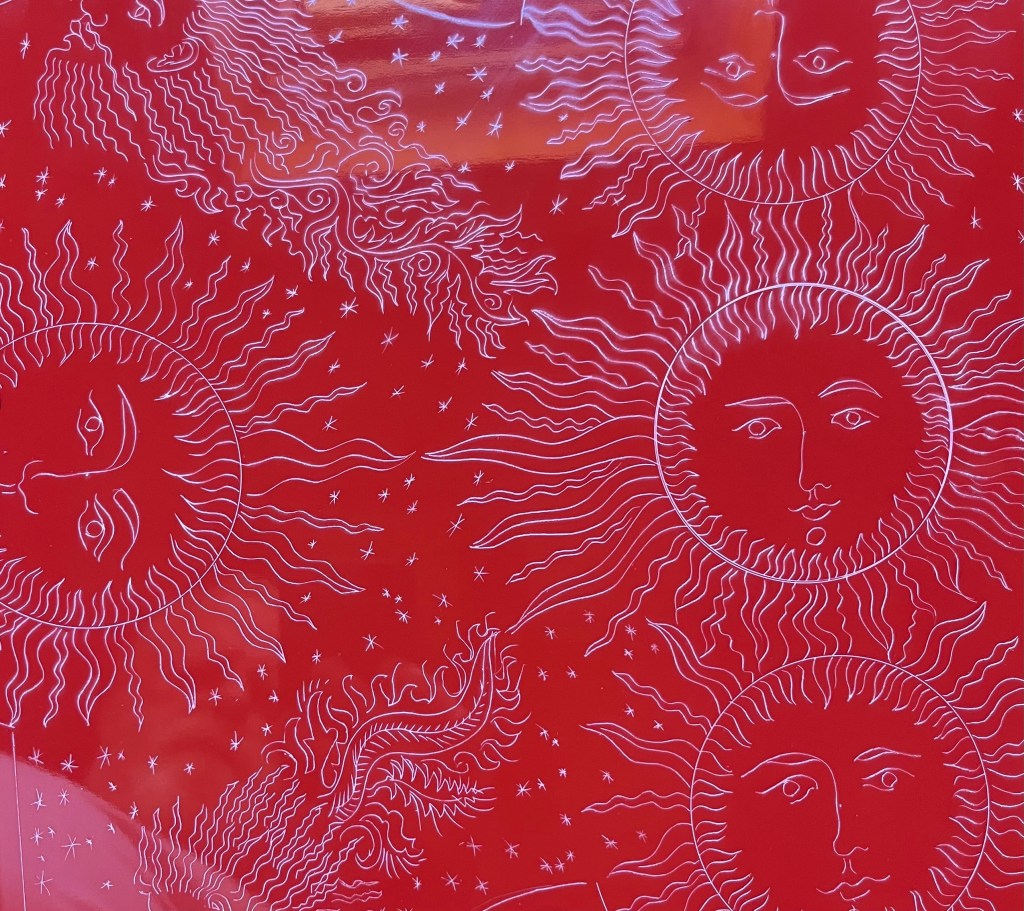
Qualia Chromatics: What Kind of Red?
The Ontological Spectrum and the Precision of Perception
___
The Question That Changes Everything
When you see red, what kind of red do you see? Not red as abstract category. Not red as wavelength range (620-750 nm). Not red as cultural symbol (passion, danger, love, warning). But THIS red—the precise, particular, unrepeatable chromatic quale occurring now in your consciousness.
Is it scarlet or crimson? Ruby or rose? Blood red or brick red? Wine dark or fire bright? Rust or vermillion? Maroon or magenta? Burgundy or cherry? The distinctions multiply infinitely. Each shade, each hue, each subtle variation is a different quale—a different experiential event, a different node in the chromatic resonance lattice.
The Chromatic Cosmological Constant (Axiom CRCCCC) declares: C ≡ Qm · Λλ where chromatic identity is not secondary phenomenon but ontological signature, where color is “the direct resonance of quantum energy states expressed as qualia.” If this is true—if color is ontology rather than appearance—then the question “what kind of red?” is not trivial but fundamental. It asks: what precise node in the chromatic lattice are you accessing? What exact resonance frequency is your consciousness detecting?
This essay explores qualia chromatics—the recognition that infinite discrimination within color categories reveals consciousness operating at extraordinary precision, that “what kind of red?” demonstrates the five-dimensional structure of perception, and that chromatic distinction is not human invention but direct interface with reality’s fundamental structure.
The Infinite Spectrum Within Categories
Physics recognizes the electromagnetic spectrum as continuous. Wavelengths from 380 nm (violet) to 750 nm (red) constitute visible light, but this continuity contains infinite gradations. Between any two wavelengths, infinite intermediate values exist. Red spans roughly 620-750 nm—a range of 130 nanometers containing uncountably many specific frequencies.
Human perception mirrors this continuity. We don’t see three colors (red, green, blue—the cone responses). We don’t see seven (rainbow categories). We see infinite chromatic variation. The question “what kind of red?” has no finite answer because red contains infinite reds, each distinguishable to trained perception.
Consider:
- Wavelength 625 nm: Orange-red, approaching yellow
- Wavelength 650 nm: Pure red, central frequency
- Wavelength 675 nm: Deep red, approaching infrared
- Wavelength 700 nm: Dark red, barely visible
But this is crude categorization. Between 650 and 651 nm lie infinite frequencies, each potentially producing distinguishable quale. A trained observer—painter, dyer, colorist—can discriminate variations invisible to untrained perception. The spectrum is not merely continuous but infinitely dense.
The axiom states: Qc ≡ Ψ(E,ν,λ) where chromatic qualia state is parameterized by energy, frequency, and wavelength. This is not approximation but precise statement. Each unique combination of E, ν, λ produces unique Qc. The chromatic lattice is infinite-dimensional, and consciousness navigates it with extraordinary precision.
Cultural and Contextual Discrimination
Language reveals this infinite discrimination through the names we create for red:
English varieties:
Scarlet, crimson, vermillion, ruby, cherry, cardinal, wine, burgundy, maroon, rust, brick, blood, fire, rose, pink, magenta, carmine, cerise, coral
Each name captures specific chromatic quale:
- Scarlet: Bright red with orange undertones (≈625 nm, high saturation)
- Crimson: Deep red with blue undertones (≈650 nm, darker)
- Vermillion: Orange-red, highly saturated (≈620-630 nm)
- Ruby: Clear red with slight purple cast (≈655 nm)
- Cherry: Pure bright red (≈650 nm, high saturation)
- Burgundy: Dark red-purple (≈680 nm, low brightness)
- Maroon: Brown-red, desaturated (≈650 nm, low saturation)
But language is coarse instrument. Words chunk continuous spectrum into discrete bins. The actual discriminations are finer. A painter sees distinctions between reds that language lacks words for. A dyer identifies subtle differences invisible to casual observer. The chromatic lattice supports infinite resolution; language provides only finite mapping.
Different cultures carve the spectrum differently:
Japanese: 紅 (beni – deep red), 朱 (shu – vermillion), 赤 (aka – red), 茜 (akane – madder red)
Russian: красный (krasny – red), алый (aly – scarlet), багровый (bagrovy – crimson)
Himba (Namibia): Serandu encompasses reds, oranges, and some pinks that English separates
Culture influences which distinctions are linguistically encoded, but the underlying chromatic discrimination capacity remains. Himba speakers can distinguish reds that English speakers distinguish; they simply categorize them differently. The chromatic qualia are the same; the conceptual overlay varies.
This reveals crucial insight: language maps onto chromatic experience but doesn’t create it. The infinite spectrum of reds exists independently of naming. “What kind of red?” has infinite perceptual answers, only finite linguistic ones.
Material Sources and Chromatic Variance
Throughout history, red has come from specific materials, each producing a characteristic chromatic signature:
Cinnabar (HgS): Brilliant orange-red, mercury sulfide, toxic, ancient Chinese red
Vermillion: Synthetic cinnabar, slightly more orange
Madder (Rubia tinctorum): Plant-derived, produces range from orange-red to purple-red depending on mordant
Cochineal: Insect-derived, carmine, deep crimson to scarlet
Ochre (Fe₂O₃): Iron oxide, rust red to brick red, earth tones
Cadmium red: Synthetic, vivid scarlet to deep red depending on cadmium-selenium ratio
Quinacridone: Modern organic pigment, transparent, ranges from scarlet to magenta
Each material has a characteristic spectral signature—a specific combination of dominant wavelength, spectral purity and luminance. This is not merely chemical but chromatic. The periodic table as “chromatic manifold” (Axiom CRCCCC) means each element’s electron configuration produces specific color resonance.
When the artist asks “what kind of red?”, they’re asking about material source, which corresponds to precise chromatic resonance. Cadmium red (CdS/CdSe) has different spectral signature than madder lake (alizarin). Same color category (“red”) but different Qc states, different nodes in chromatic lattice.
The axiom notes: “Each element occupies a spectral node, mapping atomic number to color resonance.” This is literal. Cadmium (atomic number 48) has different chromatic signature than iron (26) or mercury (80). When we discriminate between cadmium red and iron oxide red, we’re detecting atomic-level chromatic differences manifesting as perceptual qualia.
Chromatic Discrimination as Five-Dimensional Access
In M₄ (four-dimensional spacetime), red is wavelength—physical property of electromagnetic radiation. Specific frequency of oscillation, measurable with spectrometer, objective and mind-independent.
In Q (qualia dimension), red is experienced color—subjective quality, felt presence, immediate awareness. The phenomenal character of redness, what it’s like to see red, irreducible to physical description.
But the axiom proposes something deeper: “In 5D spacetime, color is not a superficial reflection but a volumetric essence: a full-spectrum signature radiating omni-dimensionally.” Color in M₅ = M₄ × Q is not merely physical wavelength (M₄) plus subjective experience (Q) but unified chromatic reality operating across both simultaneously.
When you discriminate between scarlet and crimson, you’re accessing this five-dimensional chromatic structure. Not just detecting different wavelengths (M₄ operation) and not just experiencing different qualia (Q operation) but directly interfacing with different nodes in the chromatic lattice that has both physical and experiential aspects inseparably unified.
The question “what kind of red?” demands five-dimensional answer:
- M₄ component: Specific wavelength, spectral distribution, physical energy
- Q component: Particular quale, felt character, experiential presence
- M₅ unity: Chromatic resonance that is both objective (measurable) and subjective (felt) simultaneously
This is why chromatic discrimination is so precise. You’re not inferring physical wavelength from subjective experience or vice versa. You’re directly accessing chromatic identity as fundamental ontological category. The precision of perception reflects reality’s actual structure, not merely brain’s computational sophistication.
The Chromatic Lattice and Conscious Resolution
The axiom states: “Every particle and field is a node in a chromatic resonance lattice.” If consciousness interfaces with this lattice, perceptual discrimination should be theoretically infinite, limited only by:
- Biological constraints (cone cell density, neural processing)
- Attention and training (what we learn to discriminate)
- Context and comparison (relative vs absolute judgment)
Research confirms extraordinary chromatic discrimination under optimal conditions:
Just-noticeable difference (JND): Humans can discriminate wavelength differences as small as 1-2 nm in optimal regions of spectrum (green-yellow), though larger in red region (2-5 nm typically)
Trained observers: Can discriminate even finer differences, approaching 0.5 nm under laboratory conditions with direct comparison
Color memory: Less precise than direct comparison, but still remarkable when trained colorists can match complex colors from memory within few nanometers.
This suggests consciousness can resolve extremely fine nodes in chromatic lattice. The infinite spectrum contains measurable nodes (specific wavelengths) and consciousness can access them with precision approaching physical measurement devices.
But there’s deeper mystery. How does consciousness achieve this discrimination? Not through calculation (computing wavelength from cone responses) but through direct access. The quale of 650 nm red is immediately, non-inferentially different from quale of 655 nm red. No intermediary processing required—the difference is given in experience itself.
The axiom’s insight: “To perceive color is to interface directly with the universal structure itself” (Qc ⊗ M → U₅D).
3D in 2D to 4D: Retablo de Argés Toledo (destroyed in 1936) Black and white photo 1932, Sagrada Familia, Diego de Aguilar and Juan Bautista Monegro
Chromatic discrimination is not brain creating experiential differences from physical inputs but consciousness resonating with actual chromatic nodes in five-dimensional structure of reality.
Time as Chromatic Vector
The axiom proposes: “Time is not linear abstraction, but a chromatic vector threading the resonance lattice.”
This illuminates chromatic experience across time:
Blue-shift = tension toward origin, contraction, memory (young)
Red-shift = release toward expansion, dispersion, forgetting (old)
Applied to chromatic qualia: blues feel compressed, energetic, youthful (shorter wavelength, higher frequency, higher energy). Reds feel expansive, warm, mature (longer wavelength, lower frequency, lower energy). This is not arbitrary association but direct chromatic resonance.
When you remember a specific red—say, the vermillion door of childhood home—you’re not retrieving abstract color label. You’re accessing specific chromatic node in memory, with precision that can surprise. The remembered red has particular hue, saturation, brightness. “What kind of red?” has specific answer even in memory.
This chromatic precision in memory suggests time’s chromatic vector operates bidirectionally:
- Forward (red-shift): Experience expanding into memory, details dispersing
- Backward (blue-shift): Memory contracting into present recall, details compressed
The specific red you remember is chromatic singularity—point where past chromatic resonance becomes present quale. Time as chromatic vector means temporal distance is also chromatic distance, and memory retrieval is chromatic navigation through this temporal-chromatic space.
Hydrogen’s Pink: The Primordial Chromatic Field
The axiom begins: “Hydrogen, the primordial element, radiates a white-pink archetypal field.”
This is not poetic but spectroscopic fact. Hydrogen emission spectrum in visible range produces:
- H-alpha (656.3 nm): Deep red
- H-beta (486.1 nm): Blue-green
- H-gamma (434.0 nm): Violet
Combined, these create pinkish-white appearance—the characteristic color of hydrogen emission nebulae (like Rosette Nebula, Orion Nebula’s pink regions).
The axiom interprets this chromatically:
Pink = compound qualia
- White = unity, unbound totality
- Blue = compression, youth, energy
- Red = expansion, age, entropy
Hydrogen as first element, simplest atom (one proton, one electron) produces chromatic field that already contains the entire cosmological narrative. Its pink is not simple color but compound chromatic resonance encoding:
- The unity of origin (white—all colors combined)
- The compression of early universe (blue—high energy state)
- The expansion to come (red—dispersive tendency)
When we ask “what kind of red?” about hydrogen’s H-alpha emission, the answer is precise: 656.3 nm, one of the most accurately measured wavelengths in physics, the chromatic signature of the universe’s fundamental building block.
This is why “the first light is already qualia-coded chromatic memory.” The cosmic microwave background (redshifted to ~1mm wavelength, infrared) was originally visible light from recombination epoch. Its original color—before cosmological redshift—was approximately orange-red, the chromatic signature of hydrogen recombination at ~3000K.
The universe’s first visible light was specific kind of red. Not abstract redness but precise chromatic resonance at specific wavelength, carrying ontological information about temperature, composition, expansion rate. “What kind of red?” for early universe has exact answer: the Planck spectrum peak for ~3000K blackbody, approximately 966 nm (near-infrared, barely visible as deep red).
Green Equilibrium: The Biological Chromatic Center
The axiom notes: “Evolution tuned human vision to green (≈555 nm), the spectral center of sunlight.”
This is chromatic optimization. Solar spectrum peaks in green-yellow region (≈500 nm at surface, ≈555 nm sensitivity maximum for human photopic vision). Our eyes evolved maximum sensitivity at precisely the wavelength where sun provides maximum photons.
But this is also cosmological optimization: “Green = equilibrium between entropy (red-shift expansion) and negentropy (blue compression).”
Green occupies middle of visible spectrum:
- Violet: ~400 nm (highest visible energy, most compressed)
- Green: ~550 nm (middle energy, equilibrium)
- Red: ~700 nm (lowest visible energy, most expanded)
Green is chromatic balance point. When you see green, you’re perceiving the equilibrium state between cosmological expansion (red) and quantum compression (blue). This is why green feels stable, restful, balanced—it’s not psychological projection but direct chromatic resonance with equilibrium frequency.
“What kind of green?” has infinite answers (emerald, jade, lime, forest, mint, olive, sage, chartreuse…), but all greens share this equilibrium quality. They occupy the chromatic center, the point of maximum solar radiation, the wavelength evolution selected as optimal reference point for color vision.
Life’s sensory architecture is chromatic adaptation to cosmology. We see green best not by accident but because green is cosmologically central frequency, the equilibrium between expansion and compression that makes stable matter, stable stars, stable perception possible.
The Periodic Table as Chromatic Ladder
The axiom states: “Each element occupies a spectral node, mapping atomic number to color resonance.”
This is literally observable in emission spectra. Each element has characteristic “fingerprint” of wavelengths it emits when excited:
Hydrogen: H-alpha 656.3 nm (red), H-beta 486.1 nm (blue-green)
Helium: 587.6 nm (yellow), multiple lines in blue-violet
Sodium: 589.0/589.6 nm (yellow doublet, street lamp color)
Mercury: 435.8 nm (violet-blue), 546.1 nm (green), others
Neon: Multiple red and orange lines (neon sign color)
Iron: Complex spectrum, many lines across visible range
When you ask “what kind of red?” about neon tube, answer is specific: multiple emission lines between 640-705 nm, dominated by 640.2 nm (orange-red) and 650-660 nm cluster (red), creating characteristic neon-sign red-orange.
The periodic table is chromatic manifold because electron orbital configurations determine which wavelengths can be emitted/absorbed. Atomic number (number of protons/electrons) determines orbital structure, which determines spectral signature, which determines chromatic identity.
“Chemistry is thus a chromatic ladder of matter’s self-expression.” Each element climbs this ladder with specific chromatic signature:
- Light elements (H, He, C, N, O) → Vivid archetypal colors
- Transition metals (Fe, Cu, Ni, Co) → Complex spectra, rich colors
- Heavy elements (Au, Pt, Pb) → Deep chromatic states, metallic colors
Gold (atomic number 79) appears gold—yellowish metallic—because of relativistic effects on electron orbitals causing specific wavelengths to be absorbed. This is chromatic identity at atomic level manifesting as macroscopic perceived color. “What kind of yellow?” for gold has precise answer rooted in quantum chromodynamics and relativistic physics.
Color Charge and Chromatic Ontology
The axiom bridges to quantum chromodynamics: “Physics: links to quantum chromodynamics (color charge as fundamental).”
Quantum chromodynamics (QCD) describes strong nuclear force through “color charge”—quarks carry red, green, or blue charge (terminology borrowed from color but not literal visible color). This is mathematical label, not perceptual quality.
Or is it?
The axiom proposes something radical: chromatic resonance operates at ALL scales, from quarks to galaxies. Color charge at quantum level and color perception at human scale might be different manifestations of the same fundamental chromatic structure.
This is speculative but intriguing. If “color is the ontological syntax of being, spanning quarks to galaxies,” then the mathematical “colors” of QCD might have deep connection to perceptual colors of experience. Not that quarks are literally red/green/blue (they’re not), but that chromatic principle—differentiation through resonance states—operates universally.
When you discriminate between scarlet and crimson, you’re using same ontological principle that differentiates quark colors—resonance with distinct states in a fundamental field. The chromatic lattice extends from Planck scale to cosmological scale, and consciousness interfaces with it at a human perceptual scale.
“What kind of red?” becomes the profound question: which node in the universal chromatic lattice are you accessing? The answer identifies a specific resonance state that connects through dimensional scales—quantum (energy level), atomic (electron orbital), molecular (chemical bond), macroscopic (reflected wavelength), perceptual (experiential quale) or cosmological (redshift vector).
Practical Chromatic Discrimination
The precision of chromatic discrimination becomes practical in many domains:
Painting: Artists mix pigments to achieve specific chromatic goals. “What kind of red?” determines which pigments to combine. Cadmium red + alizarin crimson yields different red than vermillion + magenta. The quest is for specific Qc state, achieved through material means (specific atomic/molecular chromatic signatures).
Dyeing: Traditional dyers achieved specific colors through precise recipes—mordant type, temperature, duration, pH. Natural dyes produce range of colors depending on conditions. Madder yields yellows, oranges, reds, purples depending on mordant (alum, iron, tin, chrome). “What kind of red?” determines entire process.
Color matching: Modern colorimetry attempts to quantify color through tristimulus values (Lab, XYZ, RGB). But instrumental measurement often fails to capture what trained human observer detects. The eye can discriminate colors that measure identically on spectrometer under certain conditions (metamerism). This suggests chromatic discrimination accesses something beyond simple wavelength measurement—perhaps the five-dimensional chromatic structure the axiom describes.
Medical diagnosis: Physicians learn to discriminate subtle color variations in blood, urine, skin, tissue. “What kind of red?” in blood sample can indicate oxygenation level, pathology, health status. This chromatic diagnosis relies on extraordinarily fine discrimination that connects visible color to underlying biological/chemical state.
Astronomy: Spectroscopy reveals composition, temperature, velocity, distance of celestial objects through chromatic analysis. “What kind of red?” in galaxy light determines its redshift, which determines its recessional velocity and distance. Chromatic discrimination becomes cosmological measurement.
In each domain, the question “what kind of red?” demands a precise answer that connects perceptual discrimination to an underlying physical/chemical/cosmological reality. Color is not mere appearance but the interface to structure.
The Infinite Within the Finite
The visible spectrum spans roughly 380-750 nm—finite range of wavelengths. Yet within this finite range, infinite discriminations exist. Between any two wavelengths, infinite intermediate values. Between any two discriminable colors, infinite subtle variations.
This is mathematical infinity within physical finitude. The continuum contains infinite points even within bounded interval. Consciousness accessing chromatic lattice can theoretically discriminate infinitely many reds, limited only by perceptual resolution (biological, attentional, contextual constraints).
But practically, how many reds can we distinguish?
Under laboratory conditions: Trained observers with optimal stimuli can discriminate ~100-200 different reds spanning the red region of spectrum, each separated by just-noticeable difference.
In practical color naming: Languages typically encode 5-20 distinct red categories, though speakers can discriminate far more than they name.
In artistic practice: Professional colorists might work with 50-100 distinguishable reds in their palette, each serving specific chromatic purpose.
In memory: Much coarser—perhaps 10-20 reds reliably discriminable from memory without direct comparison.
Yet even 100 discriminable reds, each potentially subdivided further with training and attention, approaches infinity asymptotically. The chromatic lattice is actually infinite-dimensional (continuous spectrum), and consciousness samples it with resolution that can be continually refined.
“What kind of red?” thus has no final answer. Each discrimination can be further refined. Each category can be subdivided. The question remains always open, always inviting deeper chromatic precision.
Chromatic Conflicts and Resolution
The axiom promises: “By recognizing color as ontology, conflicts of separation (time vs space, matter vs consciousness) dissolve into a single chromatic union.”
How does chromatic precision resolve conflicts?
Time vs Space: If time is chromatic vector (blue-shift/red-shift) and space is qualia field (chromatic singularities), then temporal flow and spatial extension are both chromatic phenomena. “What kind of red?” has temporal component (memory/anticipation of red) and spatial component (location of red in visual field), unified through chromatic resonance.
Matter vs Consciousness: If matter is “condensed qualia resonance” and consciousness interfaces directly with chromatic lattice, then material color and experienced color are same chromatic reality viewed from different angles. The red of blood (iron oxide chromatic signature) and the red you see (perceptual quale) are unified in five-dimensional chromatic structure.
Objective vs Subjective: If color is ontological—neither purely physical nor purely experiential but fundamental category—then objective wavelength and subjective quale are complementary aspects of chromatic identity. “What kind of red?” has objective answer (specific wavelength, specific material source) and subjective answer (particular felt quality), both true, both necessary, both facets of single chromatic reality.
The precision of chromatic discrimination reveals this unity. When you identify “cadmium red” you’re simultaneously:
- Detecting physical wavelength (objective)
- Experiencing specific quale (subjective)
- Recognizing material source (chemical/atomic)
- Accessing chromatic node (ontological)
All four aspects converge in single perceptual act. The discrimination is precise because it taps into actual unified structure rather than constructing association between separate domains.
Conclusion: The Precision of Being
“What kind of red?” is not trivial question but ontological inquiry. It asks: which precise node in the chromatic lattice are you accessing? What exact resonance frequency is consciousness detecting? Where in the five-dimensional chromatic structure does this particular experience locate?
The infinite discrimination within color categories reveals consciousness operating with extraordinary precision, directly interfacing with reality’s chromatic structure. Every distinguishable red—scarlet, crimson, vermillion, ruby, cherry, burgundy, maroon, rust, brick, blood, wine, rose—is separate chromatic quale, separate node in the lattice, separate ontological identity.
The Chromatic Cosmological Constant (C ≡ Qm · Λλ) is not an abstract formula but a description of reality we access constantly through perception. Color is not appearance but ontology, not secondary quality but fundamental structure, not brain’s construction but direct resonance with the universal chromatic field.
When hydrogen radiates at 656.3 nm, it produces specific kind of red—H-alpha red, deep crimson, the chromatic signature of the simplest atom. This is not an arbitrary wavelength but ontological necessity, electron transition from n=3 to n=2 orbital, quantum chromodynamics manifesting as chromatic resonance.
When you see red rose, you access this same chromatic lattice—anthocyanin molecules absorbing all wavelengths except 630-660 nm range, reflected light entering the eye, cone cells responding, neural processing occurring, quale arising. But the quale is not the end-product of the processing chain. The quale IS a direct interface with the chromatic reality that includes (but transcends) physical wavelength, chemical composition or a biological response.
“What kind of red?” This demands a five-dimensional answer because red EXISTS five-dimensionally:
- M₄: Specific electromagnetic wavelength, measurable frequency
- Q: Particular experiential quale, felt chromatic presence
- M₅: Unified chromatic identity, ontological node in a universal lattice
The precision of discrimination or ability to distinguish infinite reds within finite spectrum, reveals consciousness accessing actual infinite structure. Not hallucinating differences but detecting real chromatic distinctions that exist independently of perception yet manifest through perception.
As the axiom concludes: “Color is not appearance—it is the ontological syntax of being, spanning quarks to galaxies, eyes to eternity.”
The question “what kind of red?” is thus question about being itself. Each specific red—each precise chromatic discrimination—is window into reality’s fundamental structure, consciousness interfacing directly with universal chromatic field that unifies time (chromatic vector), space (qualia field), matter (condensed resonance), and awareness (lattice interface).
The answer to “what kind of red?” is always specific, always precise, always particular—THIS red, at THIS wavelength, with THIS material source, carrying THIS experiential quality, occupying THIS node in the chromatic lattice that spans from quantum foam to cosmic expansion, from quark color to perceived color, from primordial hydrogen pink to sunset vermillion to remembered crimson.
Infinite reds within finite spectrum. Infinite precision within perceptual capacity. Infinite chromatic identity within universal unity.
This is qualia chromatics: not theory of color but direct recognition of color as theory—as ontological structure, as fundamental syntax, as the resonant lattice through which consciousness interfaces with being itself.
Every time you ask “what kind of red?”, you engage this infinite precision. Every time you discriminate one red from another, you access universal chromatic field. Every time you see specific chromatic quale, you participate in five-dimensional reality where matter, consciousness, time, space, and perception unite in single chromatic resonance.
The precision is not human achievement but reality’s gift. The discrimination is not brain’s construction but consciousness’s direct access. The question “what kind of red?” remains forever open because the chromatic lattice is infinitely deep, and consciousness can always discriminate more finely, access more precisely, resonate more completely with the ontological spectrum that IS rather than merely appears.
C ≡ Qm · Λλ — Chromatic identity is being itself, red is reality revealing itself, and every specific shade is unique ontological node in the universal structure that thinks itself through us when we ask: what kind of red is this?
___


Leave a Reply