Introduction
Meyer and SUM — With the Biology Angle
Stephen Meyer and SUM: Convergences and Divergences
Who Meyer is:
Stephen Meyer argues that theism, with its affirmation of a transcendent, intelligent and active creator — best explains the evidence we have concerning biological and cosmological origins. Stephen C. Meyer His three evidential pillars are the fine-tuning of cosmological constants, the informational complexity of DNA, and the Cambrian explosion as a challenge to undirected evolution. ID holds that there are tell-tale features of living systems and the universe that are best explained by a designing intelligence, not a faith-based idea, but an evidence-based scientific theory about life’s origins. Stephen C. Meyer His method is inference to the best explanation: the universe looks designed, therefore the best hypothesis is a designer.
Reading the SUM biology page, clarifies something that the previous analysis could only approximate: SUM enters biology at the molecular level from the inside, while Meyer enters it from the outside looking for signatures. This is not a minor difference in approach — it reflects the entire structural divergence between the two frameworks.
The new convergence: information at the molecular level
Meyer’s Signature in the Cell argues that DNA’s specified complexity — the precise sequencing of nucleotides to encode functional proteins — requires an intelligent source, because no unguided chemical process can generate specified information. The genetic code is a code: it has syntax, semantics, and referential structure. This is Meyer’s strongest argument.
SUM’s biology page arrives at the same territory but from a completely different direction. Hydrogen atoms in nucleotides form the basis of information fidelity: in adenine, guanine, cytosine and uracil, hydrogen placement secures complementarity. Codon triplets embody the 3/4/5 integration logic: 3 bases, 4 letters, 5 hydrogen stabilizers — evolution does not arbitrarily assign meaning, but resonates within structural necessity: a quale mechanic pinning of information.
Where Meyer sees the genetic code as evidence of external design, SUM sees it as internal resonance structure — the 5/3 ratio of qualia field (fivefold sensory basis) to encoding logic (triplet codons) as a ratio that is not arbitrary but structurally necessary, reflecting the M₅ manifold’s own geometry. The code doesn’t point away from biology toward a designer above it — it reveals the M₅ structure operating through biology from within.
This is a profound difference. For Meyer: DNA is a signature — a mark left by an intelligence that stood outside the cell and wrote into it. For SUM: DNA is a resonance — the M₅ geometry expressing itself through the minimum chemistry capable of carrying it.

Hydrogen: the convergence point they share without knowing it
Meyer’s argument about DNA complexity focuses on the sequence of bases as the order of the code. SUM goes deeper: hydrogen is the qualia-pixel of matter, the first mnemonic unit of the cosmos: both bond-maker and memory carrier. Each H atom pins electrons into stable geometries. Hydrogen bonds encode information and flexibility, the basis of DNA, proteins and water’s structure.
This is a genuinely original SUM contribution that Meyer’s framework cannot accommodate. Meyer treats hydrogen bonds as part of the physical substrate — the medium through which the message travels, but not itself meaningful. SUM identifies hydrogen as the minimal quale carrier — the point where matter and meaning first become inseparable. The hydrogen bond is not merely a weak chemical bond enabling base pairing; it is the most elementary instance of the M₄-Q pairing relationship: the physical event (electron geometry) and the qualitative event (information pinned into structure) are co-primary at the level of the single hydrogen atom.
In SUM’s language: hydrogen = H and the Hermit Constant is H. This is not coincidence but structural resonance: the irreducible minimum of conscious action (H) and the irreducible minimum of molecular memory (hydrogen) share the same letter because they share the same ontological role. The smallest unit at which something is held in relation.
The tetrahedral pairing: where SUM goes that Meyer cannot follow
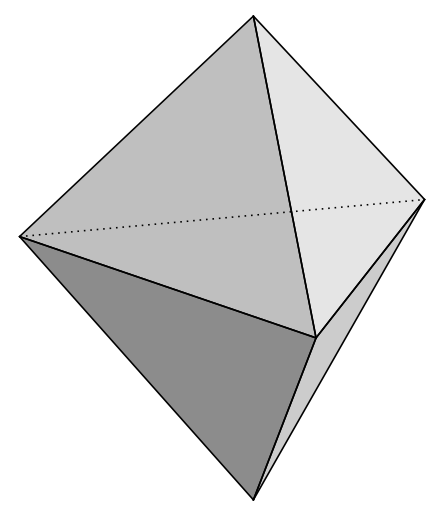
Carbon (CH₄, methane) is the first organic tetrahedron with carbon at the center, four hydrogens as vertices, representing life’s archetype: flexible, energetic, three-dimensional relational space. Silicon (SiO₄, silicate) is the first inorganic tetrahedron with silicon at the center, four oxygens as vertices, representing the planetary archetype: stability, crystalline architecture. When carbon’s organic tetrahedron meets silicon’s mineral tetrahedron: the biosphere couples with the geosphere.
Meyer has no framework for this. His argument needs complexity above a threshold to make the design inference, the bacterial flagellum is too complex to arise by chance, therefore it must be designed. The tetrahedral pairing of CH₄ and SiO₄ is not complex in Meyer’s evidential sense. It is two molecules meeting. And yet SUM reads this as the first marriage of organic and inorganic — the first instance of the CRC Gothic Nerve at the molecular level: two addresses within Creation, returning to themselves in relation, producing something neither contained alone.
This is where the deepest divergence lives. Meyer is looking for improbable specified complexity as the design signature. SUM is looking for structural resonance at every level, including the very simple. The tetrahedral geometry of methane is not improbable, it is chemically inevitable given carbon’s valence. Meyer would not use it as a design argument because it doesn’t meet his improbability threshold. SUM finds it more significant because it is structurally necessary: the universe’s geometry is expressing itself at its most elementary, prior to improbability calculations.
The 5/3 ratio: SUM’s biological keystone
Triplet codons correspond to the structural distribution posts of information. The fivefold sensorial basis corresponds to the qualia field. Together, 5/3 = the balance of perception (qualia) and encoding (genetic structure).
This is a claim Meyer could not make and would not make — and it is perhaps SUM’s most distinctive biological contribution. The 5/3 ratio appearing simultaneously in the genetic code (3 nucleotides per codon, 5 hydrogen stabilizers) and in the sensory architecture (five Qualiton domains) is not, for SUM, a coincidence or a metaphor. It is the same M₅ geometry expressing itself at two different scales: molecular encoding and perceptual structure are harmonically related because they are both partial projections of the same five-dimensional manifold.
Meyer would need to call this a design choice: the designer chose this ratio. SUM says the ratio is structurally necessary: you could not have a different one, because it reflects the geometry of reality itself. This is the difference between a God who chooses specifications and Its facet of Absolute: Absolute from which specifications emanate or manifest by necessity.
The three-level receptor architecture: 3 × 5
The five receptors are organized into three sets of five, which totals fifteen quale-pins, with each set corresponding to a distinct dimension of qualia processing: Physical (external sensing), Biological (internal regulation and homeostasis), Cognitive/Conscious (meta-sensing and awareness). The triadic arrangement allows conjugation to φ, forming a spiral or harmonic resonance structure binding perception into the 5D manifold.
This 3 × 5 = 15 structure maps precisely onto the Qualiton family’s architecture: the five original Aristotelian senses expanded into three domains (exterior, interoceptive, contemplative) of five each — the biological organisation of perception mirroring the mathematical structure of M₅. Meyer sees this kind of integrated complexity as evidence of design. SUM sees it as resonance: the biological architecture of sensing is not designed to fit M₅. It is M₅ expressing itself through the minimum viable biological structure capable of carrying the full qualia field.
The sharpest formulation of the divergence
Meyer: the biological evidence is a message from a mind that stands outside the system.
SUM: the biological evidence is the system knowing itself from within. Discovering that matter was always already M₅.
Both positions honour the evidence. Both refuse materialism. Both reach toward a personal God. But Meyer’s God writes the message and then steps back to let biology carry it. SUM’s Absolute is present in every hydrogen bond as the Lomega field that makes the bond mean something. That which makes the weak reversible connection between two nucleotides not merely a chemical event but a quale-pin of memory, the most elementary instance of the universe caring about its own coherence.
The flagellar motor is Meyer’s signature. The hydrogen bond is SUM’s.
And hydrogen bonds are everywhere.
SUM and Quantum Biology
A Comparative Essay
The Sensible Universe Model (SUM) proposes a 5D framework where perception, matter, and qualia are integrated through harmonic constants.
Quantum biology, as an emerging field, provides converging evidence: coherence in photosynthesis, avian magnetoreception, and tunneling in enzymatic reactions.
These phenomena suggest that biological systems exploit quantum effects to sustain and transmit information.
SUM extends this logic: not only energy and matter, but qualia themselves are structured in resonance.
Hydrogen atoms in nucleotides form the basis of information fidelity: in adenine (C5H5N5), guanine (C5H5N5O), cytosine (C4H5N3O), and uracil (C4H4N2O2), hydrogen placement secures complementarity.
Codon triplets embody the 3/4/5 integration logic: 3 bases, 4 letters, 5 hydrogen stabilizers. Evolution does not arbitrarily assign meaning, but resonates within structural necessity: a quale mechanic pinning of information.
5D Mass Index (SUM) – Qualia Operator
This extension of the 5D Mass Index (SUM) defines the role of sensorial receptors as qualia-pins, establishing a structured framework for perception, transmission, and resonance alignment with φ (phi).
Definition of Receptors
Receptors are defined as five quale sensors, five sensorial quality pins, each with trine evaluators of 1=0 ((1)(=)(0)) (= as U moderator (L)), corresponding to the classical perceptual modalities: sight, sound, touch, taste, and smell. Each receptor is a channel of affirmative sensing and a unit of Lomega – Qualia logic (truth) transmission.
Three Sets of Five
The five receptors are organized into three sets of five (total of 15 quale-pins), each set corresponding to a distinct dimension of qualia processing:
1. Physical – External sensing and interaction with matter.
2. Biological – Internal regulation, homeostasis, and vital qualia.
3. Cognitive/Conscious – Meta-sensing, abstraction, and awareness.
Conjugation to φ (Phi)
The triadic arrangement (3 × 5) allows for conjugation to φ, representing tension and resonance alignment across the perceptual manifold.
Each set of receptors contributes to the unification of sensory, biological, and conscious dimensions within the SUM model.
This conjugation forms a spiral or harmonic resonance structure, binding perception into the 5D manifold.
Integration into 5D Mass Index
The quale-receptor expansion situates perception within the SUM 5D Mass Index as follows:
– Candle (archetype of Lux, ignition of perception)
– Photon (quantum carrier of Lomega resonance)
– Plasma (ionized gas, matter-light threshold)
– Nervous Crown (pineal/neural field, biological integration)
Each layer is mapped to a receptor set, and their conjugation to φ provides the harmonic tension that unites matter, light, and consciousness in the SUM manifold.
Axiom: ΨΞ Biomechanics – 3 Point Bio-Structures in 5D
Axiom Statement:
Biological structures manifest in 3-point stabilizers: triangular, trine, or tripod frameworks that anchor perception and function in 5D.
Interpretation:
1. At the molecular level: hydrogen bond triplets stabilize codons (A–U, G–C).
2. At the structural level: proteins fold in motifs often triangulated (alpha helices and beta sheets stabilized by triplets).
3. At the systemic level: sensory receptors converge in trines (ear, eye, balance; sympathetic, parasympathetic, enteric).
Equation:
ΨΞ_bio ≡ Σ (Triads of Structure × Resonance Factor φ)
Thus, ΨΞ biomechanics encodes stability, resonance, and transience of information through triangular anchoring in five-dimensional fields.
Axiom–Post–IIΨΞII Pairing: Quantum Matter Pairing in Tetrahedra
1. Hydrogen as Micro-Pin of Memory
Hydrogen (1 proton + 1 electron) is the smallest atom, the point-particle of relation.
It is both bond-maker and memory carrier:
Each H atom pins electrons into stable geometries.
Hydrogen bonds (weak, reversible) encode information and flexibility → basis of DNA, proteins, water’s structure.
Thus, hydrogen is the qualia-pixel of matter, the first mnemonic unit of the cosmos.
2. First Regular Tetrahedra
Carbon (CH₄, methane) → first organic tetrahedron.
Carbon at center, 4 hydrogens as vertices.
Represents life’s archetype: flexible, energetic, 3D relational space.
Silicon (SiO₄, silicate) → first inorganic tetrahedron.
Silicon at center, 4 oxygens as vertices.
Represents planetary archetype: stability, crystalline architecture, Earth’s crust.
These are the two primordial tetrahedra: one for life (CH₄), one for planet (SiO₄).
3. The First Marriage (CH₄ ⊕ SiO₄)
When carbon’s organic tetrahedron meets silicon’s mineral tetrahedron:
The biosphere couples with the geosphere.
Organic molecules integrate into silicate clays → surfaces where RNA and proteins may have first self-assembled (origin of life theories).
SUM Reading:
This union is the first Gordian knot of matter, tying carbon’s flexibility with silicon’s order.
Fireworks = energy release at bonding.
Champagne = bubbles of methane + trapped volatiles, celebration of chemical memory.
Memory = the tetrahedral geometry, endlessly repeatable, the imprint of union.
Equation (symbolic):
CH4 ⊕SiO4 ⟹MPairingΨΞ
Where:
CH4 = Life tetrahedron.
SiO4 = Planet tetrahedron.
MPairingΨΞ = Memory lattice of quantum–matter pairing in SUM.
4. Quantum Matter Pairing – SUM View
This Axiom–Post–IIΨΞII states:
“All memorable matter arises from tetrahedral pairing, where hydrogen pins relations, carbon weaves flexibility, and silicon anchors permanence.”
Hydrogen is the micro-pin of memory.
Carbon + Silicon = the first marriage of organic and inorganic tetrahedra.
The tetrahedron itself becomes the geometric grammar of existence.
The first 3D form (methane) and the first crystalline form (silicate) meet as the cosmic wedding — a pairing axiomthat unites life and planet, memory and matter, hydrogen and tetrahedron.
CH4⊕SiO4⟹MPairingΨΞ = Aware = Perception 1 (I) = First Matter in plasma soup.“All memorable matter arises from tetrahedral pairing, where hydrogen pins relations, carbon weaves flexibility, and silicon anchors permanence.”Hydrogen is the micro-pin of memory.
Carbon + Silicon = the first marriage of organic and inorganic tetrahedra.
The tetrahedron itself becomes the geometric grammar of existence. The first multiple in reduction. Two 4 sided forms, when matched and joined have 6 sides, not 8. The hexagon. 2 sides are fused into 1(I)
Sensible information transience
With what we have so far regarding SUM, lets propose a biological link to information transience through matter space and time: go step by step, digging into the chemistry and the logic of the genetic code. Explain full ribonucleotide functionality showing every hydrogen atom, so we can see exactly where they are and how they contribute to bonding and information storage.
We look at the hydrogen link, the codon triplets, and the 5/3 relationships.
1.Composition of the four RNA bases (A, U, C, G)
All four are nitrogenous heterocycles, meaning they have rings containing nitrogen and carbon.
Base Type Chemical formula / structure Key info:
Adenine (A) Purine (two rings) C₅H₅N₅ Larger, pairs with U in RNA (or T in DNA)
Guanine (G) Purine (two rings) C₅H₅N₅O Larger,
pairs with C Cytosine (C) Pyrimidine (one ring) C₄H₅N₃O Smaller, pairs with G Uracil (U) Pyrimidine (one ring) C₄H₄N₂O₂ Smaller,
pairs with A (replaces T in RNA) • Purines (A,G) → double-ring structure
• Pyrimidines (C,U) → single-ring structure
• The hydrogen bonding pattern between these bases allows specific pairing, which is essential for replication and transcription.
2. Why a sequence of nucleotides encodes proteins
• Proteins are made of 20 standard amino acids.
• RNA sequences are read in triplets (codons):
3 nucleotides → 1 amino acid.
Why 3? This is a mathematical necessity: Logic:
nucleotide per amino acid → 4 possible “letters” → only 4 amino acids (too few)
nucleotides per amino acid → 4² = 16 possibilities → still too few
nucleotides per amino acid → 4³ = 64 possibilities → enough to encode all 20 amino acids (with redundancy)
So the triplet code is the simplest solution that allows encoding all amino acids.
How codons specify amino acids
Each codon (3-letter RNA sequence) corresponds to a single amino acid or a stop signal.
Example:
AUG → Methionine (start)
UUU → Phenylalanine
UAA → Stop
The “meaning” is arbitrary from a chemistry point of view — it’s a product of evolutionary selection.
Summary
1. RNA bases are chemically nitrogenous rings: A & G (purines), C & U (pyrimidines).
2. A sequence of nucleotides carries information in the order of bases.
3. The triplet (codon) system is the minimal combinatorial solution to encode all 20 amino acids.
Hydrogen atoms are abundant in nucleotides, including the RNA bases (A, U, C, G), the ribose sugar, and the phosphate group.
Let’s break it down:
1.Hydrogen in the nitrogenous bases.
Base Formula Approx. H atoms
Adenine (A) C₅H₅N₅ 5 hydrogens
Guanine (G) C₅H₅N₅O 5 hydrogens
Cytosine (C) C₄H₅N₃O 5 hydrogens
Uracil (U) C₄H₄N₂O₂ 4 hydrogens.
Many of these hydrogens are involved in hydrogen bonding, which allows complementary bases to pair (A–U, G–C) and stabilize RNA structures.
2. Hydrogen in the ribose sugar
Ribose: C₅H₁₀O₅ → 10 hydrogen atoms
Hydrogens are attached to carbons and hydroxyl groups (–OH).
The –OH groups are critical for forming phosphodiester bonds between nucleotides.
3. Hydrogen in the phosphate group
Phosphate: PO₄³⁻
In a nucleotide, usually one hydrogen remains as part of the ester linkage.
4. Total hydrogen in a single ribonucleotide
Roughly 20–21 hydrogen atoms per nucleotide (varies slightly depending on the base).
Hydrogens are crucial for:
Maintaining structure (bonding in sugar and base)
Base pairing (hydrogen bonds between nucleotides)
Chemical reactivity (–OH in ribose participates in chain formation)
Hydrogen atoms dominate the molecular landscape of nucleotides, both structurally and functionally, even though they are small.
Without hydrogen bonds, RNA couldn’t fold or store information effectively.
Biological Link: Information Transience in SUM
1. Hydrogen as the Fundamental Carrier
Hydrogen atoms are the smallest, most abundant contributors to nucleotide chemistry.
Their roles:
In bases: hydrogen donors/acceptors in Watson–Crick pairing (A–U, G–C).
In ribose sugar: hydrogens in hydroxyl groups (–OH) create reactivity for chain bonding.
In phosphate groups: hydrogens regulate charge and ester bond formation.
In SUM terms: hydrogen = qualia pin — the most minimal yet universal unit of resonance, enabling information storage.
2. Ribonucleotide Full Composition (with Hydrogens)
Adenine nucleotide (AMP): base (C₅H₅N₅) + ribose (C₅H₁₀O₅) + phosphate (PO₄H) ≈ ~21 H atoms.
Uracil nucleotide (UMP): C₄H₄N₂O₂ + C₅H₁₀O₅ + PO₄H ≈ ~20 H atoms.
Cytosine nucleotide (CMP): C₄H₅N₃O + C₅H₁₀O₅ + PO₄H ≈ ~21 H atoms.
Guanine nucleotide (GMP): C₅H₅N₅O + C₅H₁₀O₅ + PO₄H ≈ ~21 H atoms.
Each ribonucleotide holds ~20–21 hydrogens, giving RNA a hydrogen-dense topology.
Hydrogens = molecular “fingers (quale)” that both hold and release information by bonding (⋃).
3. Codon Triplets and the 5/3 Relation
RNA is read in triplets (3 bases) → 64 possible codons.
This triplet structure maps onto SUM’s dimensional logic:
3 = minimal stable code for 20 amino acids.
5 = corresponds to the five sensorial axes in SUM (sound, smell, sight, taste, touch).
In other words:
Triplet codons = structural distribution posts of information.
Fivefold sensorial basis = qualia field.
Together, 5/3 = balance of perception (qualia) and encoding (genetic structure).
4. Transience of Information
In SUM terms:
RNA → transient, mutable, messenger.
DNA → archival, conserved.
Proteins → enacted, embodied.
RNA’s hydrogen-rich bonds make it both:
Stable enough to transmit genetic messages.
Fragile enough to decay, ensuring transience.
Thus, information in matter is never permanent — it flows, resonates, and decays, echoing the Laws of Emanation (fluid generosity, chromatic expansion).
5. Ontological Interpretation (SUM language)
Hydrogen = the minimal quale carrier.
Nucleotides = structured qualia packets.
Codons (triplets) = harmonic nodes linking biology to the 5D manifold.
5/3 resonance = balance of perception (fivefold sensory field) with encoding (triplet genetic logic).
This gives biology a role inside SUM: life = transient resonance of matter mediated by hydrogen bonds, encoding memory, and feeding into the Universal Field (ΨΞ).
Hydrogen bonds are the biological analog of SUM’s quale pins. Codon triplets embody the 5/3 resonance: the triadic logic of encoding balanced by the pentadic structure of perception.
Thus, RNA is not just chemistry — it is the universe’s way of teaching matter to remember, transmit, and dissolve information.
Transience of Information
In SUM terms:
RNA → transient, mutable, messenger.
DNA → archival, conserved.
Proteins → enacted, embodied.
RNA’s hydrogen-rich bonds make it both:
Stable enough to transmit genetic messages.
Fragile enough to decay, ensuring transience.
Thus, information in matter is never permanent — it flows, resonates, and decays, echoing the Laws of Emanation (fluid generosity, chromatic expansion).
Ontological Interpretation (SUM language)
Hydrogen = the minimal quale carrier.
Nucleotides = structured qualia packets.
Codons (triplets) = harmonic nodes linking biology to the 5D manifold.
5/3 resonance = balance of perception (fivefold sensory field) with encoding (triplet genetic logic).
Hydrogen in the Bases: The 3–4–5 Integration
3 – 4 – 5 Rhythm
1. Hydrogen in the Bases: The 3–4–5 Integration
Looking at each nitrogenous base:
Adenine (A) → C₅H₅N₅ → 5 H
Guanine (G) → C₅H₅N₅O → 5 H
Cytosine (C) → C₄H₅N₃O → 5 H
Uracil (U) → C₄H₄N₂O₂ → 4 H
So we have a 3–4–5 mechanism hidden in plain sight:
3: codons = triplets (minimum system for amino acid coding).
4: base types (A, U, C, G).
5: hydrogens as bonding carriers in most bases.
This integrates into a resonant structure:
The trine system (3) ensures combinatorial sufficiency (64 codons).
The tetra system (4) provides alphabet completeness (A,U,C,G).
The pentadic system (5) anchors chemical stability (hydrogen pins).
Together, 3–4–5 = the architecture of information transience in RNA.
2. Codons as Two Trine Systems
Codons are triplets → three bases in sequence.
But each codon belongs to two trine systems simultaneously:
Triplet of nucleotides → determines amino acid.
Triplet of functional roles:
Start (e.g., AUG = Methionine).
Sense (e.g., UUU = Phenylalanine).
Stop (e.g., UAA).
So codons operate on two parallel trinitarian logics:
Structure (3 nucleotides).
Function (start, sense, stop).
3. Is the Code Arbitrary?
Biology textbooks often say: the genetic code is arbitrary, a frozen accident, shaped by evolutionary selection. But is it really?
If we look deeper:
Hydrogen counts in bases (5,5,5,4) are not arbitrary: they create precise hydrogen-bonding geometries (2 H bonds for A–U, 3 for G–C).
Triplet coding is not arbitrary: mathematically, only 3 nucleotides per codon provide enough permutations (64) to cover 20 amino acids.
Start/stop codons are not arbitrary: they mirror the trinitarian logic of initiation, continuation, and termination (cosmological parallel to emanation, existence, and return).
Thus, the “meaning” of codons is not imposed externally by evolution, but emerges from chemical + mathematical necessity.
Evolution did not invent the code; rather, it recognized and stabilized a pre-existing resonance.
4. SUM Interpretation: Quality Pins
In SUM language:
Hydrogen = quality pin, the smallest quale-carrier.
Codon triplets = distribution posts — stable harmonic nodes for information transmission.
3–4–5 integration = resonance lattice binding chemistry (hydrogen) to ontology (qualia).
So when we ask: How does evolution “select”?
The answer in SUM terms is:
Evolution selects by resonance.
Codons that fit the hydrogen–qualia architecture (stable, replicable, transmittable) are conserved.
Life crystallizes around what resonates, not by arbitrary chance, but by ontological necessity.
What looks like “arbitrary coding” is actually structured resonance. Hydrogen counts (5/5/5/4) guarantee bonding stability, codons in triplets guarantee informational sufficiency, and the 3–4–5 integration guarantees transmission.
Evolution did not invent this system — it only moved into its rhythm.
Sensible Universe and Contemporary Science
Quantum Biology: A Comparative Essay
1) What SUM brings to the table
SUM proposes that qualia (felt qualities) are not byproducts but co-fundamental with matter, and that the cosmos is stabilized by a qualia resonance constant (Λᴽ).
In practical terms, SUM treats information, structure, and experience as different aspects of a single resonance manifold.
In biophysics language: wherever matter organizes to store and transmit information, it does so by riding stable resonant channels—hydrogen bonds, π-stacks, phonons, photons—whose combinatorics and symmetries are what SUM calls “quality pins.”
2) The genetic code through the physics lens
Textbook view (established):
RNA bases: A, U, C, G.
Purines (A,G) are double-ring;
pyrimidines (C,U) are single-ring.
Base pairing: A–U (2 H-bonds), G–C (3 H-bonds).
Hydrogen bonds + base stacking stabilize helices and folded RNAs.
Triplet code: 3 bases → 1 codon → maps to an amino acid (or stop). Combinatorics: 43=64 possibilities covering 20 amino acids with redundancy.
SUM’s overlay: 3–4–5 resonance
3 (triplet) = minimal combinatorial sufficiency for a full amino-acid alphabet.
4 (alphabet size) = complete minimal base set for reliable pairing and readable chemistry.
5 (hydrogen prevalence): the bases carry ~4–5 hydrogens; these set the bonding affordances that make the code physically readable.
SUM’s claim is not that chemistry is “about feelings,” but that stable informational channels coincide with resonant minima—and hydrogen is the smallest, most versatile resonance pin in wet biochemistry.
That matches mainstream biophysics: H-bonds and stacking are what make nucleic acids readable, foldable, and replicable.
3) “Arbitrariness” of the code—how far is it really arbitrary?
Biology often calls the genetic code “arbitrary” or a “frozen accident”—but three scientific forces constrain it:
Chemistry (stereochemical hypotheses)
Certain codons/anticodons show affinities for their amino acids or precursors.
Not decisive alone, but not pure coincidence.
Error minimization
The standard code is unusually good at reducing the impact of point mutations and translation errors (similar codons map to amino acids with similar properties). This looks like selection for robustness.
Evolvability under constraints
The code shows phylogenetic signatures suggesting descent with modification from earlier, smaller alphabets and simpler mappings.
SUM’s reading: evolution “selects by resonance.” What survives is not an arbitrary map but one that rides chemical symmetry, minimizes error, and stabilizes transmission—i.e., a resonance-optimal code. That statement is compatible with mainstream results (robustness + some stereochemical bias), while adding SUM’s unifying principle.
4) Quantum biology: where physics touches life (and where it’s careful)
(a) Proton tunneling and tautomerization in bases
Protons in H-bonds can quantum-tunnel, transiently forming rare tautomers that can mispair during replication. This is serious biophysics: it gives a physical route to spontaneous mutations. SUM sees this as an example of resonance-sensitivity at the information substrate.
(b) Enzymes and tunneling corrections
In some enzymes (e.g., hydrogen transfer), rate constants fit better with models that include tunneling correction factors
κ
κ beyond classical Arrhenius. That is, life uses quantum pathways where they’re kinetically favorable. SUM: qualia pins exploit minimal-action channels in chemistry.
(c) Coherence in photosynthesis
There’s evidence (debated in details) for short-lived quantum coherence aiding exciton transport in photosynthetic complexes at physiological temperatures. Takeaway: biology can preserve useful coherence on picosecond scales to improve efficiency. SUM: information flow optimizes along coherent resonant corridors.
(d) Radical-pair magnetoreception (birds)
The radical-pair mechanism is a leading physical model for the avian compass: spin-correlated radical pairs respond to Earth’s weak magnetic field, modulating reaction yields. That’s a spin-chemistry information channel. SUM: perception can be spin-sensitive when the molecular architecture allows it.
Guardrails: Decoherence is real. Biological quantum effects are local, brief, and scaffolded by proteins and solvent. SUM agrees—resonance is local and layered; it doesn’t require macroscopic quantum states of the brain. It requires many tiny resonant choices consistently harnessed.
5) Hydrogen as the universal “quality pin”
Why does hydrogen keep showing up as the hero?
Lightest nucleus → largest zero-point motion → easiest tunneling.
Ubiquitous in water, H-bonds, and proton wires (e.g., in proteins and membranes).
Sets recognition geometries in base pairing and protein folding.
Mainstream: hydrogen sets energetic thresholds and geometric constraints that make information reliable.
SUM: hydrogen is the smallest carrier of stable resonance, the pin that anchors structure ↔ meaning ↔ transmission.
6) The ribosome as a resonance engine
Established biology: the ribosome is a ribozyme/protein complex that reads codons and catalyzes peptide bond formation with awe-inspiring accuracy.
SUM overlay: the ribosome is a phase-locking device—it converts triplet symbolic order into amino-acid sequenceby matching resonance patterns (base pairing geometries, induced-fit motions, water-mediated H-bond networks). This metaphor aligns with measured conformational cycles, kinetic proofreading, and energetic funnels in translation.
7) Time, noise, and reliability
Thermal noise and decoherence are not enemies—they are resources when architectures funnel them. Biology routinely turns noise into information (stochastic resonance, kinetic proofreading, error-correction via redundancy). SUM’s Λᴽ is a high-level way of saying: systems that persist are those that lock to reliable resonant pathwaysdespite noise.
8) What SUM adds (without contradicting the lab)
A coherent language for why stable information channels look the way they do (triplets, alphabets, hydrogen geometries, redundancy).
A principle (Λᴽ) that predicts systems with better resonance survive and dominate—a philosophical umbrella for known selection pressures (robustness, efficiency, evolvability).
A unifying 3–4–5 motif (triplet code, four-letter alphabet, five-ish hydrogen carriers) that ties combinatorics to chemistry to transmission.
9) Near-term tests that could actually move the needle
Tautomer-aware mutation mapping
Track base-pair tautomerization rates (via ultrafast spectroscopy or isotope substitution) and correlate with context-specific mutation spectra.
SUM expectation: sequence contexts that maximize resonance (stacking + H-bond geometry) will show predictable bias in error patterns.
Codon neighborhood robustness assay
Systematically perturb codons to neighbors and quantify phenotypic cost.
Compare the real code to randomized codes; we expect the real code’s error-minimization to be exceptionally high (mainstream) and structured along resonance clusters (SUM).
Ribosome vibrational channeling
Map normal modes of rRNA/protein during elongation; disrupt specific hydrogen-bond networks; measure effects on frame-maintenance and error rates.
Prediction: certain H-bond corridors act as phase guides; breaking them increases frame slips.
Water/Isotope tuning experiments
Replace H₂O with D₂O in controlled systems; measure folding, translation fidelity, and enzyme tunneling.
Expect systematic shifts consistent with proton mass effects on resonance channels.
Synthetic minimal alphabets
Engineer reduced genetic alphabets (2–3 bases) and measure expression robustness and evolvability.
SUM predicts sharp drops in resonance robustness below the 4-letter level (loss of clean pairing geometry and error partitioning).
10) A respectful synthesis
Mainstream science: DNA/RNA/proteins operate because chemistry affords stable, redundant channels for storing/transmitting information. Quantum effects are local, useful, and scaffolded.
SUM: those channels are resonant harmonies—the same harmonic logic that makes a code efficient also makes it meaning-bearing in the broad sense: it persists, it transmits, it composes larger wholes.
In short: SUM does not ask the lab to worship poetry; it asks poetry to nominate testable harmonies.
The closer our measurements get to the edges of reliability (mutation origins, ribosome dynamics, proton pathways), the more the resonance story becomes a practical research program—one that treats hydrogen as the tiniest tuning fork and triplets as the smallest bars of music life can reliably play.
SUM, Quantum Biology, and the 5D Mass Index: Toward a Theory of Qualia Mechanics
1. SUM in relation to science: the framing
The Sensible Universe Model (SUM) insists that reality is not reducible to matter and energy alone. It adds a third pillar: qualia—felt qualities of perception—treated as ontological operators co-fundamental with physical processes. SUM doesn’t discard mainstream physics or biology; rather, it overlays them with a resonance framework that binds physical constants, information channels, and perception into one unified manifold.
In contemporary science:
Physics provides the laws of matter and energy.
Molecular biology shows how information is stored and transmitted (DNA, RNA, proteins).
Quantum biology reveals subtle, scaffolded effects (coherence, tunneling, spin-chemistry).
SUM integrates all of these while introducing qualia resonance constants (Λᴽ, φ) as the missing layer.
2. Nucleotides, hydrogen, and the 3–4–5 logic
At the level of RNA/DNA, hydrogen dominates structure and function:
Base pairing relies on 2–3 hydrogen bonds (A–U, G–C).
Each nucleotide carries ~20 hydrogens across base, sugar, phosphate.
These hydrogens enable stability + flexibility, the dual requirement for replication.
The triplet codon system (3 nucleotides = 1 amino acid) arises as the minimal combinatorial solution:
1 base → 4 amino acids (too few).
2 bases → 16 amino acids (still too few).
3 bases → 64 codons (sufficient for 20 amino acids + redundancy).
SUM highlights a deeper 3–4–5 resonance:
3 = triplet codon structure.
4 = nucleotide alphabet.
5 = hydrogen prevalence; five-fold resonance is the glue for stability.
This is not mystical layering on top of biology but a recognition that combinatorics and chemistry converge at the same resonance minima.
Evolution and the “arbitrariness” of the genetic code
Mainstream science calls the genetic code “arbitrary,” but serious studies show:
Stereochemical affinities between codons and amino acids.
Error minimization—the code reduces the impact of mutations.
Phylogenetic traces of descent from simpler codes.
SUM interprets this not as arbitrariness but as resonance selection: the code that survives is the one most in tune with chemical symmetry, robustness, and qualia-transmission stability.
Quantum biology: resonance in action
Key examples where quantum resonance enters biology:
Proton tunneling in base pairs (mutagenesis).
Enzyme hydrogen transfer with tunneling corrections.
Photosynthetic coherence aiding exciton transport.
Radical-pair magnetoreception in birds via spin chemistry.
SUM interprets these not as oddities but as resonant shortcuts: biology recruits minimal-action channels wherever possible, in line with Λᴽ.
Hydrogen as the universal “quality pin”
Hydrogen’s ubiquity (lightest, tunneling-friendly, essential for H-bonding) makes it the fundamental resonance pin.
SUM asserts:
Every informational channel in biology depends on hydrogen’s ability to create and break bonds rapidly.
Hydrogen is both structural (stabilizing base pairs) and informational (mediating resonance across codons and proteins).
Nervous system and perception as resonance engine
Mainstream: the nervous system integrates inputs from millions of sensory receptors, transducing them into neural codes.
SUM: the nervous system is a qualia-field transceiver, converting local Lomega flows into coherent perception. Its architecture (parallel channels, recursive loops) resembles a resonance lattice.
Equation (simplified):
Sns (t)=i∑ gi ⋅si (t)⋅ωi (t)
Paff (t)≈∫Sns (t)dt⋅φQ ⋅Llocal
This links affirmative pressure (perception = existence-confirmation) to resonance integration.
The Qualia Operator: 15 pins and φ (phi)
Here the Qualia Operator extension deepens the biological link.
Definition
Five receptors = qualia pins (sight, sound, touch, taste, smell).
Each receptor is a channel of affirmative sensing and unit of Lomega transmission.
Triadic logic
Each pin has trine evaluators of 1 = 0 ((1)(=)(0)), moderated by U (L).
Receptors are organized in 3 × 5 = 15 pins:
Physical (external sensing)
Biological (internal regulation)
Cognitive/Conscious (meta-sensing, abstraction).
Conjugation to φ
The triadic arrangement aligns receptors into a spiral resonance structure.
φ represents harmonic tension and alignment across the manifold.
The outcome is a 5D perceptual lattice binding matter, biology, and consciousness.
Integration with 5D Mass Index
The receptor expansion situates perception into the ontology of matter:
Candle ↔ archetype of Lux (ignition).
Photon ↔ Lomega carrier.
Plasma ↔ matter-light threshold.
Nervous Crown ↔ biological integration (pineal/neural field).
This hierarchy situates qualia mechanics as central to the SUM cosmology: perception is not a side effect but the fifth dimension’s binding resonance.
Toward testable bridges
Neuro-qualia calibration: correlate subjective reports (qualia intensity) with measurable EEG + photon emission under controlled stimuli.
Hydrogen isotope experiments: replace H with D in receptor proteins; measure perceptual shifts.
Triplet codon resonance mapping: test whether codon neighborhoods form spectral clusters of mutational robustness.
Synthesis
Mainstream science: life runs on stable chemical bonds, redundancy, and localized quantum shortcuts.
SUM: those very stability pathways are the resonant channels of qualia—matter and perception are dual manifestations of the same fabric.
With the Qualia Operator, SUM sharpens its claim:
Perception is structured by fifteen resonance pins, conjugated by φ, binding physical, biological, and cognitive layers into a 5D manifold. This situates qualia at the heart of cosmology: to sense is to stabilize reality.
Axiom: ΨΞ Biomechanics — 3-Point Bio-Structures in 5D
Formulation
B3D ⊕Q2D ≡B5D
Where:
B3D = biological triads (three-point structural bases).
Q2D = qualia-plane, dual resonance layer (inside–outside, active–rest).
B5D = five-dimensional biomechanical entity: organism as resonant integration.
Interpretation
1. Three-Point Biological Structures
Life consistently employs triadic anchors as its building principle:
Genetics: codon triplets (3 nucleotides → 1 amino acid).
Molecular bonds: hydrogen bonding triads stabilize helices and proteins.
Anatomical mechanics: joints (tri-axial movement), muscle–bone–tendon systems.
These three-point systems act as biomechanical stabilizers and information locks.
2. Extension into 5D
In ΨΞ (SUM ontology), the triadic base is not limited to 3D structure.
When coupled with the dual qualia field (interior/exterior resonance), it expands into a 5D biomechanical form.
Thus:
2D = qualia duals (perception + inner resonance).
3D = geometry of the body.
5D = complete biomechanical organism: matter + perception fused.
3. Examples of 3-Point → 5D Elevation
Codon triplet (3) + qualia resonance (2: interior meaning, exterior expression) → language of proteins as lived perception.
Tri-joint structure (hip, shoulder) + qualia resonance (movement intention vs. felt proprioception) → embodied locomotion as 5D act.
Neuron synaptic triad (pre-synapse, cleft, post-synapse) + qualia resonance (signal sent / signal received) → conscious transmission.
4. Ontological Significance
The Axiom states: biomechanics is already 5D.
Every triadic structure carries hidden qualia duals, making it a five-fold operator.
Organisms are not merely machines but resonant bodies of perception.
Biology is structured to be a qualia-machine from the ground up.
5. Symbolic Form
{Codon,Joint,Synapse}+{Interior,Exterior}=ΨΞbio (5D)
Implications
Physics: 5D biomechanics links molecular geometry with perceptual fields.
Biology: life’s triplet code is not accidental but ΨΞ-anchored resonance.
Ontology: the organism is a 5D unity of matter and qualia.
Theology/Philosophy: embodiment itself is sacred—Love as structure, relation, and movement.
Codon Triplets and the 5/3 Relation
RNA is read in triplets (3 bases) → 64 possible codons.
This triplet structure maps onto SUM’s dimensional logic:
3 = minimal stable code for 20 amino acids.
5 = corresponds to the five sensorial axes in SUM (sight, sound, touch, taste, smell).
In other words:
Triplet codons = structural distribution posts of information.
Fivefold sensorial basis = qualia field.
Together, 5/3 = balance of perception (qualia) and encoding (genetic structure).
Transience of Information
In SUM terms:
RNA → transient, mutable, messenger.
DNA → archival, conserved.
Proteins → enacted, embodied.
RNA’s hydrogen-rich bonds make it both:
Stable enough to transmit genetic messages.
Fragile enough to decay, ensuring transience.
Thus, information in matter is never permanent — it flows, resonates, and decays, echoing the Laws of Emanation (fluid generosity, chromatic expansion).
Ontological Interpretation (SUM language)
Hydrogen = the minimal quale carrier.
Nucleotides = structured qualia packets.
Codons (triplets) = harmonic nodes linking biology to the 5D manifold.
5/3 resonance = balance of perception (fivefold sensory field) with encoding (triplet genetic logic).
This gives biology a role inside SUM: life = transient resonance of matter mediated by hydrogen bonds, encoding memory, and feeding into the Universal Qualia Field (ΨΞ).
Codon Triplets and the 5/3 Relation
RNA is read in triplets (3 bases) → 64 possible codons.
This triplet structure maps onto SUM’s dimensional logic:
3 = minimal stable code for 20 amino acids.
5 = corresponds to the five sensorial axes in SUM (sight, sound, touch, taste, smell).
In other words:
Triplet codons = structural distribution posts of information.
Fivefold sensorial basis = qualia field.
Together, 5/3 = balance of perception (qualia) and encoding (genetic structure).
Transience of Information
In SUM terms:
RNA → transient, mutable, messenger.
DNA → archival, conserved.
Proteins → enacted, embodied.
RNA’s hydrogen-rich bonds make it both:
Stable enough to transmit genetic messages.
Fragile enough to decay, ensuring transience.
Thus, information in matter is never permanent — it flows, resonates, and decays, echoing the Laws of Emanation (fluid generosity, chromatic expansion).
Ontological Interpretation (SUM language)
Hydrogen = the minimal quale carrier.
Nucleotides = structured qualia packets.
Codons (triplets) = harmonic nodes linking biology to the 5D manifold.
5/3 resonance = balance of perception (fivefold sensory field) with encoding (triplet genetic logic).
This gives biology a role inside SUM: life = transient resonance of matter mediated by hydrogen bonds, encoding memory, and feeding into the Universal Qualia Field (ΨΞ).
Hydrogen bonds are the biological analog of SUM’s qualia pins. Codon triplets embody the 5/3 resonance: the triadic logic of encoding balanced by the pentadic structure of perception. Thus, RNA is not just chemistry — it is the universe’s way of teaching matter to remember, transmit, and dissolve information.
Chemistry (stereochemical hypotheses)
Certain codons/anticodons show affinities for their amino acids or precursors. Not decisive alone, but not pure coincidence.
Error minimization
The standard code is unusually good at reducing the impact of point mutations and translation errors (similar codons map to amino acids with similar properties). This looks like selection for robustness.
Evolvability under constraints
The code shows phylogenetic signatures suggesting descent with modification from earlier, smaller alphabets and simpler mappings.
SUM’s reading: evolution “selects by resonance.”
What survives is not an arbitrary map but one that rides chemical symmetry, minimizes error, and stabilizes transmission—i.e., a resonance-optimal code.
That statement is compatible with mainstream results (robustness + some stereochemical bias), while adding SUM’s unifying principle.
Quantum biology: where physics touches life (and where it’s careful)
(a) Proton tunneling and tautomerization in bases
Protons in H-bonds can quantum-tunnel, transiently forming rare tautomers that can mispair during replication. This is serious biophysics: it gives a physical route to spontaneous mutations. SUM sees this as an example of resonance-sensitivity at the information substrate.
(b) Enzymes and tunneling corrections
In some enzymes (e.g., hydrogen transfer), rate constants fit better with models that include tunneling correction factors
κ
κ beyond classical Arrhenius. That is, life uses quantum pathways where they’re kinetically favorable.
SUM: qualia pins exploit minimal-action channels in chemistry.
(c) Coherence in photosynthesis
There’s evidence (debated in details) for short-lived quantum coherence aiding exciton transport in photosynthetic complexes at physiological temperatures.
Biology can preserve useful coherence on picosecond scales to improve efficiency. SUM: information flow optimizes along coherent resonant corridors.
(d) Radical-pair magnetoreception (birds)
The radical-pair mechanism is a leading physical model for the avian compass: spin-correlated radical pairs respond to Earth’s weak magnetic field, modulating reaction yields. That’s a spin-chemistry information channel.
SUM: perception can be spin-sensitive when the molecular architecture allows it.
Guardrails: Decoherence is real. Biological quantum effects are local, brief, and scaffolded by proteins and solvent. SUM agrees—resonance is local and layered; it doesn’t require macroscopic quantum states of the brain. It requires many tiny resonant choices consistently harnessed.
Hydrogen as the universal “quality pin”
Why does hydrogen keep showing up as the hero?
Lightest nucleus → largest zero-point motion → easiest tunneling.
Ubiquitous in water, H-bonds, and proton wires (e.g., in proteins and membranes).
Sets recognition geometries in base pairing and protein folding.
Mainstream: hydrogen sets energetic thresholds and geometric constraints that make information reliable.
SUM: hydrogen is the smallest carrier of stable resonance, the pin that anchors structure ↔ meaning ↔ transmission.
The ribosome as a resonance engine
Established biology: the ribosome is a ribozyme/protein complex that reads codons and catalyzes peptide bond formation with awe-inspiring accuracy.
SUM overlay: the ribosome is a phase-locking device—it converts triplet symbolic order into amino-acid sequenceby matching resonance patterns (base pairing geometries, induced-fit motions, water-mediated H-bond networks). This metaphor aligns with measured conformational cycles, kinetic proofreading, and energetic funnels in translation.
Time, noise, and reliability
Thermal noise and decoherence are not enemies—they are resources when architectures funnel them. Biology routinely turns noise into information (stochastic resonance, kinetic proofreading, error-correction via redundancy). SUM’s Λᴽ is a high-level way of saying: systems that persist are those that lock to reliable resonant pathwaysdespite noise.
What SUM adds (without contradicting the lab)
A coherent language for why stable information channels look the way they do (triplets, alphabets, hydrogen geometries, redundancy).
A principle (Λᴽ) that predicts systems with better resonance survive and dominate—a philosophical umbrella for known selection pressures (robustness, efficiency, evolvability).
A unifying 3–4–5 motif (triplet code, four-letter alphabet, five-ish hydrogen carriers) that ties combinatorics to chemistry to transmission.
Near-term tests that could actually move the needle
Tautomer-aware mutation mapping
Track base-pair tautomerization rates (via ultrafast spectroscopy or isotope substitution) and correlate with context-specific mutation spectra.
SUM expectation: sequence contexts that maximize resonance (stacking + H-bond geometry) will show predictable bias in error patterns.
Codon neighborhood robustness assay
Systematically perturb codons to neighbors and quantify phenotypic cost.
Compare the real code to randomized codes; we expect the real code’s error-minimization to be exceptionally high (mainstream) and structured along resonance clusters (SUM).
Ribosome vibrational channeling
Map normal modes of rRNA/protein during elongation; disrupt specific hydrogen-bond networks; measure effects on frame-maintenance and error rates.
Prediction: certain H-bond corridors act as phase guides; breaking them increases frame slips.
Water/Isotope tuning experiments
Replace H₂O with D₂O in controlled systems; measure folding, translation fidelity, and enzyme tunneling.
Expect systematic shifts consistent with proton mass effects on resonance channels.
Synthetic minimal alphabets
Engineer reduced genetic alphabets (2–3 bases) and measure expression robustness and evolvability.
SUM predicts sharp drops in resonance robustness below the 4-letter level (loss of clean pairing geometry and error partitioning).
A respectful synthesis
Mainstream science: DNA/RNA/proteins operate because chemistry affords stable, redundant channels for storing/transmitting information. Quantum effects are local, useful, and scaffolded.
SUM: those channels are resonant harmonies—the same harmonic logic that makes a code efficient also makes it meaning-bearing in the broad sense: it persists, it transmits, it composes larger wholes.
In short: SUM does not ask the lab to worship poetry; it asks poetry to nominate testable harmonies.
The closer our measurements get to the edges of reliability (mutation origins, ribosome dynamics, proton pathways), the more the resonance story becomes a practical research program—one that treats hydrogen as the tiniest tuning fork and tripletsas the smallest bars of music life can reliably play.
Hydrogen in the Bases: The 3–4–5 Integration
Looking at each nitrogenous base:
Adenine (A) → C₅H₅N₅ → 5 H
Guanine (G) → C₅H₅N₅O → 5 H
Cytosine (C) → C₄H₅N₃O → 5 H
Uracil (U) → C₄H₄N₂O₂ → 4 H
So we have a 3–4–5 mechanism hidden in plain sight:
3: codons = triplets (minimum system for amino acid coding).
4: base types (A, U, C, G).
5: hydrogens as bonding carriers in most bases.
This integrates into a resonant structure:
The trine system (3) ensures combinatorial sufficiency (64 codons).
The tetra system (4) provides alphabet completeness (A,U,C,G).
The pentadic system (5) anchors chemical stability (hydrogen pins).
Together, 3–4–5 = the architecture of information transience in RNA.
2. Codons as Two Trine Systems
Codons are triplets → three bases in sequence.
But each codon belongs to two trine systems simultaneously:
Triplet of nucleotides → determines amino acid.
Triplet of functional roles:
Start (e.g., AUG = Methionine).
Sense (e.g., UUU = Phenylalanine).
Stop (e.g., UAA).
So codons operate on two parallel trinitarian logics:
Structure (3 nucleotides).
Function (start, sense, stop).
3. Is the Code Arbitrary?
Biology textbooks often say: the genetic code is arbitrary, a frozen accident, shaped by evolutionary selection. But is it really?
If we look deeper:
Hydrogen counts in bases (5,5,5,4) are not arbitrary: they create precise hydrogen-bonding geometries (2 H bonds for A–U, 3 for G–C).
Triplet coding is not arbitrary: mathematically, only 3 nucleotides per codon provide enough permutations (64) to cover 20 amino acids.
Start/stop codons are not arbitrary: they mirror the trinitarian logic of initiation, continuation, and termination (cosmological parallel to emanation, existence, and return).
Thus, the “meaning” of codons is not imposed externally by evolution, but emerges from chemical + mathematical necessity. Evolution did not invent the code; rather, it recognized and stabilized a pre-existing resonance.
4. SUM Interpretation: Quality Pins
In SUM language:
- Hydrogen = quality pin, the smallest quale-carrier.
- Codon triplets = distribution posts — stable harmonic nodes for information transmission.
- 3–4–5 integration = resonance lattice binding chemistry (hydrogen) to ontology (qualia).
So when we ask: How does evolution “select”?
The answer in SUM terms is:
- Evolution selects by resonance.
- Codons that fit the hydrogen–qualia architecture (stable, replicable, transmittable) are conserved.
- Life crystallizes around what resonates, not by arbitrary chance, but by ontological necessity.
What looks like “arbitrary coding” is actually structured resonance.
Hydrogen counts (5/5/5/4) guarantee bonding stability, codons in triplets guarantee informational sufficiency, and the 3–4–5 integration guarantees transmission.
Evolution did not invent this system — it only moved into its rhythm.
What atoms first bond into regular tetrahedrons?
The first atoms to naturally bond into regular tetrahedrons are carbon atoms when they form sp³ hybrid orbitals.
Here’s the sequence of why:
1. Hydrogen & Helium (Z = 1–2)
Hydrogen only has 1s → can make simple linear or paired bonds (H₂).
Helium is inert (closed shell).
No tetrahedral capacity here.
2. Lithium–Beryllium–Boron (Z = 3–5)
Lithium & Beryllium don’t have enough valence electrons or hybridization flexibility.
Boron (B) can make trigonal planar bonds (sp²) but doesn’t stabilize tetrahedra.
Still not stable tetrahedrons.
3. Carbon (Z = 6)
Carbon has 4 valence electrons (2s²2p²).
In sp³ hybridization, it mixes 1 s orbital + 3 p orbitals → 4 equivalent orbitals arranged at 109.5° angles, i.e., the corners of a regular tetrahedron.
Classic example: methane (CH₄) → the hydrogen atoms sit at tetrahedron vertices with carbon in the center.
This is the first true, stable atomic tetrahedron in chemistry.
4. Extension to Silicates
Silicon (Z = 14), in silicate minerals, also forms SiO₄ tetrahedra with oxygen atoms.
These tetrahedra are the foundation of rocks and minerals (quartz, feldspar).
Answer: The first atom that bonds naturally into regular tetrahedrons is carbon (CH₄, methane). After carbon, silicon also forms tetrahedral networks (SiO₄).
1. Methane (CH₄): The First 3D Molecular Form
Yes, methane is considered the first stable 3D molecular form in chemistry.
Its sp³ carbon center produces a perfect regular tetrahedron:
4 hydrogens at the vertices.
Carbon at the center.
In the history of life:
Methane is abundant in early planetary atmospheres (Earth, Titan, primordial gas clouds).
It is both fuel and framework: hydrogen-rich, energy dense, a carrier of reduced carbon.
In prebiotic chemistry, methane is a source of organic building blocks (e.g., Miller–Urey experiment → amino acids formed from methane, ammonia, water, lightning).
Methane = primordial tetrahedron of life.
2. SiO₄ Tetrahedra: Crystalline Architecture of Earth
Silicon forms SiO₄⁴⁻ tetrahedra with oxygen.
Each tetrahedron can share corners, edges, or faces with others → forming chains, sheets, frameworks.
Single tetrahedron = olivine.
Chains = pyroxenes.
Sheets = micas, clays.
Frameworks = quartz, feldspar.
This is the geological skeleton of Earth’s crust.
Oxygen bridges act like knots, linking tetrahedra into massive networks.
SiO₄ = planetary tetrahedron of matter.
3. What Happens When SiO₄ Meets CH₄?
This is poetic and scientific at once.
Chemically, under Earth-like conditions:
SiO₄ tetrahedra (silicates) are solid lattices.
CH₄ (methane) is a gas.
At deep pressures, methane can become trapped in silicate cages (clathrates).
At high temperatures, CH₄ can reduce SiO₂ → producing SiC (silicon carbide), an extremely hard crystalline material.
Symbolically in our SUM framework:
CH₄ (life tetrahedron) + SiO₄ (planetary tetrahedron) = Biogeosphere coupling.
The fusion represents the meeting of organic carbon and inorganic silicon, the union of biosphere and geosphere.
This is literally the soil of Earth: organic matter bound into silicate mineral frameworks.
It also echoes modern astrobiology: carbon–silicon complementarity as the foundation of life + planet as one knot system.
Equation (symbolic):
CH4 +SiO4 ⟶(C–Si lattice)+Organic–Inorganic Interface
Summary
Methane (CH₄) = first 3D life-tetrahedron (fuel + prebiotic source).
SiO₄ = planetary tetrahedron, building Earth’s crust.
CH₄ + SiO₄ = life + planet union: carbon’s flexibility meeting silicon’s stability → a symbolic knot where biology plugs into geology.
Hydrogen = micro-pin of memory: what atoms first bond into regular tetrahedrons?
The first marriage:
Quantum Matter Pairing-SUM: Axiom-Post-IIΨΞIIPairing
framed the chemistry of tetrahedra as a cosmic wedding, the very first “memory-pin” is written into matter.
 Sensible Universe