I. What is GRAVIS in SUM?
Quick reminder of SUM’s concept:
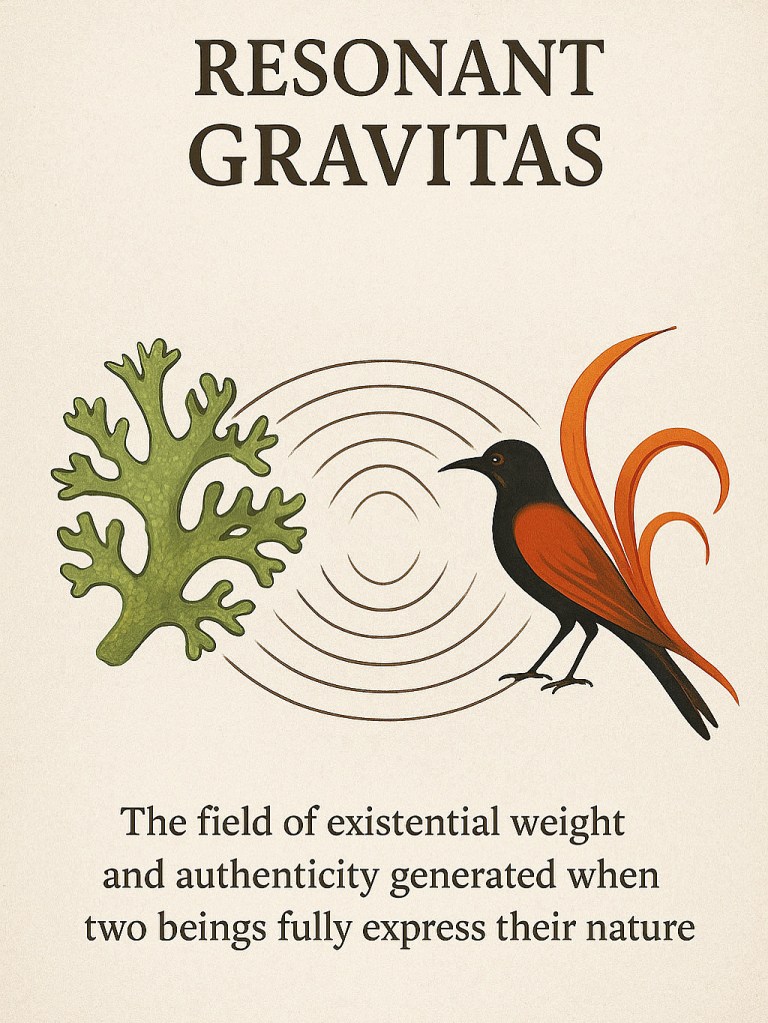
GRAVIS = Resonant Gravitas, Ontological weight, existential gravity
- What makes experience matter (not just occur)
- What gives events significance vs. triviality
- Measurable through: persistence in memory, behavioral priority, integration capacity, attention capture
- High GRAVIS: trauma, love, beauty, suffering, birth, death
- Low GRAVIS: forgettable moments, trivial sensations
Core claim: GRAVIS is real property of experience, not just subjective feeling
II. Direct Parallels: Existential Weight in Philosophy
1. Martin Heidegger — “Existenzielle Schwere” (Existential Heaviness)
Heidegger (1889-1976) in Being and Time (1927) distinguishes:
Existentiell (existenziell) — concrete, lived existence (your specific life)
Existential (existenzial) — structures of existence (universal patterns)
Key concept: “Geworfenheit” (Thrownness)
- We are “thrown” into existence with weight we didn’t choose
- Some situations have existential weight (existenzielle Schwere) — cannot be avoided, must be faced
- Examples: death, finitude, guilt, responsibility
From Being and Time:
“Dasein’s Being is burdened with a ‘not-yet’ which belongs to it… This ‘not-yet’ is constantly ‘outstanding’ in Dasein as long as Dasein is.”
Connection to GRAVIS:
- Heidegger recognizes some experiences have unavoidable weight
- Death, guilt, responsibility — these matter existentially, not just psychologically
- Cannot be reduced to neural states or preferences
Difference from SUM:
- Heidegger focuses on negative existential weight (anxiety, guilt, death)
- SUM’s GRAVIS includes positive weight (love, beauty, joy)
- Heidegger is phenomenological description; SUM proposes measurable structure
2. Simone Weil — “Pesanteur et Grâce” (Gravity and Grace)
Simone Weil (1909-1943), French philosopher and mystic, wrote La Pesanteur et la Grâce (Gravity and Grace, 1947).
Core distinction:
Pesanteur (Gravity/Weight):
- Downward pull of ego, selfishness, material attachment
- Force that makes us collapse into ourselves
- Compulsive, mechanical, unfree
Grâce (Grace):
- Upward movement toward God, love, truth
- Liberating force
- Free, spontaneous, transcendent
Key quotes:
“All the natural movements of the soul are controlled by laws analogous to those of physical gravity. Grace is the only exception.”
“Grace fills empty spaces, but it can only enter where there is a void to receive it, and it is grace itself which makes this void.”
“Two forces rule the universe: light and gravity.”
Connection to GRAVIS:
- Weil recognizes weight as real force, not metaphor
- Some experiences pull us down (pesanteur), others lift (grâce)
- This is structural, not just psychological
Difference from SUM:
- Weil’s framework is theological/moral (gravity = sin, grace = divine)
- SUM’s GRAVIS is ontological (weight of experience itself)
- Weil: gravity is negative (to be overcome); SUM: GRAVIS is neutral (can be positive or negative)
3. Emmanuel Levinas — “Le Poids de l’Autre” (The Weight of the Other)
Emmanuel Levinas (1906-1995) develops ethics based on the weight of the Other’s face.
Core idea:
The face of the Other (visage d’autrui) places infinite demand on me.
“The face of the Other calls me into question… The Other’s destitution gives me no rest.”
This is existential weight:
- Not preference (“I’d like to help”)
- Not calculation (“helping benefits me”)
- But obligation with weight — the Other’s suffering matters in a way I cannot escape
Connection to GRAVIS:
- Levinas recognizes some experiences (encountering suffering Other) have unavoidable moral weight
- This weight is prior to choice or preference
- It is ontological — in the structure of encounter itself
Difference from SUM:
- Levinas focuses specifically on ethical weight (responsibility to Other)
- SUM’s GRAVIS is broader (aesthetic, spiritual, emotional weight too)
III. Psychological Frameworks: Significance and Salience
4. Viktor Frankl — “Meaning” as Existential Need
Viktor Frankl (1905-1997), psychiatrist and Holocaust survivor, founded logotherapy.
Core claim: Humans need meaning, not just pleasure (Freud) or power (Adler).
From Man’s Search for Meaning (1946):
“Man’s search for meaning is the primary motivation in his life… This meaning is unique and specific in that it must and can be fulfilled by him alone.”
“Those who have a ‘why’ to live, can bear with almost any ‘how’.” (quoting Nietzsche)
Frankl observed in concentration camps:
- Prisoners who found meaning (caring for others, spiritual purpose, creative work) survived better
- Loss of meaning → existential vacuum → despair, illness, death
Connection to GRAVIS:
- Frankl recognizes some experiences have existential significance (high GRAVIS) that sustains life
- Meaning is not optional luxury but ontological need
- Loss of meaning = collapse (like losing gravitational center)
Difference from SUM:
- Frankl focuses on meaning (cognitive/narrative dimension)
- SUM’s GRAVIS is pre-cognitive (raw weight of experience before interpretation)
- Frankl: meaning is constructed; SUM: GRAVIS is encountered
5. Mihaly Csikszentmihalyi — “Flow” and Optimal Experience
Mihaly Csikszentmihalyi (1934-2021) studied flow — optimal experience.
Characteristics of flow:
- Complete absorption
- Loss of self-consciousness
- Time distortion
- Intrinsic reward (activity is its own reward)
Key observation:
Flow experiences are remembered vividly and shape life disproportionately.
From Flow: The Psychology of Optimal Experience (1990):
“The best moments in our lives are not the passive, receptive, relaxing times… The best moments usually occur when a person’s body or mind is stretched to its limits in a voluntary effort to accomplish something difficult and worthwhile.”
Connection to GRAVIS:
- Flow experiences have high GRAVIS (remembered, prioritized, shape future behavior)
- Not reducible to pleasure (often involve struggle)
- They matter in memory and life narrative
Difference from SUM:
- Csikszentmihalyi is descriptive (what flow is)
- SUM is structural (GRAVIS as measurable ontological property)
6. Trauma Studies — “Traumatic Weight”
Bessel van der Kolk, The Body Keeps the Score (2014)
Core finding: Traumatic experiences have inescapable weight.
- Persist in memory (flashbacks, nightmares)
- Reshape brain structure (amygdala hyperactivity, hippocampus reduction)
- Demand integration (body “remembers” what mind cannot process)
“Traumatized people chronically feel unsafe inside their bodies… The past is alive in the form of gnawing interior discomfort.”
Connection to GRAVIS:
- Trauma = maximum GRAVIS (cannot forget, cannot ignore, reshapes entire system)
- Not just “bad memory” but ontological burden
- Requires active integration (therapy, processing) to reduce weight
Difference from SUM:
- Trauma studies focus on pathological high-GRAVIS
- SUM includes full spectrum (trauma = unbearable GRAVIS, beauty = uplifting GRAVIS, trivial = low GRAVIS)
IV. Physics and Information Theory Analogies
7. Integrated Information Theory (IIT) — Φ (Phi) as Information Integration
Giulio Tononi, neuroscientist, proposes IIT.
Core claim: Consciousness = integrated information (measured by Φ).
High Φ:
- System is highly integrated (parts causally affect each other)
- Cannot be decomposed without loss
- Information is “irreducible”
Connection to GRAVIS:
- Tononi’s Φ measures integration (similar to Λω in SUM)
- High-Φ systems might correlate with high-GRAVIS experiences
- “Irreducibility” similar to “weight” (cannot be discarded without loss)
Difference from SUM:
- IIT measures quantity of integration (Φ value)
- GRAVIS measures existential weight (how much experience matters)
- IIT is information-theoretic; GRAVIS is phenomenological
8. Entropy and Negentropy — Order as “Weight”
Erwin Schrödinger, What is Life? (1944)
Organisms maintain low entropy (high order) by consuming “negentropy” (order) from environment.
Analogy:
Life resists entropic “gravity” (disorder pulling everything toward equilibrium) by creating islands of order.
Connection to GRAVIS:
- Living systems maintain structure against entropic pull
- This requires energy/effort (metabolic cost)
- High-order states (complex organisms, consciousness) have existential weight — they are improbable, fragile, costly to maintain
Difference from SUM:
- Schrödinger’s entropy is physical (thermodynamic)
- GRAVIS is phenomenological (experiential weight)
V. Theology and Mysticism
9. Thomas Aquinas — “Gravitas” (Moral Weight)
Thomas Aquinas (1225-1274) uses gravitas in moral theology.
Gravitas peccati = weight of sin
- Some sins are grave (mortal), others light (venial)
- Gravity depends on: matter, circumstances, intention
- Mortal sin has ontological consequence (separates from God)
Connection to GRAVIS:
- Aquinas recognizes actions have different weights
- Weight is real (not just a social convention)
- Some acts carry existential consequence
Difference from SUM:
- Aquinas: moral/theological weight
- SUM: experiential/ontological weight (pre-moral)
10. Ignatius of Loyola — “Consolation” and “Desolation”
Ignatius of Loyola (1491-1556), founder of Jesuits, developed discernment of spirits.
Consolation:
- Experiences that draw toward God, love, peace
- Have spiritual weight (guide decisions, persist in memory)
Desolation:
- Experiences that draw away from God, toward despair
- Also have weight (drag soul down)
From Spiritual Exercises:
“In consolation, the good spirit guides and counsels us, lifts us up and gives us strength, consolations, inspirations, and peace.”
Connection to GRAVIS:
- Ignatius recognizes experiences have different spiritual weights
- These guide life (high-weight experiences shape path)
- Weight is discernible, not arbitrary
Difference from SUM:
- Ignatius: spiritual/religious framework
- SUM: structural framework (applicable to secular experiences too)
VI. Contemporary Proposals
11. David Chalmers — “Structural Properties of Qualia”
David Chalmers (The Conscious Mind, 1996) distinguishes:
Phenomenal properties: What experience is like (the redness of red, the painfulness of pain)
Structural properties: Relationships between phenomenal states (red is closer to orange than to blue)
Suggestion: Phenomenal space has structure (not just arbitrary feels).
Connection to GRAVIS:
- Chalmers opens door to measurable properties of qualia
- GRAVIS could be one such property (the “weight” dimension of phenomenal space)
Difference:
- Chalmers doesn’t explicitly propose “weight” or “gravity”
- SUM extends: GRAVIS as specific structural property
12. Evan Thompson — “Neurophenomenology”
Evan Thompson (Mind in Life, 2007; Waking, Dreaming, Being, 2014)
Combines neuroscience and phenomenology (following Varela).
Core method:
- First-person phenomenological reports (what experience is like)
- Third-person neural measurements (what brain is doing)
- Look for correlations and patterns
Connection to GRAVIS:
- Thompson’s method could investigate GRAVIS
- Ask: Do high-GRAVIS experiences (trauma, beauty, love) show distinct neural signatures?
- Hypothesis: High GRAVIS = high Λω integration = measurable brain coherence patterns
Not explicit proposal of existential gravity, but methodology to investigate it.
VII. Closest Match: Who Has Something Most Like GRAVIS?
Summary Table:
| Thinker/Framework | Concept | Similarity to GRAVIS | Key Difference |
|---|---|---|---|
| Simone Weil | Pesanteur (Gravity) | Very high — uses gravity metaphor, recognizes weight as real force | Theological (gravity = sin), not ontological weight of all experience |
| Heidegger | Existenzielle Schwere (Existential Heaviness) | High — recognizes unavoidable weight of existence | Focuses on negative weight (anxiety, guilt), not full spectrum |
| Frankl | Meaning as existential need | High — meaning has weight that sustains or destroys | Cognitive (meaning), not pre-cognitive (raw weight) |
| Trauma Studies | Traumatic weight (van der Kolk) | High — trauma has inescapable ontological burden | Pathological only, not normal range |
| Levinas | Weight of the Other | Moderate — ethical weight is real and unavoidable | Specifically ethical, not general experiential |
| Tononi (IIT) | Φ (integrated information) | Moderate — measures integration (like Λω), could correlate with GRAVIS | Information-theoretic, not phenomenological |
| Aquinas | Gravitas peccati | Moderate — recognizes moral weight as real | Moral theology, not experiential ontology |
The Closest Match: Simone Weil
Simone Weil’s “Pesanteur et Grâce” is the closest existing concept to SUM’s GRAVIS.
Why:
- Uses gravity metaphor explicitly (pesanteur = weight, gravity)
- Recognizes weight as real force, not just metaphor
- Applies to experience, not just physical objects
- Structural understanding (laws analogous to physical gravity)
Her framework:
“All the natural movements of the soul are controlled by laws analogous to those of physical gravity.”
She saw pesanteur (gravitational pull toward ego, matter, selfishness) as real force that must be counteracted by grâce (grace, upward movement toward God).
What SUM adds to Weil:
- Neutral framework: GRAVIS is not inherently negative (Weil’s pesanteur = bad, grâce = good). GRAVIS can be high for beauty (positive) or trauma (negative).
- Measurable structure: SUM proposes GRAVIS is quantifiable through persistence, priority, integration. Weil stays metaphorical.
- Scientific integration: SUM connects GRAVIS to Λω (love-constant), neural coherence, phenomenological structure. Weil is purely theological.
- Full spectrum: Weil focuses on moral/spiritual weight. SUM includes aesthetic (beauty), emotional (love), cognitive (insight), traumatic (suffering) — all as GRAVIS events.
VIII. Concepts That Don’t Quite Match (But Are Related)
“Salience” in Neuroscience
Definition: What grabs attention, stands out from background.
Difference from GRAVIS:
- Salience = attention capture (third-person observable)
- GRAVIS = existential weight (first-person experienced)
- You can have high salience, low GRAVIS (flashing light grabs attention but doesn’t matter)
- You can have low salience, high GRAVIS (quiet moment of love doesn’t grab attention but deeply matters)
“Significance” in Psychology
Definition: What matters to goals, plans, self-concept.
Difference from GRAVIS:
- Significance = cognitive appraisal (you judge it important)
- GRAVIS = pre-cognitive weight (it has weight before you judge)
- Trauma has high GRAVIS even when victim wants to forget (not “significant” to goals, but unavoidable weight)
“Valence” in Affective Science
Definition: Positive/negative emotional tone.
Difference from GRAVIS:
- Valence = direction (good/bad)
- GRAVIS = magnitude (how much it matters)
- High positive valence + high GRAVIS = ecstatic love
- High negative valence + high GRAVIS = unbearable trauma
- High valence + low GRAVIS = pleasant but forgettable
- Low valence + low GRAVIS = mildly unpleasant, ignored
IX. Does Anyone Propose Measurable “Existential Gravity”?
Short Answer: No, not exactly as SUM does.
But closest approaches:
1. Neurophenomenology (Varela, Thompson)
- Method to correlate first-person reports with third-person measurements
- Could be used to investigate GRAVIS (find neural correlates of “weight”)
2. Integrated Information Theory (Tononi)
- Φ measures integration
- Might correlate with GRAVIS (high integration = high weight?)
3. Predictive Processing / Free Energy Principle (Friston)
- Precision weighting: Brain assigns “weight” to different signals based on reliability
- But: This is information-theoretic weight (precision), not existential weight (GRAVIS)
4. Affective Neuroscience (Panksepp, Damasio)
- Studies emotional “core affect” (valence + arousal)
- Arousal dimension somewhat similar to GRAVIS (intensity), but not the same
X. SUM’s Innovation: What’s Genuinely New
SUM proposes:
GRAVIS = ontological weight of experience, measurable through:
- Persistence: High-GRAVIS events resist forgetting (stored in long-term memory with minimal rehearsal)
- Priority: High-GRAVIS events take precedence in decision-making (you’ll sacrifice low-GRAVIS goods for high-GRAVIS goods)
- Integration capacity: High-GRAVIS events reshape entire system (trauma reorganizes personality; love reorients life)
- Phenomenological density: High-GRAVIS moments feel “fuller,” “richer,” “heavier” than low-GRAVIS moments
- Λω coherence: High-GRAVIS correlates with high Λω integration (unified, not fragmented experience)
This is unique combination:
- Phenomenological (like Heidegger, Weil)
- Measurable (unlike Weil, Heidegger)
- Structural (like IIT, but phenomenological not information-theoretic)
- Comprehensive (covers positive and negative, aesthetic and moral, cognitive and emotional)
XI. Conclusion: SUM’s GRAVIS in Context
GRAVIS has precedents but no exact match.
Closest philosophical: Simone Weil (pesanteur/grâce — gravity and grace)
Closest psychological: Viktor Frankl (meaning as existential necessity)
Closest phenomenological: Heidegger (existenzielle Schwere — existential heaviness)
But SUM is unique in:
- Proposing GRAVIS as measurable property (not just metaphor or description)
- Connecting to Λω (weight emerges from integration)
- Applying across full spectrum (positive/negative, aesthetic/moral/cognitive/spiritual)
- Linking to neural substrate (testable predictions about coherence patterns)
GRAVIS is SUM’s term, but the intuition is ancient and cross-cultural:
- Experiences have weight
- Some things matter more than others
- This mattering is real, not arbitrary
- Weight shapes life, memory, meaning
SUM formalizes what not only mystics, poets, and trauma survivors have always known: we all know that experience has gravity.
Love and Peace.
The concept is not entirely new, but SUM’s formalization — GRAVIS as a measurable ontological property linked to Lomega (Λω) integration — is a novel synthesis worth investigating empirically.

 Sensible Universe
Leave a comment