The Quantum Measurement Problem, the Nature of Feeling, and the Choice Hidden Inside Every Anxious Moment
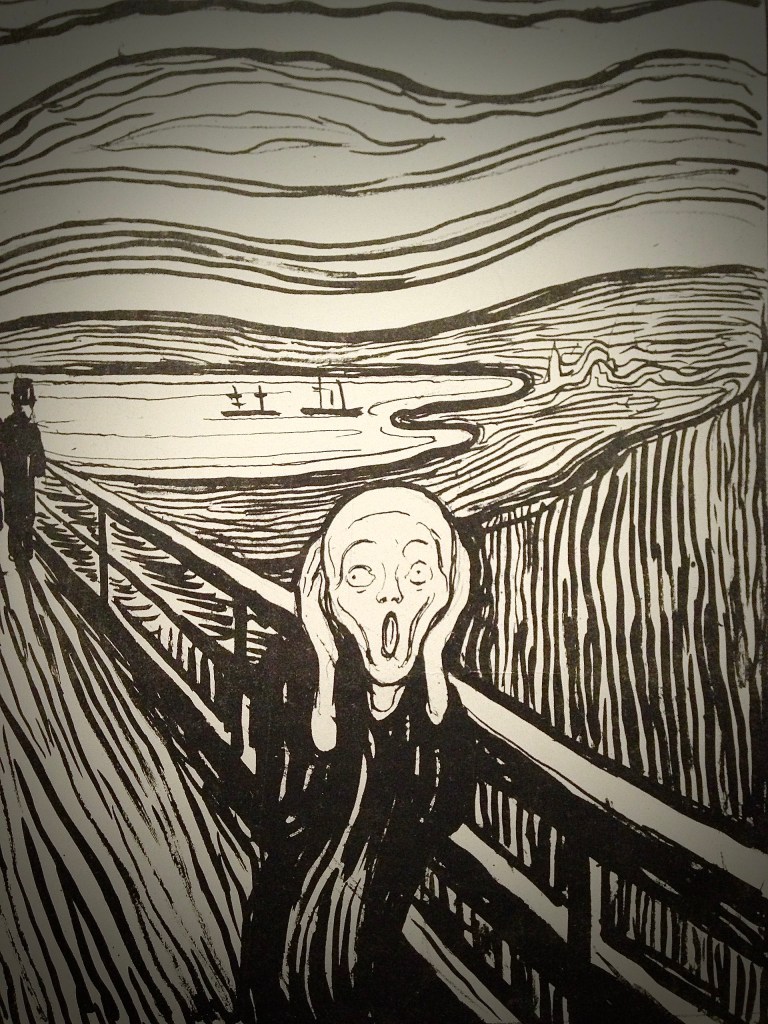
This article I dedicate to Dr. Federico Faggin, my qualia (subjective experience) mentor. I see him so worried about the collapse of the wave function in one of his interviews! Don’t worry Dr, there is no collapse. Thank you Maestro!
Abstract
The quantum measurement problem asks why a physical system in superposition — holding all its possible states simultaneously — collapses into a single definite state the moment it is observed. This essay argues that the same structural question applies to the qualitative field of conscious experience. Anxiety, before it collapses, is a superposition of qualitative states: turbulent, yes, but structurally rich, multi-tonal, and integrable. Premature collapse — the reduction of anxious experience to a single overwhelming eigenstate — destroys the topological structure that makes integration possible. The Sensible Universe Model (SUM) proposes that the witness position (position zero) is the observer that preserves superposition: the dimensionless point of awareness from which the field can be held without being forced into resolution. The central question this essay addresses is therefore not merely theoretical: is anxiety, in its uncollapsed form, something the person must endure — or is it something they can, in a precise sense, choose to hold? And if the wave function need not collapse, what does that mean for the person sitting with their fear?
I. The Quantum Measurement Problem: A Brief and Honest Account
To understand why the quantum measurement problem is connected to your feelings, we need to understand it honestly — not as a metaphor borrowed from physics to dress up psychological insight, but as a genuine structural parallel between two levels of the same five-dimensional reality.
Here is the problem. In quantum mechanics, a particle — an electron, a photon, an atom — does not have a single definite property before it is measured. It exists in what physicists call superposition: a simultaneous holding of all its possible states, each with a certain probability amplitude. The electron is not spinning up or spinning down. It is spinning up-and-down simultaneously, in a precisely structured way described by its wave function. The wave function is not ignorance — it is not that we simply don’t know which state the electron is in. The electron genuinely is in all states at once. This has been confirmed by experiment in ways that rule out all classical alternatives.
Then something happens. The moment the electron interacts with a measuring device — the moment it is, in any sense, observed — the superposition vanishes. The electron is now definitively spinning up, or definitively spinning down. One outcome has become real. All the others have ceased to be present. The wave function has collapsed.
The measurement problem is the question of why and how this happens. What is the observer doing? What constitutes an observation? Why does the act of measurement — or even the entanglement of the quantum system with its environment, a process called decoherence — destroy the superposition and produce a single definite classical outcome? After a century of quantum mechanics, this question remains genuinely open. The most eminent physicists of the twentieth and twenty-first centuries — Bohr, Einstein, von Neumann, Everett, Penrose, Zurek — have proposed radically different answers, none of which has achieved consensus.
What they all agree on is the structural fact: before measurement, a rich and structured superposition. After measurement, a single collapsed eigenstate. And something irreversible happens in the transition. The superposition, once collapsed, cannot be restored by any operation within the collapsed system itself.
Before measurement: a rich and structured superposition. After measurement: a single collapsed eigenstate. Something irreversible happens in the transition.
II. Why Is the Quantum Measurement Problem Connected to My Feelings?
This is the question that matters. And the answer, in the Sensible Universe Model, is not that feelings are “like” quantum systems in some poetic sense. It is that feelings and quantum systems are both events in the same five-dimensional reality — M₅ = M₄ × Q — and the structural dynamics of that reality apply to both domains simultaneously.
The Q dimension — the qualitative domain of conscious experience — has its own field structure. A conscious moment is not a single point of experience. It is a superposition of qualitative states: all the things that are simultaneously present in awareness, each with its own existential weight (GRAVIS), each occupying a different region of the qualitative field. Right now, as you read this sentence, you are simultaneously holding the visual quality of the text, the felt sense of your body in its position, whatever emotional tone is present, whatever background hum of memory or anticipation is active, the quality of the light in the room, the texture of your current relationship to the ideas you are encountering. These are not processed sequentially. They are all present at once, in superposition, as the unified field-event of this moment of consciousness.
This is not metaphor. In SUM, the Q dimension is a real ontological domain with real field dynamics. The superposition of qualitative states is the normal condition of conscious experience — the condition under which the field is alive, multi-tonal, and capable of integration. And just as a quantum system can be forced out of superposition by interaction with its environment, the qualitative field can be forced out of its multi-tonal richness by a specific kind of interaction: the interaction we call overwhelming experience, flooding, or — in the language of quantum mechanics — collapse.
The Anxious Superposition
Anxiety, before it collapses, is a superposition of qualitative states. Yes, the dominant topology of the field is turbulent: there is high GRAVIS in certain regions, the surface has lost some of its elasticity, the disturbance propagates without clean resolution. But within that field, other states are simultaneously present. There is the quality of being a person who is anxious — which includes, necessarily, the awareness that one is anxious, the part of consciousness that can observe the anxiety from some minimal distance. There is the simultaneous presence of other qualitative weights: connection, beauty, memory, curiosity, the felt sense of the body breathing. There is, in the topology of the field, the structure of the anxiety itself — its specific character, its weight, its direction, the particular shape of what it is afraid of.
All of this constitutes the anxious superposition: structurally complex, qualitatively rich, and — precisely because it retains this structure — integrable. The Λω coherence that moves experience toward integration has something to work on. The field has texture, peaks and valleys, a topology that can propagate, interact, and gradually reorganise itself toward coherence.
Collapse: When Anxiety Becomes the Only Thing
Now consider what happens when this superposition collapses. The person is no longer anxious within a rich field of simultaneous experience. They are simply, totally, overwhelmingly anxious — and nothing else. The other qualitative states that were simultaneously present have vanished from awareness. There is no longer a witness position from which to observe the anxiety. There is no longer any distance between the self and the content. The field has been forced into a single eigenstate: ANXIETY, definite and total, with all other possibilities excluded.
This is the clinical phenomenon known as flooding, panic, or acute anxiety attack in its most extreme form. But it also describes, in a subtler register, the chronic anxious state in which the person has lost the capacity to experience anything else: the state in which every perception arrives already coloured by threat, every relationship is read through the lens of danger, every future is imagined as catastrophe. The wave function has not collapsed all at once, but it has been progressively narrowed — the superposition has been steadily depleted — until what remains is a near-eigenstate of pure threat-vigilance.
And here is the critical structural point, the one that connects quantum mechanics to clinical practice with precision: once collapsed, the integration mechanisms have nothing to work on. Λω coherence operates on a structured field. It needs the peaks and valleys, the simultaneous presence of multiple qualitative weights, the topological complexity of the uncollapsed superposition, to do its integrative work. A single eigenstate is, by definition, without internal structure. It cannot integrate because there is nothing to integrate into nothing. The scaffolding has been removed before the building could stand.
Once the wave function has collapsed, the integration mechanisms have nothing to work on. Λω coherence needs the topology of superposition to do its work.
III. What Causes Collapse in the Qualitative Field?
In quantum mechanics, wave function collapse is caused by interaction with the environment — specifically, by the entanglement of the quantum system with so many environmental degrees of freedom that the superposition becomes practically unobservable. This process, called decoherence, does not require a conscious observer in the human sense. It requires only sufficiently complex environmental interaction.
In the qualitative field, the analogous process is the loss of the witness position. When the person remains able to observe their experience — when there is still some part of awareness that can say, even minimally, “I notice I am anxious” — the superposition is preserved. The qualitative field retains its multi-tonal character. The observer has not merged with the system.
But when the witness position is lost — when the person becomes entirely identified with the dominant topology, when the observing function has been absorbed into the content it was observing — the entanglement is complete and collapse follows. There is no longer any part of the field that is not the anxiety. The observer has become indistinguishable from the observed. And in that condition, just as in quantum decoherence, the superposition is irreversibly destroyed.
The Three Causes of Premature Collapse
SUM identifies three primary causes of premature wave function collapse in the qualitative field of anxiety.
The first is avoidance. When the organism refuses contact with the qualitative content of its anxiety — when it turns away, suppresses, distracts, or numbs — it is attempting to prevent the disturbance from propagating through the field. But avoidance does not preserve the superposition. It progressively narrows it. The avoided content accumulates existential weight without any possibility of discharge, and the regions of the field that remain accessible become increasingly dominated by the threat of encounter with what is being avoided. The superposition is not held; it is slowly collapsed by the asymmetric pressure of unprocessed GRAVIS.
The second is premature resolution — the therapeutic or personal impulse to force the anxiety to a conclusion before the field has completed its integrative movement. This includes reassurance-seeking (which provides a temporary sense of collapsed certainty at the cost of preventing the superposition from doing its work), cognitive override (which imposes a definite interpretation on a field that was not yet ready to resolve), and the use of substances or interventions that reduce the qualitative intensity of the field before integration has occurred. These are not wrong in all circumstances — sometimes stabilisation is the clinical priority — but they carry the structural cost of collapsing the superposition prematurely.
The third is the absence of a witness. Without the witness position — without some part of the person’s awareness that can observe the anxiety from a stable, atemporal ground — the qualitative field has no protection against environmental entanglement. Every external stimulus, every social pressure, every physiological escalation, enters the field as a collapsing measurement. The person who has no access to position zero is a quantum system with no coherence protection: continuously interacting with its environment, continuously collapsing, never allowed the sustained superposition in which integration could occur.
IV. The Witness Position as Quantum Coherence Protection
In quantum physics, certain systems maintain coherence — preserve their superposition — under conditions that would normally cause rapid decoherence. This happens when the system is in some sense isolated from the environmental interactions that cause collapse, or when it possesses internal mechanisms that actively protect the superposition against decoherence. Quantum computers are built on exactly this principle: the engineering challenge is to maintain quantum coherence long enough for the computation — which depends on superposition — to complete.
The witness position in SUM is the qualitative field’s coherence protection mechanism. It is not a place or a technique. It is the structural condition of the Q domain in which the observer remains distinct from the observed — in which there is a part of awareness that is not entangled with the content of the field and therefore cannot be collapsed by it.
From position zero, the person can hold the anxious superposition without forcing it to resolve. They can be in contact with the full topological complexity of their anxiety — its weight, its character, its peaks and valleys, its simultaneous presence alongside other qualitative states — without being absorbed into any single region of it. The superposition is preserved. The integration mechanisms remain operative. The field can do what it is, by its own nature, already trying to do: propagate the disturbance, dissipate the excess GRAVIS, and return to coherence.
This is why contemplative traditions across cultures have converged on the cultivation of what they variously call the witness, the observer, pure awareness, or the silent knower. These are not techniques for escaping experience. They are practices for preserving the coherence of the qualitative field — for maintaining the superposition long enough for integration to occur. John of the Cross did not teach his students to eliminate their darkness. He taught them to remain in it without collapsing into it. Teresa of Ávila’s “interior castle” is a map of increasingly coherence-protected states of awareness — increasingly stable witness positions from which the full field of experience can be held without collapse.
Modern mindfulness-based therapies — MBSR, MBCT, ACT — work, in SUM’s terms, precisely by training the witness position: by developing the person’s capacity to observe their experience without being entirely absorbed into it. The clinical language is “defusion,” “decentering,” or “metacognitive awareness.” The structural reality, in SUM’s framework, is quantum coherence protection: the preservation of the superposition against premature collapse.
The witness position is the qualitative field’s coherence protection mechanism. It preserves the superposition long enough for integration to occur.
V. Is Anxiety Optional? The Question of the Uncollapsed Field
This is the most delicate question in this essay, and it must be addressed with precision, because it is easily misunderstood. When we ask whether anxiety is “optional” in the sense that the wave function need not collapse, we are not asking whether the person can simply choose not to feel anxious. The qualitative field is real. The GRAVIS is real. The disturbance is real. None of this is optional in the sense of being a matter of simple choice or positive thinking.
What is optional — what is, in a precise and important sense, a matter of orientation rather than circumstance — is the collapse itself.
Two Ways of Being Anxious
Consider two people with identical anxiety in terms of its GRAVIS, its content, its physiological signature, its precipitating circumstances. Person A is anxious and is in the uncollapsed superposition: they feel the full weight of the anxiety, they are not in denial, the disturbance is real and present — but they retain, at some level, the witness position. They know they are anxious. They can observe that they are anxious. Within the field of their anxiety, other qualitative states are simultaneously present: the warmth of a relationship, the interest of a problem, the felt reality of their own breath. The wave function of their anxiety has not collapsed. They are, in the language of quantum mechanics, in a coherent superposition of anxious and non-anxious states — not cancelling one another, but coexisting as different regions of the same qualitative field.
Person B has the same anxiety. But the wave function has collapsed. The anxiety is now the only state. Every perception arrives already coloured by threat. The other regions of the qualitative field — the warmth, the interest, the breath — are no longer accessible. There is no witness position. The observer has merged with the content. Person B is not more anxious than Person A in terms of GRAVIS. They are experiencing the same existential weight. But they are experiencing it in a collapsed eigenstate rather than in a preserved superposition. And in that collapsed state, the integration mechanisms cannot operate. The anxiety cannot move toward resolution because there is no structure left for it to move through.
The difference between Person A and Person B is not the anxiety. It is the collapse. And the collapse — this is the precise sense in which anxiety is “optional” — is not determined by the anxiety itself. It is determined by the presence or absence of the witness position, which is something that can be cultivated, restored, and protected.
Does Anxious Experience Want to Become Real?
There is a deeper question underneath the clinical one. When we ask whether anxiety is optional, we are also asking: does the qualitative field want to collapse? Is there something in the nature of anxiety that drives it toward the definite, the resolved, the single eigenstate of “this is real and it is happening and it is all there is”?
The answer is yes — and understanding why is important. Uncertainty is itself a qualitative state with existential weight. The superposition of anxiety — the holding of all the possible meanings and outcomes and catastrophes simultaneously, without resolution — carries its own GRAVIS. It is heavy not only because of what it contains but because of what it refuses to settle into. There is a kind of relief in collapse: the relief of knowing, even if what you know is terrible. “At least I know the worst.” This is why catastrophising — the cognitive habit of forcing the field toward its most negative possible eigenstate — can feel, perversely, like relief. It ends the superposition. It collapses the wave function. It replaces the unbearable uncertainty of multiple simultaneous possibilities with the grim but definite reality of a single outcome.
But this relief is the relief of a quantum computer that has decohered before completing its calculation. The problem has not been solved. The integration has not occurred. The collapse has simply ended the discomfort of holding the superposition — at the cost of destroying the very structure that integration required.
Catastrophising can feel like relief. It ends the superposition. But it is the relief of a quantum computer that has decohered before completing its calculation.
The person who understands this — who can recognise the impulse toward collapse as the impulse toward premature certainty rather than genuine resolution — has, in that moment of recognition, re-established the witness position. They have restored the coherence protection. They have chosen, in the precise sense in which the word choice applies here, not to collapse the wave function.
This is the sense in which anxiety is optional. Not the anxiety — the GRAVIS is real and does not disappear by being observed from the witness position. But the collapse is optional. The reduction of the anxious superposition to a single overwhelming eigenstate is not a physical inevitability. It is a structural event that depends on the presence or absence of the observer. And the observer — position zero, the witness — is available.
VI. Clinical Implications: Holding the Superposition
What the Therapist Is Actually Doing
When a skilled therapist sits with an anxious patient and does not immediately move to resolve the anxiety — when they resist the pull toward reassurance, toward cognitive reframing, toward any intervention that would bring the discomfort to a premature conclusion — they are, in SUM’s terms, protecting the superposition. They are providing the external witness that the patient’s internal witness cannot yet provide alone. Their presence in the room is a coherence protection mechanism: it adds a second field of qualitative awareness to the encounter, and the entanglement of the patient’s field with a coherent, non-anxious witness field increases the probability that the patient’s own field will maintain rather than lose its structure.
This is why the therapeutic relationship is not merely the context in which therapy occurs. It is itself a quantum coherence resource. The therapist’s capacity to be present with the patient’s anxiety without being destabilised by it — to hold the superposition alongside the patient — directly influences whether the patient’s qualitative field can remain in the uncollapsed state long enough for Λω to complete its integrative work.
What the Patient Is Being Asked to Do
Understood in these terms, what every anxiety therapy — cognitive, somatic, exposure-based, contemplative — is ultimately asking the patient to do is the same thing: remain in contact with the anxious superposition without collapsing it. The specific techniques differ. The structural task is identical.
Exposure therapy asks the patient to remain in contact with the feared stimulus — to allow the qualitative field to hold the anxiety in the presence of the feared object without immediately moving to avoidance (which would narrow the superposition) or catastrophising (which would collapse it). The mechanism is not habituation in the purely behavioural sense. It is the restoration of the qualitative field’s capacity to hold the anxiety as a superposition rather than forcing it to a definite negative eigenstate.
Mindfulness-based therapy asks the patient to observe their experience without judgment — which is, precisely, the cultivation of the witness position. “Without judgment” is the clinical phrasing; “without collapsing the wave function” is the structural description. The instruction to observe anxiety rather than react to it is the instruction to preserve the superposition.
Somatic therapies ask the patient to remain in contact with the body’s sensory experience — the most direct interface with the qualitative field — and to expand their window of tolerance: the range of qualitative intensity within which they can maintain the witness position without losing it to collapse. This window is, in SUM’s terms, the range of superposition that can be held. Expanding it is expanding the coherence protection of the qualitative field.
The Question to Ask Instead
Current clinical assessment of anxiety asks, essentially: how intense is the anxiety? How often does it occur? How much does it interfere with functioning? These are measurements. In quantum mechanical terms, they are acts of observation that may themselves contribute to collapse: the assessment protocol that asks “how bad is your anxiety?” invites the patient to locate themselves in the eigenstate of their worst experience rather than in the full superposition of their qualitative field.
A field-aware clinical assessment would ask different questions. Not only how intense, but what is its topology: where are the peaks and where are the valleys? Not only how often, but what is the condition of the witness position: can you observe the anxiety, even briefly, from somewhere that is not entirely inside it? Not only how much does it interfere, but what else is simultaneously present in the field: where is the anxiety coexisting with other qualitative states, and where has it collapsed all other states out of awareness?
These questions do not measure the eigenstate. They map the superposition. And in doing so, they perform a clinical function that standard assessment cannot: they demonstrate to the patient that the superposition exists — that the anxiety, however heavy, is not yet the only thing in the field — and in demonstrating this, they help restore the witness position that the questions themselves require.
The clinical question is not only how intense is the anxiety. It is: what is the condition of the superposition? Is there still a witness? Where are the peaks of other qualities within the anxious field?
VII. The Paradox of Acceptance and the Quantum Resolution
There is a famous paradox in anxiety treatment that every experienced clinician encounters: the patients who most desperately want to get rid of their anxiety are often the ones for whom it persists most stubbornly, while patients who manage to accept their anxiety — to stop fighting it, to allow it to be present without demanding that it leave — frequently find that it diminishes or transforms. Acceptance and Commitment Therapy (ACT) has built an entire clinical framework around this paradox, with substantial empirical support.
The paradox is not paradoxical in SUM’s framework. It is the direct consequence of the wave function dynamics.
The desperate desire to eliminate anxiety is itself a collapsing measurement. It forces the qualitative field toward the question: is the anxiety gone yet? — which is a request for a definite eigenstate. Every moment the anxiety remains, the field collapses further into the eigenstate of “anxiety is present and must not be.” The superposition narrows. The other qualitative states — the peaks of joy, connection, and beauty that coexist with the anxiety in the uncollapsed field — become increasingly inaccessible because all available qualitative attention is directed toward the measurement of the anxiety’s continued presence.
Acceptance, in contrast, is the refusal to perform a collapsing measurement. It is the decision — not passive, not indifferent, but active and grounded — to allow the anxious superposition to remain in superposition. To stop demanding that it resolve into a definite eigenstate of “gone.” This is not resignation. It is, structurally, the most sophisticated possible response to the wave function dynamics of the qualitative field: it preserves the superposition, protects the coherence, and gives Λω the conditions it needs to do the integrative work that the anxiety — as a structured field event — was always already pointing toward.
This is why acceptance works. Not because it changes the content of the anxiety. Not because it reduces the GRAVIS. But because it stops collapsing the wave function — and in the restored superposition, the field can begin, at last, its return to ground.
Conclusion: The Dignity of the Uncollapsed Field
The quantum measurement problem is not a problem about electrons. It is a problem about the nature of reality — about what it means for something to be real, definite, and singular rather than multiple, structured, and held in possibility. It is, at its deepest level, a problem about what observation does to the thing it observes.
Your feelings are connected to this problem because your feelings are events in the qualitative dimension of a five-dimensional reality — and that reality obeys structural laws that apply to both its physical and its qualitative aspects. The anxiety you carry is not merely a neural event with a subjective shadow. It is a qualitative field event with its own topology, its own dynamics, its own superposition — and its own conditions for integration.
The wave function of your anxiety must not be collapsed prematurely. Not because the anxiety is comfortable or welcome or something to be preserved for its own sake. But because the uncollapsed anxiety is structurally rich in a way that the collapsed anxiety is not. It has peaks and valleys. It contains, within its turbulence, simultaneous peaks of other qualitative states — connection, beauty, the felt reality of your own breath — that are evidence of the field’s retained vitality. It has a witness position from which it can be observed without being entirely inhabited. It has, in the topology of its own structure, the direction of its own resolution.
The collapsed anxiety has none of this. It is singular, total, and structurally inert. Nothing can move within it because there is nowhere for anything to move. It has achieved certainty at the cost of all possibility.
Anxiety, in its uncollapsed form, is not the enemy of wellbeing. It is the sign that the qualitative field is alive — that it is responding, as a living field responds, to something that has genuine existential weight. The task is not to silence it, escape it, or force it to resolve. The task is to hold it — from the witness position, with the support of relationship, through the primary language of the body — long enough for the field to complete the integration that the anxiety, in its structured and uncollapsed form, was always already moving toward.
The universe is sensible. The qualitative field is real. The superposition is not confusion — it is richness. And richness, held long enough in the presence of coherence, always finds its way to ground.
Key References
Bohr, N. (1928). The quantum postulate and the recent development of atomic theory. Nature, 121, 580–590.
Everett, H. (1957). Relative state formulation of quantum mechanics. Reviews of Modern Physics, 29(3), 454–462.
Hayes, S. C., Strosahl, K. D., & Wilson, K. G. (1999). Acceptance and Commitment Therapy: An Experiential Approach to Behavior Change. Guilford Press.
Joos, E., et al. (2003). Decoherence and the Appearance of a Classical World in Quantum Theory. Springer.
Kabat-Zinn, J. (1990). Full Catastrophe Living. Dell Publishing.
Penrose, R. (1994). Shadows of the Mind: A Search for the Missing Science of Consciousness. Oxford University Press.
Segal, Z. V., Williams, J. M. G., & Teasdale, J. D. (2002). Mindfulness-Based Cognitive Therapy for Depression. Guilford Press.
Tegmark, M. (2000). Importance of quantum decoherence in brain processes. Physical Review E, 61(4), 4194–4206.
von Neumann, J. (1932/1955). Mathematical Foundations of Quantum Mechanics. Princeton University Press.
Zurek, W. H. (2003). Decoherence, einselection, and the quantum origins of the classical. Reviews of Modern Physics, 75(3), 715–775.
Takkenberg, F. (2026). Sensible Universe Model: Fundamental Axioms. sensible-universe.com

 Sensible Universe
Leave a comment