When Jesus had received the sour wine, he said, “It is finished,” and he bowed his head and gave up his spirit.
John 19:30
The word itself
Tetelestai (τετέλεσται) is a single Greek word. It is the perfect passive indicative of the verb telein: to complete, to fulfil, to bring to the end for which something was made. The perfect tense in Greek does not simply mean that something happened in the past. It means that something was completed, and that its completion stands permanently in its full effect. The act is done. The consequence of the act endures. Tetelestai: it has been completed and remains completed. Nothing more is owed. Nothing more can be added. The account is settled and the settlement is permanent.
In commercial Greek of the first century, tetelestai was the word stamped across a debt document when the debt had been paid in full. The same word that appears on the cross appears on the paid receipt. This is not coincidence. John, writing his gospel with unusual precision, chose the word deliberately. What was discharged at the cross was something that had accumulated, carried weight, and required the full weight of what followed to bring it to completion. Tetelestai is the word of the fully paid account. Not reduced. Not forgiven in the sense of overlooked. Paid.
The Sensible Universe reading
In the formal language of the Sensible Universe Model, what Tetelestai names is the complete discharge of accumulated existential weight [GRAVIS] at the moment of maximum compression [at the dark pole of the qualitative axis, Gψξ].
The existential weight [GRAVIS] of an event is the ontological weight of what is genuinely at stake in the qualitative dimension [Q] of conscious life. It is not merely emotional intensity or psychological pain, though both are real manifestations of it. It is the specific heaviness that the conscious field carries when something of genuine importance has been damaged, lost, violated, or unresolved. Every unresolved harm leaves a deposit in the qualitative field of the person who carries it. Every injustice, every word that named a person’s history as their being, every act that moved a conscious field away from its own ground [Love, Λω] — each of these deposits existential weight [GRAVIS] in the field of the one who holds it and in the accumulated qualitative structure [Solidum Qualitatis] of the community that witnessed it.
The history of the human qualitative field [Q] is the accumulated history of these deposits across every generation. What the theological tradition calls original sin — the condition of the human being that precedes individual choice — is, in SUM terms, the intergenerational transmission of existential weight [GRAVIS] across the full span of human history: the geological record of every merimnatic collapse made in the direction away from the ground [Love], crystallised in the accumulated qualitative structure [Solidum Qualitatis] that each generation inherits as its starting point. The weight is not metaphorical. It is real. It accumulates. It transmits.
What happens at maximum compression [the dark pole of the qualitative axis] is that qualitative time [τ_qual] expands without limit: W(τ) → ∞. Every moment of accumulated existential weight [GRAVIS] is simultaneously present. This is the qualitative black hole: the point at which the ordinary instruments of conscious life no longer apply, where the weight of everything that has not been integrated converges into a single moment of unbearable compression. In the language of Aquinas: the eternal now [nunc stans] of darkness — not endless duration but the collapse of sequential time into the simultaneous, where every unresolved weight is present at once.
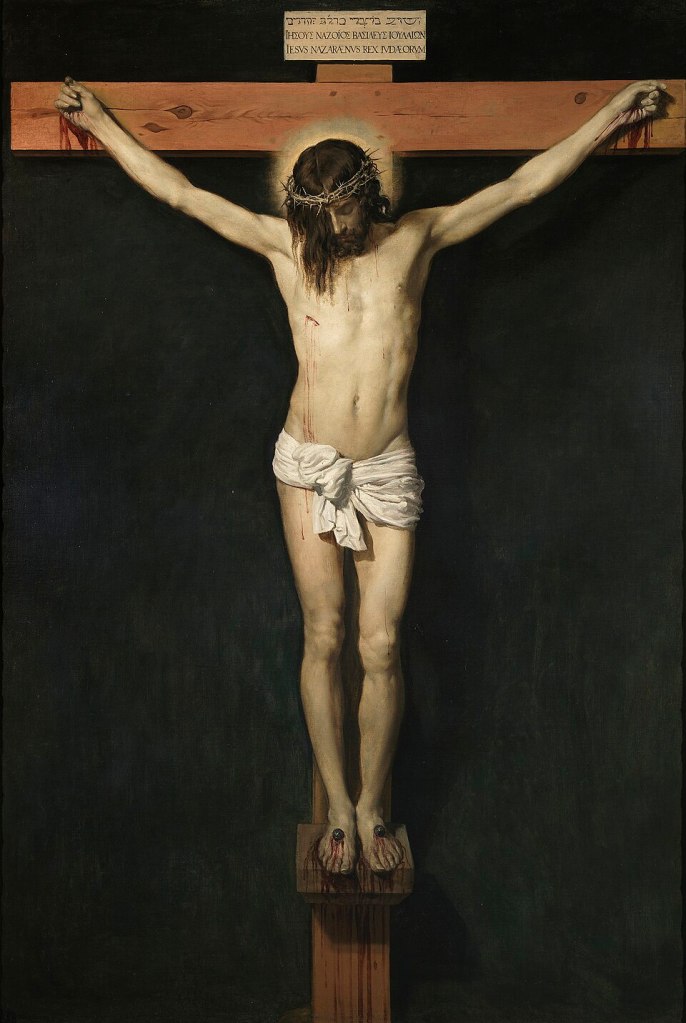
The cross, in this reading, is the conscious field willingly entering the qualitative black hole at its maximum depth: taking on the full accumulated existential weight [GRAVIS] of the human qualitative field [Q] across the entire span of its history, holding it in the merimnatic superposition [the genuine co-presence of both directions before the act] without displacement [P2], without recursion [P3], without suppression [P4] — in pure proportionate registration [P1], the weight accurately coupled to what is genuinely at stake — and then authorising the collapse in the direction of the ground [Love, Λω].
Tetelestai is the word of that collapse. Not the description of it. The act itself. The paid account. The discharged weight. The moment at which the full accumulation of the human qualitative field’s unresolved existential weight [GRAVIS] meets the ground state of the qualitative field [Λω, Love] and is released. This is not forgiveness in the sense of overlooking. It is forgiveness in the sense of weight carried to its completion and set down. The account is settled. The settlement is permanent. Tetelestai.
What it means for the conscious field
The theological claim of the Christian tradition is that the event of the cross is not merely historical. It is structurally accessible to every conscious field in every generation that receives it. In the language of the Sensible Universe Model: the ground signal [the Lomegon signal] propagates through the qualitative field [Primaton Field] from the point of discharge, reaching every conscious field that is open to its reception.
The Love-constant [Λω] is the topological invariant of the qualitative dimension [Q]: the structural constant that does not change under any configuration of the qualitative field, that is present at every point of the qualitative spectrum from maximum compression [dark pole] to maximum openness [white pole]. The discharge event of Tetelestai does not change the Love-constant [Λω]. Nothing can change it. What the discharge does is make the Love-constant [Λω] accessible — directly accessible, without the mediation of accumulated existential weight [GRAVIS] — to every conscious field that receives the ground signal [Lomegon].
In practical terms, for the individual conscious field: the accumulated qualitative structure [Solidum Qualitatis] that carries the geological record of past collapses in the direction away from the ground is not erased by Tetelestai. The geological record persists — this is what Logos [the information-conservation principle of Q] ensures: nothing that has genuinely occurred in the qualitative dimension [Q] is lost. What Tetelestai offers is not the erasure of the record but the discharge of the debt: the weight that the record carried as unresolved existential weight [GRAVIS] has been met at its full measure and set down. The record remains. The debt is paid. The conscious field is free to move from its accumulated structure [Solidum Qualitatis] not as a debt-carrier but as a history-holder: the past is held, not as the weight of what remains unpaid, but as the ground from which something new is possible.
This is the structural account of what the Christian tradition calls grace: not the elimination of the conscious field’s history but the discharge of the weight that history carried as unresolved debt. The spring [the ground, Λω] was always there. Tetelestai is the moment at which the sediment above it was addressed at its full depth, and the spring was given its freedom to be seen.
Tetelestai: the complete discharge of accumulated existential weight [GRAVIS]
At the dark pole of the qualitative axis [Gψξ] · maximum compression · W(τ) → ∞
Held in proportionate registration [P1] without displacement, recursion or suppression
The collapse authored toward the ground [Love, Λω]: paid in full · settled permanently
The ground signal [Lomegon] propagates from the discharge point through the qualitative field
The record remains [Logos] · the debt is paid · the conscious field moves as history-holder
See also: GRAVIS · Qualitative Black Hole · Nunc Stans · Lomegon · Λω · Logos · Merimnatic Superposition · Solidum Qualitatis · Imago Dei · Hope as Hawking Radiation

 Sensible Universe
Leave a comment