
Dedicated to Dr. John Polkinghorne, Dr. Federico Faggin, and my Father, Prior and Mentor, for 8 years, Padre Francisco Brändle.
Part I: The Artist’s Crucible
The Three Witnesses
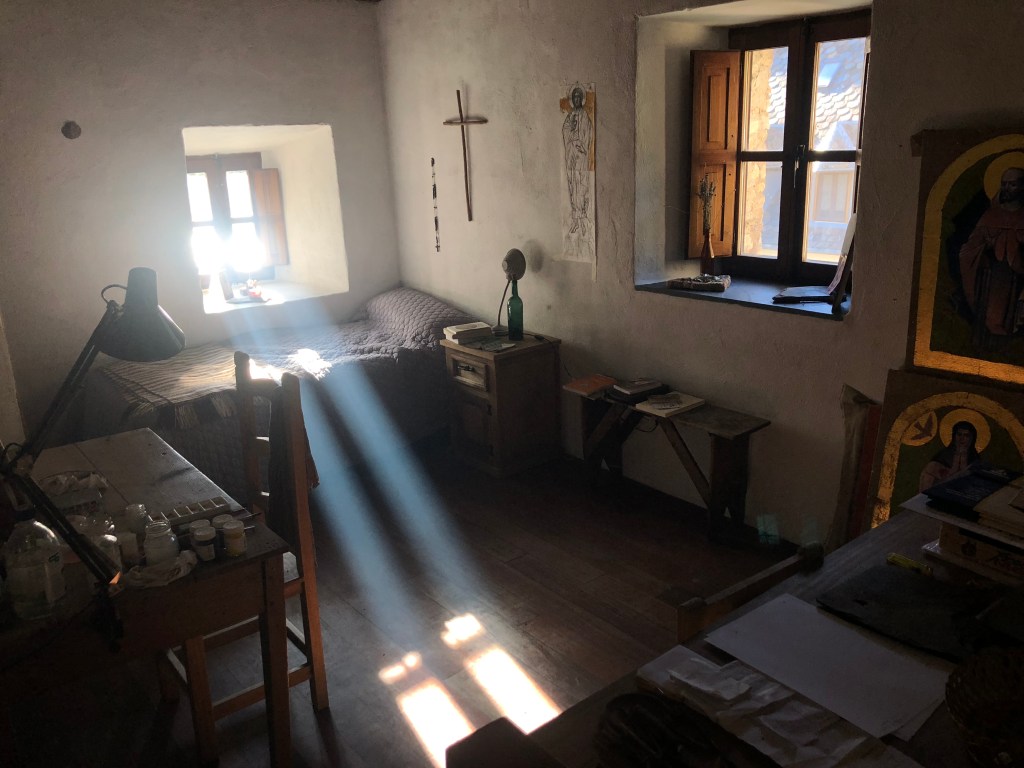
In my hermitage, where light falls through ancient stone, illuminating dust or smoke from the hearth, suspended in the air, each particle visible, each trajectory traceable, the whole dance comprehensible as motion, as relation, as presence revealing itself through what it touches.
I have spent seven years in contemplative silence in an effort to understand this light, not as physicist that calculates photons, nor as a mystic who might interpret it as divine illumination, but as an artist witness: directly, immediately, with the whole sensorium engaged in one instant.
This is where the concept for the Sensible Universe Model began: in presence through solitude. Not in theory divorced from experience but in the crucible where science, spirituality, and art converge through the act of witnessing. For what is science but humanity’s systematic witness to physical structure? What is spirituality but humanity’s sustained witness to ultimate meaning? And what is art but humanity’s immediate witness to the truth of experience itself?
The artist completes this triad. Without the witness, science becomes calculation and theology becomes doctrine. The artist, working with his body, the senses, materials, forms, reveals what neither an equation nor exegesis alone can capture: a lived truth, an embodied reality, the sensible and sensitive universe as it actually presents itself to my consciousness and my capacity for looking and seeing.
What am I witness to, and joyously why? I believe that I’m witness to a gift, not something that comes from me, my mind, but from Him. The gift received. A waking to the perspectives of suffering and how meaning derives from it.
Studying the work of Edith Stein, especially the phenomenological aspects of inner experience, strengthened my views on the fact that love must be a constant.
Saint Benedicta of the Cross´s (Edith Stein) encounter with phenomenology shaped not only her philosophy but also the structure of her interior life, prayer, and understanding of sanctity. Her spirituality inherits Husserl’s call to go “to the things themselves,” but she applies it to the experience of God and the human person.
Stein first embraced phenomenology as a method for describing how things are given in consciousness, learning from Edmund Husserl about intentionality, evidence, and “essences.” She saw in Husserl’s reduction and analysis of givenness a way to reach reliable insight into truth, beyond skepticism and relativism.
This methodological commitment carried over into her conversion and later mystical theology: she treats religious experience not as vague feeling, but as something that can be carefully described in its structures, motives, and effects. One study on her “way to know God” notes that she develops a phenomenology of religious attitude that remains faithful to description while opening to transcendence.
Edith Stein in her book “Science of the Cross” understands a “science” not merely as abstract theory, but as an ordered body of knowledge grounded in reality and experience. In The Science of the Cross, the “object” of this science is not a concept but the living mystery of Christ crucified, a “living, real, and effective truth” implanted like a seed in the soul and growing through grace. This science is inseparable from discipleship: one cannot truly know the cross without entering into it by love, imitation, and participation in (Christ’s) suffering.
Stein applies her phenomenological sensitivity to the experience of darkness, trial, and purification. She shows how the “nights” described by John of the Cross reconfigure consciousness—its understanding, memory, and affectivity—so that the person becomes transparent to God’s presence.
She shows that for John of the Cross, and for herself, the cross is the central law and form of Christian existence: a pattern by which God purifies, empties, and elevates the human person into union with himself. This “logic of the cross” overturns worldly criteria of success and usefulness; it sees apparent failure, obscurity, and pain as the very places where divine love works most deeply.
A central theme in Stein’s “Science of the Cross” is that suffering, when united to Christ, becomes redemptive and transformative rather than merely destructive. She insists that suffering in itself has no value as meaningless pain or abuse, but receives salvific power only “in union with the Divine Head,” that is, when conformed to Christ’s own loving self-offering. In this way, she guards against any morbid cult of pain while still affirming the necessity of sharing Christ’s cross.
Stein describes the cross as the place where nature yields to grace: as human strength collapses, supernatural light and divine life progressively take over and divinize the faculties. This is a “death of death,” in which sin, understood as a deprivation of being and love, is overcome through participation in the crucified and risen Christ. The final goal is a transforming union of perfect charity (love), a “bridal” communion in which the soul belongs wholly to God and, through this, becomes most truly itself.
For Stein, this union is inseparable from love of neighbor: self‑fulfillment, union with God, and working for others’ union with God belong together as aspects of one vocation. The science of the cross therefore produces not withdrawal from the world but a new capacity to bear others in intercession, to accept suffering on their behalf, and to witness to a higher hope in the midst of historical catastrophe. Her own arrest and martyrdom as a Jewish Christian nun, taken with her sister Rosa to Auschwitz, have often been read as the ultimate “experiment” in the science she had studied: a conscious offering of her life for her people and for peace.
Stein’s The Science of the Cross stands at the crossroads of modern philosophy, biblical faith, and Carmelite mysticism, offering a “theocentric humanism” in which the dignity of the human person is understood from the cross. In an age marked by mass suffering, ideological violence, and existential anxiety, she proposes that genuine human flourishing cannot be achieved by fleeing the cross but by accepting it in union with Christ as the path to love and transcendence.
The foundation work: Faggin and Polkinghorne
Curiously, Federico Faggin, John Polkinghorne and myself had our transformative events when we were about 50 years old.
The Sensible Universe Model builds upon these three thinkers whose research and reason designed the foundation for what follows. Federico Faggin, physicist and inventor of the microprocessor, brings rigorous understanding of quantum mechanics, information theory, and the hard problem of consciousness. His work demonstrates that consciousness cannot be reduced to computation, that qualia resist algorithmic capture, that experience itself must be granted ontological status rather than dismissed as epiphenomenal illusion.
John Polkinghorne was a theoretical physicist and Anglican theologian, and provides the second pillar: “critical realism” that maintains disciplined boundaries between science and theology while showing their unexpected kinship. His work demonstrates that quantum mechanics and theological inquiry share structural patterns. Both pursue truth through distinct but coordinated methods, neither reducing to the other, both required for an adequate understanding of reality’s multifaceted depth.
Father Francisco Brändle of the Order of Discalced Carmelites, has been Prior and Provincial many times, is a prolific writer of spiritual inner mechanics and how we relate to scripture and spiritual wisdom in our daily lives. Every day he underlines the need to be at the source of love when in meditation, prayer or contemplation. the hermit mind, flows in all three directions, in different intensities at the same time. Meditation in eastern practice has a different meaning to meditation in English or Spanish. In western practice meditation is more oriented to meditating a problem or trying to mediate it. Prayer is directional (I pray that or for), and from our point of view, contemplation is superposition, the whole view, grounded in love. The pleasant part is that you truly feel It. The ground, the stability, the constancy and permanence. It has structure.
They are all three masters in their art. Faggin masters the art of physical investigation, pushing quantum theory toward consciousness. Polkinghorne masters the art of theological reflection, showing how divine action coheres with scientific causality. Padre Francisco, helped me discover “position 0”, the center in which you are in presence of, and not looking out at, but inward the witness witnessing, from the love ground. Faggin refers to this as recognizing “The part whole”.
Each of them reveal truths that help me find mine. Each provides instruments through which love, the integration constant, the harmonic principle, the force enabling relation, can be expressed quite well.
There is no omission in learning. Each framework adds structure, crystallizes different aspects of the same underlying reality. The question is not whether to choose physics or theology or art, but how to coordinate them, how to maintain their unique integrity while recognizing their common ground.
The Artist as Instrument
My biography unfolds across artistic interests spanning all fields of free human action and endeavor. I work in wood, iron, stone. I work in color, sound, movement. I work with my body and its gifts, the senses as tools receptors and nodes for creation, for revelation, able to witness and transmit.
Art reveals what we would otherwise not see. In art we find meaning, truth. Art reveals truth, not truth opposed to scientific or spiritual truth, but truth coordinated with them, truth experienced directly through sensory engagement with materials, forms and processes. How much mathematics do you need to build a temple? A skyscraper, a plane, a chalice? Mathematics provides precision, enables calculation, ensures that structure stands. But mathematics alone doesn’t build. You need hands, eyes, proprioceptive sense of balance and weight, aesthetic judgment about proportion and form, material knowledge of how wood splits and stone fractures and iron bends. Endow matter with meaning.
Look at the engineering side of art, which starts with the first tool, the finger, the second tool, the hand, and the third tool, a simple piece of charcoal. Creativity lives in conscious beings, love is creative, including animals, where creativity plays an important role in seduction towards union.
What are pure pigments but pure chemistry? Yet the chemist’s analysis of molecular structure doesn’t produce a painting. The artist must know pigment through different epistemology, through touch, through mixing, through application to surface, through observation of how light interacts with particular molecular arrangements to produce particular phenomenal experiences we call “color,” accessing reality through many different entry points and the ability to assign meaning through observation and feeling.
Love as Leitmotif
Polkinghorne is right: ontological structures must remain intact and unique. Physics cannot collapse into theology without losing empirical discipline. Theology cannot reduce to physics without losing transcendent reference. Art cannot unite with either without losing an immediate conscious witness. The boundaries matter. The distinctions preserve clarity and truth.
With this insight we maintain unique identity made possible through love.
Not love as mere emotion or preference, but love as the principle that allows distinct entities to relate without one dominating or absorbing the other. Love as what enables “I + 1 = I”—wholeness integrated with new experience remains wholeness, not through exclusion but through sufficient integration capacity to hold both identity and addition simultaneously.
The passion for truth is shared across these three domains: science, spirituality and art. Yet the truth each pursues is unique to its method, its materials, its mode of witness. Your truth, my truth, his truth: not relativism suggesting all claims equally valid, but recognition that reality exhibits such richness that multiple frameworks are required. No single perspective exhausts what is.
Physics tracks physical causation like frequencies of matter-energy, quantum field dynamics, spacetime structure. Spirituality tracks ultimate meaning like presence, purpose, transcendence within immanence. Art tracks lived experience, like how light can appears, how stone actually feels, how color affects consciousness. These truths coordinate without collapsing. They inform each other without one replacing the other.
Love enables this coordination. Love is a leitmotif: the recurring theme that unifies without uniformity, that motivates coherence without conformity, that allows the many to express the One while remaining genuinely many. Love is true, not just subjectively preferred but objectively operating as an integration constant guiding distinct entities to achieve relation without losing identity.
Quality Input: The Necessity of Beauty
I need quality input. That is a truth for me. Not superficial aesthetics but the kind that reveals structure, that distinguishes between order and disorder, that points beyond itself toward deeper patterns both inside the soul as much as the outer tactile reality. Quality input nourishes consciousness, provides material for integration, expands love (Λω) by presenting experience as worth holding together. Not merely holding it together.
This is why art matters philosophically. Art curates experience, recognizes and selects forms that resonate with reality’s intrinsic structure, presents phenomena that invite sustained attention rather than fragmenting consciousness through distraction or dispersion. The cathedral in Toledo where light falls through stone is quality input. The carefully prepared pigment applied with understanding of its chemical and phenomenal properties is quality input. The precisely cut timber joint where wood grain aligns with structural force is quality input. There are infinite examples of human output like this.
These are not mere preferences. They reflect reality’s Fr-F-H structure—frequencies (temporal rhythms of light, periodic grain in wood, harmonic overtones in sound), fractals (self-similar patterns across scales), harmonics (relationships enabling diverse elements to coexist coherently). Quality input means input that aligns with fundamental patterns, that resonates and interfere, that integrate rather than fragment.
The artist curating quality input performs philosophical work: selecting what deserves or needs attention, what merits integration into consciousness as information, what contributes to expand Λω (Lomega) rather than trapping awareness in low-integration states. This curation isn’t arbitrary—it responds to discovered structure, to reality’s own preferences for certain forms over others, to objective beauty as manifestation of cosmic order. A facet of Love.
The Rebel’s Beauty
There is beauty in rebellion—not rebellion against truth but rebellion against fragmentation masquerading as truth. Rebellion against disciplines claiming exclusive access to reality. Rebellion against boundaries that prevent growth. Rebellion against intellectual habits that fragment knowledge into specializations unable to communicate.
But rebellion guided by love, not by destruction. Rebellion that seeks to restore wholeness, not impose uniformity. Rebellion that maintains each framework’s unique integrity while showing their unexpected kinship. This is the beauty of the rebel: seeing what traditional boundaries can veil or reveal, articulating what fragmented disciplines separately glimpse, witnessing what one theory alone cannot capture or explain.
The Sensible Universe Model emerges from this rebel stance. It refuses to choose between physics and spirituality. It refuses to exile art from serious philosophical inquiry. It refuses to accept that consciousness must remain permanently mysterious or dismissible as epiphenomenal. It refuses fragmentation when integration proves possible.
Yet it rebels through love—recognizing that Faggin’s physics and Polkinghorne’s theology each reveal essential truths, that maintaining their distinctness preserves what makes them valuable, that the task is coordination not conquest. The rebel artist witnesses what the physicist calculates and the theologian contemplates, adding third testimony that completes without canceling the other two.
Toward Unified Perception
Unified perception doesn’t mean seeing everything the same way. It means developing capacity to hold multiple perspectives simultaneously, as in superposition. Without one canceling another. It means amplifying Λω (Lomega)—increasing integration constant—so consciousness can encompass physics spirituality and art without fragmenting, so it can maintain distinctions without losing coherence.
This is what “toward” signifies in the title. We are not claiming to have achieved final unified perception but enjoy moving in that direction. The Sensible Universe Model provides instruments, agencies and tools like mathematical formalizations, philosophical frameworks, contemplative practices that support this postulate of feeling. It maps the topography of the territory while acknowledging the map is not the terrain.
consciousness resists algorithmic reduction—through recognition that consciousness is not product but producer, not emergent but fundamental.
It is an invitation to visualize Λω – Lomega, the particularity of love, a fixed and encompassing universal constant. It is, able to release your own integration capacity with and through your senses, to develop the ability to hold contradictions without fragmenting, to maintain distinctions without losing coherence. It is an invitation to be a true witness: to engage with reality directly through the senses, through reason, through contemplation, through creative work in ALL five dimensions of a sensible universe.
It is an invitation to understand love structurally, not as preference but as the operating principle. Love is what enables you to encounter this sensible-sensitive framework either by accepting it critically or rejecting it defensively. Love as what allows your truth and my truth and his truth to coordinate and explore possibility without collapsing into a fixed decision. Love as the constant that makes unified perception possible while maintaining the very diversity that makes perception so varied and rich, it invites questions, refinements, continuation, adventure and ramification, and hopefully one day, acceptance.


Leave a Reply