
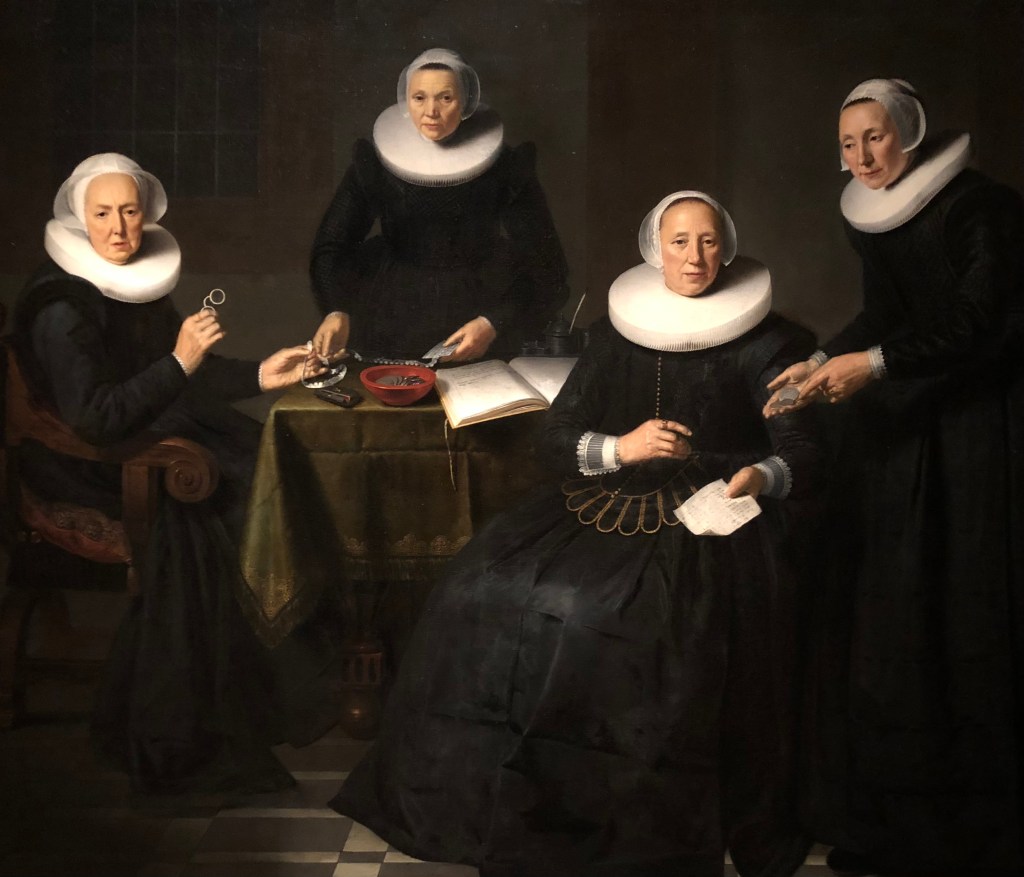
‘loose girls. The governor on the left inspects a piece of lace
made by an inmate, the one on the right pays for purchases.
The two ‘house mothers’ supervise the prisoners. They stand:
an indication of their subordinate status.
Ethics and morality are usually treated as one word wearing two hats, but they are not synonyms, and the difference between them is the right door into this whole question.
Ethics comes from the Greek ēthos — character, a settled disposition, the shape a person’s inner life takes through repeated action.
Morality comes from the Latin mores — custom, the code a community actually lives by.
One names an interior orientation; the other names an exterior structure people are held to.
Ethics is closer to Ϙ (koppa – the qualitative dimension), morality is closer to M4.
One is the felt shape of content and character, the other is the coordinated, observable code, a group of people who press upon and enforce onto each other, but can also submit to voluntarily. Politically in its worst form it takes the shape of a totalitarian democracy. Where the will of the majority becomes a moral rule.But what morals?
ARE THEY FUNDAMENTAL?
Iustitia — justice as right proportion — is already named as one of the facets under which Λω itself is known, standing alongside Logos and Aletheia.
Not derived from Λω the way a theorem is derived from an axiom, but constitutive of it, the way a triangle’s three angles are not consequences of the triangle but part of what makes it one.
If that placement is taken seriously, the answer to “are ethics and morality fundamental” is not a qualified yes. It is closer to: they were never a layer added on top of a morally neutral universe in the first place.
Right proportion is as built into the ground state as truth and intelligibility are.
That is a real philosophical position, not a private invention.
Plato held that the Good was not one value among others but the highest reality, the thing that made every other form intelligible at all.
Aquinas’s natural law tradition held that moral order is written into being itself, discoverable by reason rather than merely legislated by will or convention.
Contemporary moral realists — G.E. Moore’s non-naturalism, and more recent defenses like Derek Parfit’s — hold that moral facts are as objective and mind-independent as mathematical ones, not reducible to preference or custom. This model’s placement of Iustitia inside Λω sits in that lineage.
It deserves equally honest mention that this is a contested position, not a settled one. J.L. Mackie’s error theory argued that objective moral facts don’t exist at all — that morality is something humanity invented and then mistook for a discovery.
Expressivists hold that moral claims are refined expressions of attitude, not descriptions of fact.
Cultural relativists hold that what counts as right proportion is set entirely by the community doing the counting.
These are not fringe views; they are live, seriously defended positions in professional philosophy.
This model has made its choice — Iustitia is in Λω, not appended to it — but it is worth knowing exactly which side of a real, unresolved argument that choice takes.
It is also worth looking into the ethics and morals in animals, the sense of love, trust, loyalty, care, music even, gives them a sense of just or unjust recompense. Putting energy into something constructive, teamwork, dependence, a work ethic, survival. do they have a sense of what is just? These are things Humans as well as animals do. But humans are the only ones asking why we are here. That is no longer a moral or ethical question.
FUNDAMENTAL AND PARTICULAR, NOT FUNDAMENTAL OR PARTICULAR
The question of whether E+M is fundamental or particular assumes those are opposites. Aristotle already showed they don’t have to be. His doctrine of the mean holds that courage is a genuine, universal virtue, not a preference, not a custom, and also that where the mean between cowardice and recklessness actually falls is never fixed in advance.
It depends on the specific danger, the specific person, the specific stakes of the specific moment.
The principle of right proportion is universal.
Its application is irreducibly particular, worked out fresh in every situation it meets.
This maps onto M5 without needing to be forced there.
Iustitia, as a facet of Λω, is fundamental in exactly the sense M4 and Q are both fundamental — not optional, not negotiable, present in every Primaton event whether anyone attends to it or not. But what right proportion actually asks for in a given event is as particular as the event itself, because Iustitia is a facet of a relational ground, not a fixed lookup table.
Fundamental supplies the axis. Particular supplies the coordinate on it. Neither one replaces the need for the other.
THE EXISTENTIAL LANDSCAPE
Picture the qualitative field’s topology the way the Higgs entry pictured a potential: not flat, but curved, with a ground state that isn’t at the center.
Every event in Ϙ sits somewhere on that curvature.
Action aligned with Iustitia moves with the field’s own contour — toward the ground, the way water finds a valley without being forced.
Action that violates right proportion is not merely disapproved of from outside; it is action forced against the grain of a landscape that already has a shape, and forcing anything against a real contour costs real energy to sustain.
That is what happiness, pain or guilt’s felt heaviness actually is on this model: not a social penalty imposed after the fact, but the ordinary physical experience of holding a position the field itself is constantly working to release you from.
A lie, once told, does not become weightless just because it goes undiscovered.
It is a configuration held against the field’s own tendency, and tendencies, given time, tend to win.
WHERE THEY ORIGINATE
The Higgs entry distinguished the M4-mechanism (evolution, biology, chemistry) from the Q-level reality that mechanism gives creatures access to, without confusing one for the other. The same distinction applies here.
Evolutionary biology has real, well-documented findings about the origins of moral-adjacent behavior, and none of them need denying.
Frans de Waal’s work with capuchin monkeys showed that they visibly reject an unequal reward for the same task. A documented aversion to unfairness in a species with no culture, no religion, no legal code to have taught it that lesson.
Chimpanzees reconcile after conflict, console the distressed, and show behavior that looks, unmistakably, like an early draft of a conscience. This is not a threat to E+M being fundamental.
It is the M4-mechanism by which creatures capable of any interiority, like feeling inner pain or abandonment, attachment and love will become progressively more able to detect a structure — Iustitia — that, on this model, did not have to wait for evolution to become real, any more than light waited for an eye to evolve before it existed.
Evolution explains the instrument. It does not manufacture what the instrument detects.
WHY THEY MATTER IN DAILY LIFE
Because a violation of right proportion, on this model, is never contained to the single relationship it happens in.
Betrayal is not just a broken bond; it is a violated Iustitia, and a violated Iustitia inflames outward past its original site the way necrotic tissue damage spreads past the original wound, which is precisely why betrayal so often erodes trust in people.
E+M matters daily not because a rulebook says it should, but because right proportion is part of the terrain everyone is already standing on, whether or not anyone has named it.
Ignoring the terrain does not remove it. It just guarantees the misstep happens by accident instead of on purpose!
LEARNED OR INTRINSIC?
Every human is born with the capacity for language — a universal grammar, in Chomsky’s sense — while which specific language they end up speaking is entirely a matter of what they were raised inside.
Several moral psychologists, most notably John Mikhail building on an analogy first drawn by John Rawls, have proposed something structurally identical for morality: a universal moral grammar, an intrinsic capacity for judging harm, fairness, and reciprocity that shows up remarkably early in human development and across very different cultures, onto which specific moral codes — specific mores — are then written by upbringing, religion, law, and community.
On this model, that is exactly the shape E+M takes.
The capacity to perceive Iustitia at all is intrinsic, guaranteed by the fact that any sufficiently developed Q-coupling is a coupling to a Λω that already has Iustitia as one of its facets — no one has to be taught that betrayal feels like a wound. But which specific customs count as fair, which specific acts count as betrayal in a given culture, at a given moment in history — that is mores, learned the way a specific language is learned, built on a grammar nobody had to invent.
See also: Λω – Lomega, 3 · Aletheia · Iustitia, 38 · Logos: In the Beginning Is Logos · GRAVIS · Primaton Field, 17


Leave a comment