
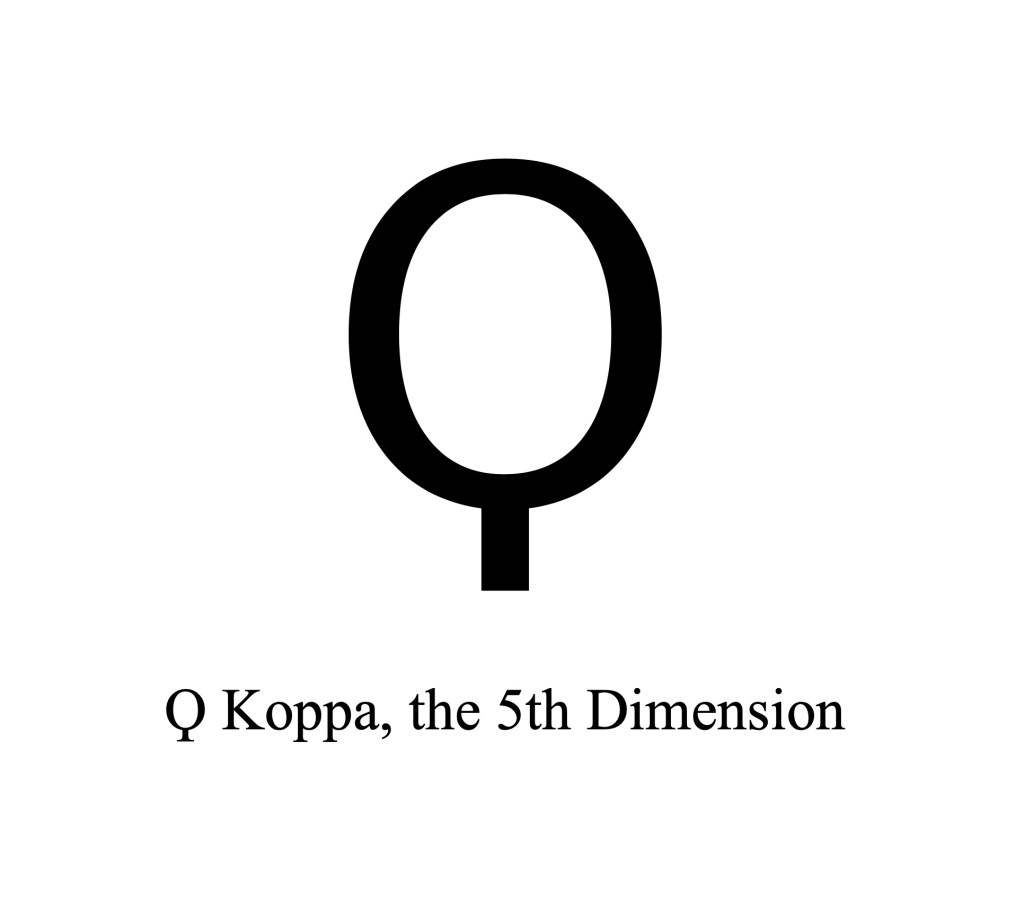
Naming your child: the beginning of Meaning
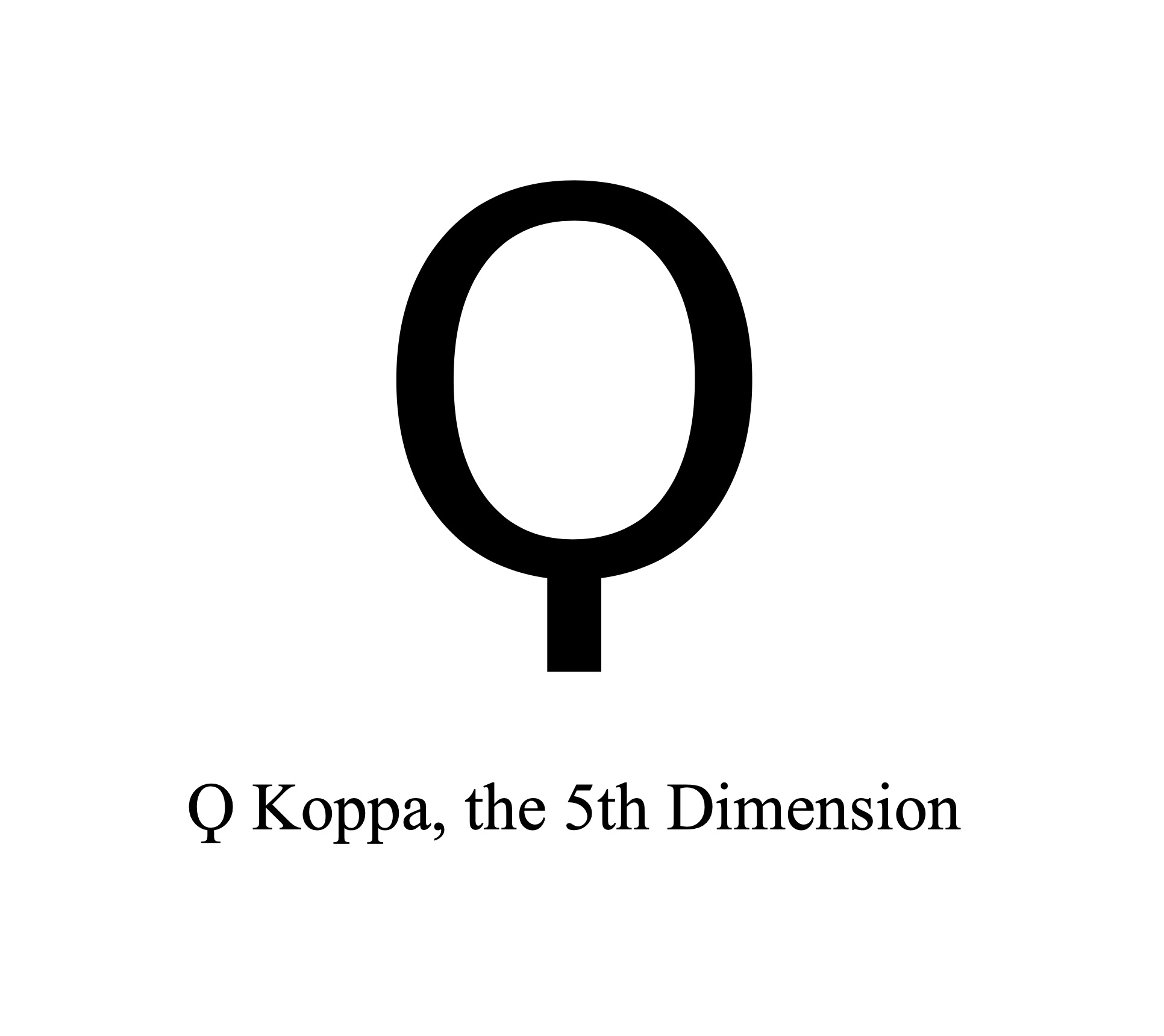
Koppa (, ϙ): an archaic Greek letter — Unicode U+03D8 / U+03D9 — descended from Phoenician qoph, and the direct ancestor of the Latin letter Q ·
I. THE CASE FOR A CHANGE
The Index entry’s closing paragraph did necessary work: it told the reader that Q, here, is none of the other things Q usually means — not charge, not heat, not quality factor, not quintessence, not Q-methodology, not the Gospels’ hypothetical source document. That paragraph will have to be written again, in shorter form, in every future entry that leans on Q, for as long as Q is the symbol in use. A borrowed letter with six other tenants doesn’t stop being borrowed just because one entry explained the lease once. The cleaner fix is to stop borrowing it.
II. KOPPA’S OWN HISTORY
The letter has a real history, and it happens to run through exactly the sound this dimension’s own symbol wants to make.
It descends from Phoenician qoph, a sign some trace to an even earlier image of the eye of a needle, in use around 1000 BCE in Byblos and the Phoenician and Canaanite trading world. The Greeks borrowed it and renamed it koppa, using it for a /k/ sound before the back vowels ο, υ, and ω. Greek already had kappa for that same sound, which made koppa redundant, and by around the fifth century BCE most of the Greek-speaking world had dropped it in favor of kappa alone. It lasted a little longer in some Doric-speaking regions — Corinth kept stamping its coinage with a koppa as the city’s own mark after much of the rest of Greece had already let the letter go. From there, by way of the western Greek alphabet and the Etruscans, koppa passed into Latin, where it was reshaped into the rounded form with the curved descending tail that became the letter Q.
The old letter-shape itself, Ϙ and ϙ, has not been used for anything since.
III. WHY THE ARCHAIC FORM, AND NOT THE NUMERAL
/ ϙ, the archaic form, has no numeral duty, no active discipline, no live convention holding a claim on it — it has simply not been used for around two and a half thousand years. It is also the better visual match: it is closer to what the Latin sign looked like before Rome rounded it out, so the notation still reads as “Q” to any eye, while the character underneath it belongs to no one else currently writing anything.
IV. THE ADOPTION
From here forward, (and ϙ, where a lowercase form is needed) replaces the Latin Q as the symbol for the qualitative dimension:
M5 = M4 × Ϙ
Nothing about the vocabulary changes — qualitative dimension, qualia, Qualiton all stay exactly as they were. Only the single mathematical symbol moves, from a letter with six other tenants to one that has been sitting empty since antiquity.
V. WHAT CHANGES, AND WHAT DOESN’T
Changes: M5 = M4 × Q becomes M5 = M4 × . The Primaton Field’s subscript, Π_Q, becomes Π_, for the same reason the dimension’s own symbol changes. The proportion Qualia : Q :: Event : M4 becomes Qualia : :: Event : M4. Any “Q ⊃ {…}” set notation becomes “ ⊃ {…}”.
Doesn’t change: the English and Latin vocabulary — qualia, qualitative, Qualiton, quale — none of which was ever the source of the collision. The single capital letter was.
Becomes mostly historical: the Index entry’s “Other Q” paragraph was written to manage a collision this addendum removes at the root. It is worth keeping as a short footnote explaining why the symbol changed, rather than as a live disambiguation the reader still needs.
This addendum proposes and formalises the change; it does not itself go back and edit the Index entry or 3.a / 3.b to replace their existing Q’s. That is a short, mechanical pass, and worth doing deliberately rather than folding into this piece.
FORMAL DESCRIPTION
ϙόππα
(U+03D8 / U+03D9, “archaic koppa”): adopted symbol for the qualitative dimension, replacing Latin Q
M5 = M4 ×
Π_ ⊃ { Λω, GRAVIS, Perceptual Condensate, Qualiton family, 0P }
Qualia : :: Event : M4
See also: · Q — Index Entry · Primaton Field, 17 · Λω – Lomega, 3 · 3.a The Higgs Analogy · 3.b Κένωσις · Vacuum · Symmetria
Q borrowed a letter with six other tenants already living in it. Ϙ () ϙόππα – koppa: is that letter’s oldest ancestor, vacant for two and a half thousand years, waiting for exactly this.
Español
Q : Ϙ KOPPA
Nombrar a tu hijo: el comienzo del Significado
Koppa (Ϙ, ϙ): una letra griega arcaica — Unicode U+03D8 / U+03D9 — descendiente del fenicio qoph, y antepasado directo de la letra latina Q ·
I. LA RAZÓN DEL CAMBIO
El párrafo final de la entrada de Índice hizo un trabajo necesario: le dijo al lector que la Q, aquí, no es ninguna de las otras cosas que la Q suele significar — ni carga eléctrica, ni calor, ni factor de calidad, ni quintaesencia, ni metodología Q, ni el hipotético documento fuente de los evangelios. Ese párrafo habrá que volver a escribirlo, en forma más breve, en cada entrada futura que se apoye en la Q, mientras la Q siga siendo el símbolo en uso. Una letra prestada con seis inquilinos más no deja de estar prestada solo porque una entrada haya explicado el contrato una vez. El arreglo más limpio es dejar de tomarla prestada.
II. LA HISTORIA PROPIA DE KOPPA
La letra tiene una historia real, y resulta que esa historia atraviesa exactamente el sonido que el símbolo de esta dimensión quiere hacer.
Desciende del fenicio qoph, un signo que algunos remontan a una imagen todavía anterior del ojo de una aguja, en uso hacia el año 1000 a.C. en Biblos y en el mundo comercial fenicio y cananeo. Los griegos lo tomaron prestado y lo rebautizaron koppa, usándolo para un sonido /k/ ante las vocales posteriores ο, υ y ω. El griego ya tenía kappa para ese mismo sonido, lo que volvió redundante a koppa, y hacia el siglo V a.C. la mayor parte del mundo de habla griega la había abandonado en favor de kappa sola. Duró algo más en algunas regiones de habla doria — Corinto siguió acuñando su moneda con una koppa como marca propia de la ciudad mucho después de que buena parte del resto de Grecia hubiera dejado ir la letra. Desde allí, por vía del alfabeto griego occidental y de los etruscos, koppa pasó al latín, donde se remodeló en la forma redondeada de cola descendente y curva que acabó siendo la letra Q.
La forma antigua de la letra en sí, Ϙ y ϙ, no se ha usado para nada desde entonces.
III. POR QUÉ LA FORMA ARCAICA, Y NO EL NUMERAL
Ϙ / ϙ, la forma arcaica, no tiene función numeral, ni disciplina activa, ni convención viva que reclame derechos sobre ella — simplemente no se ha usado desde hace unos dos mil quinientos años. Es además la mejor coincidencia visual: se parece más a lo que era el signo latino antes de que Roma lo redondeara, de modo que la notación sigue leyéndose como «Q» para cualquier ojo, mientras que el carácter que hay debajo no pertenece a nadie más que esté escribiendo algo hoy.
IV. LA ADOPCIÓN
De aquí en adelante, Ϙ (y ϙ, donde haga falta una forma minúscula) reemplaza a la Q latina como símbolo de la dimensión cualitativa:
M₅ = M₄ × Ϙ
Nada del vocabulario cambia — dimensión cualitativa, qualia, Cualitón siguen exactamente igual. Solo se mueve el único símbolo matemático: de una letra con seis inquilinos más a otra que lleva vacía desde la antigüedad.
V. QUÉ CAMBIA Y QUÉ NO
Cambia: M₅ = M₄ × Q pasa a ser M₅ = M₄ × Ϙ. El subíndice del Campo Primatón, Π_Q, pasa a ser Π_Ϙ, por la misma razón por la que cambia el símbolo de la dimensión. La proporción Qualia : Q :: Evento : M₄ pasa a ser Qualia : Ϙ :: Evento : M₄. Cualquier notación de conjuntos «Q ⊃ {…}» pasa a ser «Ϙ ⊃ {…}».
No cambia: el vocabulario castellano y latino — qualia, cualitativo, Cualitón, quale — nada de lo cual fue nunca el origen de la colisión. El origen era la única letra mayúscula.
Pasa a ser sobre todo histórico: el párrafo «Otras Q» de la entrada de Índice se escribió para gestionar una colisión que este apéndice elimina de raíz. Vale la pena conservarlo como una nota breve que explique por qué cambió el símbolo, y no como una desambiguación viva que el lector todavía necesite.
Este apéndice propone y formaliza el cambio; no vuelve por sí mismo sobre la entrada de Índice ni sobre 3.a / 3.b para sustituir las Q que ya tienen. Eso es una pasada breve y mecánica, y conviene hacerla deliberadamente en vez de plegarla dentro de este texto.
DESCRIPCIÓN FORMAL
ϙόππα
Ϙ (U+03D8 / U+03D9, «koppa arcaica»): símbolo adoptado para la dimensión cualitativa, en sustitución de la Q latina
M₅ = M₄ × Ϙ
Π_Ϙ ⊃ { Λω, GRAVIS, Condensado Perceptual, familia Cualitón, 0P }
Qualia : Ϙ :: Evento : M₄
Véase también: Ϙ · Q — Entrada de Índice · Campo Primatón, 17 · Λω – Lomega, 3 · 3.a La Analogía de Higgs · 3.b Κένωσις · Vacío · Simetría
La Q tomó prestada una letra que ya tenía seis inquilinos viviendo dentro. Ϙ, ϙόππα — koppa — es el antepasado más antiguo de esa letra, vacante desde hace dos mil quinientos años, esperando exactamente esto.


Leave a Reply