
“Chapter 1”
“From suffering have emerged the strongest souls; the most massive characters are covered with scars.” — Kahlil Gibran
The Solidity of Suffering
There exists a type of pain that transcends the merely psychological. It possesses weight, density, a peculiar substantiality that everyone struggles to articulate.
Simone Weil understood this when she wrote: “Gravity and grace: these are the two essential forces operating on us. Gravity makes us fall, grace lifts us up.”
Pain, in its metaphysical dimension, is not simply a signal of bodily damage or emotional distress, it is GRAVIS, the gravity of reality itself pressing upon consciousness.
Explanation of GRAVIS
GRAVIS is a term I use to capture two meanings:
- Gravis (Latin): Heavy, serious, most important
- Gravity (physical) and Quantum Gravity: The force that attracts bodies (matter)
I propose that experience has “ontological weight”—some experiences press more strongly upon consciousness than others. Intense pain, profound love, overwhelming beauty—all manifest this weight, this existential gravity.
When suffering reaches a certain intensity, it no longer feels like an experience about something else. It becomes its own phenomenon, irreducible and self-justifying.
Hermetic traditions speak of nigredo—blackness, the blackening, the descent into depths where all superficialities are burned away.
Saint John of the Cross called it the Dark Night, not as a poetic metaphor, but as a precise phenomenological description: “The dark night is an entrance of God into the soul, which purifies it of its ignorances and imperfections.”
This is where philosophy must begin, not with doubt, as Descartes proposed, but with the undeniable reality of felt experience.
Pain cannot be removed. It insists. It reveals.
Conversion as Epistemic Rupture
My life has been marked by inflection points, moments when the structure of reality seemed to shift beneath me. These were not gradual evolutions, but sudden conversions in the spiritual sense.
Sometimes what transformed was my understanding of physics. Sometimes it was my experience of love, or interpretation of death. Sometimes it was the recognition that suffering itself was teaching me something that language, or reason itself could not fully capture. Intense pain can function as one of these transformative symbols. It is not only psychological suffering—it is an ontological revelation that forces an epistemic conversion. Pain taught me things about reality that no equation or book could teach you or make you feel.
Paul Ricoeur distinguished between mere change and genuine transformation: “The symbol gives rise to thought.” Symbols, whether mathematical, spiritual, or experiential, don’t only represent reality; they reveal it.
The Hermit Tradition and the Carmelite Paradox
The hermit tradition offers a framework for understanding these ruptures and unions. In Carmelite spirituality, Teresa of Jesus describes the soul’s journey through seven abodes toward union with God.
But this is not escapism, nor hierarchical—it’s the opposite. As she writes: “Christ has no body now but yours. No hands, no feet on earth but yours.” The journey inward is simultaneously a journey outward. Maximum interiority produces maximum participation.
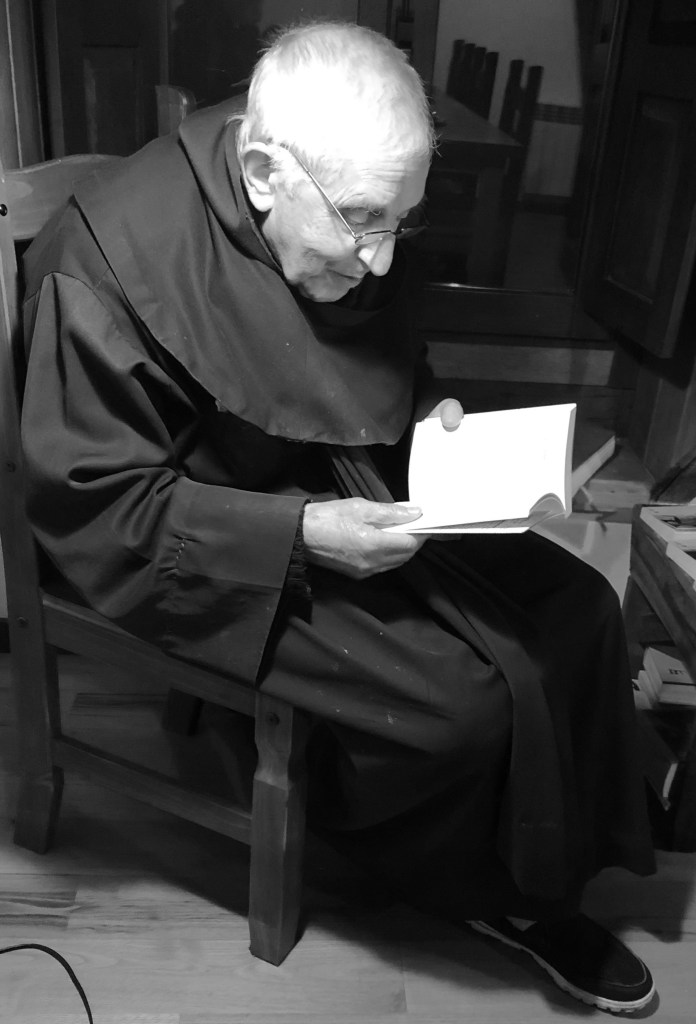
This is the paradox I have lived, the words of my beloved Father Miguel de los Sagrados Corazones, missionary in Africa, and holy man, the world opened to me when I heard his exclamation:
“A Carmelite is 100% contemplative and 100% missionary.”
Not 50-50, which suggests compromise or division, but both completely.
The more I descended into the gravity of my own consciousness, the more I found connections with everything else. Pain revealed the structure. A pattern of suffering revealed. What felt most private turned out to be most universal.
The Method: Phenomenology as Contemplation
Edmund Husserl’s phenomenological method, the epoché, the bracketing of assumptions to see what actually appears, is structurally identical to contemplative practice.
Both require rigorous attention. Both demand that we set aside our theories about experience to attend to experience itself. Both discover that consciousness has structure, that subjectivity is not chaos, but cosmos.
“To the things themselves!” Husserl declared. Saint Teresa of Jesus would have understood perfectly.
Her interior castle is phenomenological psychology avant la lettre, a systematic investigation of consciousness through disciplined introspection. When she describes the prayer of quiet, she is not being mystical in the vague sense; she is being precise about a specific state of consciousness with identifiable characteristics.
Pain, then, is my starting point, not because I glorify suffering, but because I take it seriously. It happened. It was real. It had structure. It happens, it is real, it has structure. And most importantly, it reveals something: that consciousness is not epiphenomenal but fundamental, that love is not contingent but constant, that the division between matter and meaning is artificial.


Leave a comment